Key takeaways
- The best online business bank accounts for 2026 pair no monthly fees with competitive interest on balances and direct integrations with accounting software like QuickBooks Online, and is a Xero connected app.
- Many online business accounts are FDIC-insured through partner banks, while fintech platforms like OFX protect funds through state licensing and federal regulation rather than deposit insurance.
- Businesses that pay or get paid overseas should weigh FX costs and multi-currency support, because bank exchange-rate markups and wire fees can quietly erode margins.
- You can open most online business accounts in under 10 minutes with your EIN and basic business documentation.
Managing business finances across multiple currencies and payment channels can drain your time and erode your margins. This guide compares the best online business bank accounts and fintech alternatives for 2026, helping you find an account that fits your business structure, fee tolerance, and international payment needs.
Jump to:
• What to look for in the best online business bank accounts
• The best online business accounts and fintech providers compared
• The top online business accounts and fintech providers for 2026
• Are online business accounts safe? Banks vs. fintechs
• How to choose the right online business account
• Why a global business account can beat a traditional bank account
• Why OFX stands out for business
• FAQs aboute the best online business accounts
What to look for in the best online business bank accounts.
The best online business bank accounts share a few traits: low or no monthly fees, fair transaction and wire pricing, useful interest on idle cash, and tools that fit how your business already works. A no fee business bank account sounds appealing, but the real cost often hides in wire fees, FX markups, and transaction limits. With more than 36 million small businesses operating in the US1, the account you choose has a real impact on your fees, cash flow, and daily operations.
Here are the key criteria to evaluate:
- Monthly fees and waivers: Many accounts charge no monthly fee, while others waive a fee if you keep a minimum balance. Traditional banks often charge a monthly maintenance fee.
- Interest rates (APY): A high yield business checking account lets you earn on idle cash. Rates vary widely by tier.
- Transaction and wire fees: Domestic ACH transfers are usually free, but outgoing wires often carry a fee at traditional banks, and international wire fees add up fast.
- Cash deposit support: Online-only accounts often have limited cash deposit options. If your business handles cash, check for ATM networks or retail deposit partnerships.
- Accounting integrations: Look for direct syncs with QuickBooks Online and Xero to reduce manual reconciliation.
- Mobile app and team access: Multiple users, sub-accounts, and approval workflows help growing teams manage spending.
OFX has no minimum balance requirement and integrates with QuickBooks Online, and is a Xero connected app, which makes it a strong fit for a small business checking account setup that needs transparent pricing without hidden fees or lock-in contracts.
Online vs. traditional banks vs. credit unions.
An online business bank account typically offers lower fees and higher interest than a traditional branch bank because there’s no branch overhead. The trade-off is limited cash deposit options and no in-person service.
Traditional banks like Chase and Bank of America offer branch access and full-service business banking. Their fee structures tend to be higher, and international wires cost more.
Credit unions provide competitive rates and personal service, but they often have membership requirements and fewer digital tools. For businesses that prioritize convenience and low fees, a digital business bank account usually wins.
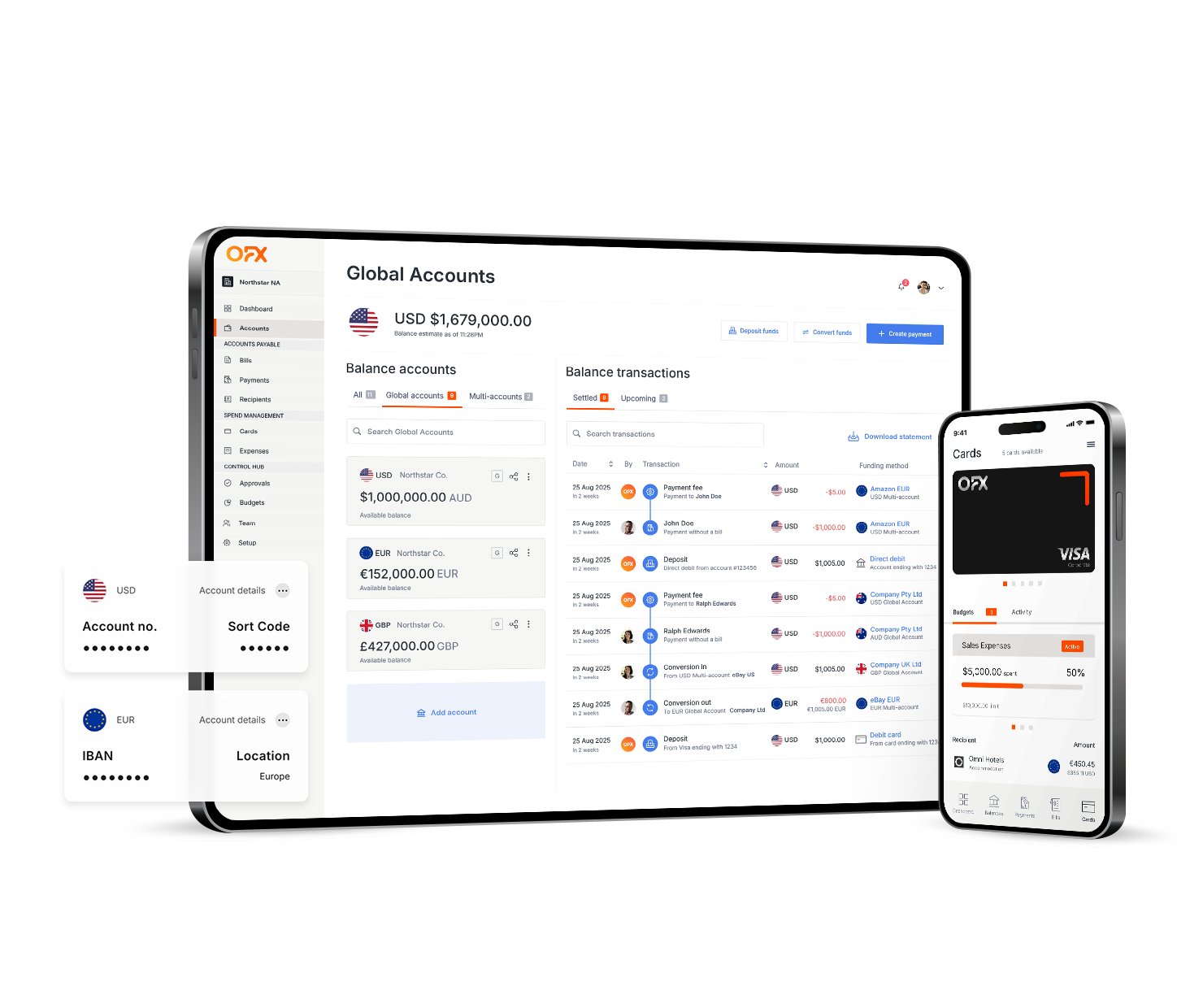
OFX Global Business Account.
Receive, hold, convert and send funds across a wide range of currencies, reduce costs and gain greater control over your international payments.
The best online business accounts and fintech providers compared.
This table summarizes the featured accounts by fees, interest, coverage, and international support so you can scan the best business banks and fintech alternatives at a glance. Every figure traces to a verified pricing page or official source. OFX and other non-bank providers are fintech alternatives, not banks.
| Account | Best for | Monthly fee | APY / interest | FDIC / coverage | International & FX support |
|---|---|---|---|---|---|
| OFX Global Business Account (fintech) | Multi-currency and international payments | $0 (Standard) / $75 (Full Suite)2 | Not applicable | Not FDIC insured (licensed money transmitter)3 | 30+ currencies4, 180+ countries18, local rails, transparent FX pricing |
| Bluevine (fintech) | Earning interest on checking | $0 / $30 (Plus) / $95 (Premier)5 | Interest paid across plan tiers | FDIC coverage via partner-bank sweep | International wire (USD) $25 / $20 / $12.50 plus FX by plan5 |
| Mercury (fintech) | Startups and tech companies | $0 / $29.90 (Plus) / $299 (Pro), billed annually6 | Treasury option available | FDIC coverage via partner-bank sweep | International wire $0 (SHA) / $15 (OUR); non-USD wire 1%6 |
| Relay (fintech) | Multiple accounts and expense control | $0 / $30 (Grow) / $90 (Scale)7 | Interest paid across plan tiers | FDIC coverage via Thread Bank | International SWIFT $20 to $25; FX from 1.00%8 |
| Novo (fintech) | Simple, fee-free banking | $09 | Not applicable | FDIC $250,000 via Middlesex Federal Savings9 | US domestic payments focus |
| American Express Business Checking | Rewards and brand loyalty | $010 | 1.30% on balances up to $500,00011 | FDIC insured | No outgoing international wires; debit FX 2.7%11 |
| Chase Business Complete Banking | Cash deposits and full-service banking | $15 (waivable with a $2,000 minimum daily balance)12 | Not applicable | FDIC insured | USD-only account; fees on foreign-currency purchases12 |
The top online business accounts and fintech providers for 2026.
Each account below serves a specific business need. We evaluated them on fees, features, international support, and user experience. OFX and the fintech platforms here are non-bank alternatives to traditional business banks.
OFX Global Business Account: Best for international and multi-currency businesses.
For businesses that pay suppliers or receive payments across borders, the OFX Global Business Account offers multi-currency capabilities that most domestic accounts lack. You get local account details in USD, EUR, GBP, and CAD, so you can receive payments like a local in those regions.
OFX supports transfers to 180+ countries18 in 30+ currencies4, using local payment rails instead of relying solely on SWIFT. This approach often delivers faster, lower cost settlements. Registration is quick online, and verification typically completes within a few business days while you get immediate platform access.
The Standard plan costs $0 per user per month. The Full Suite plan is $75 per month and includes 5 users, with each additional user at $10 per month2. Custom plans are available. Both plans include corporate cards that earn cashback on eligible business card spend (terms apply; availability varies by region — see cashback terms), AP automation, spend management, integrates with QuickBooks Online, and is a Xero connected app.
Best for: Businesses with cross-border payments, multiple currencies, or international suppliers and customers.
I was recommended to use OFX, but honestly I wish I knew about it sooner. By far OFX is the most competitively priced and easiest platform we’ve ever used. The user experience and customer service have been a lot better for our finance teams to manage,” said Jonathon, co-founder of BikesOnline.
Bluevine: Best for earning interest on checking.
Bluevine stands out for businesses that keep cash in their operating account, paying interest that increases with higher plan tiers. Monthly fees run $0 for the standard plan, $30 (Plus), and $95 (Premier)5.
International wires start at $25 plus an FX markup that steps down from 1.5% to 1.0% by plan5, which adds up for businesses with frequent overseas payments.
Best for: Businesses that hold meaningful checking balances and want to earn interest without moving funds to a separate savings account.
Mercury: Best for startups and tech companies.
Mercury has a strong reputation among startups, with a clean interface, a treasury option, and investor-friendly tools. Monthly fees are $0 for the base plan, $29.90 (Plus), and $299 (Pro) when billed annually6, with no minimum balance or opening deposit13.
Domestic wires, ACH, and checks are free13. International wires are $0 with shared fees (SHA) or $15 with full fee coverage (OUR), and non-USD wires carry a 1% fee6. Mercury extends FDIC coverage through a partner-bank sweep network.
Best for: Tech startups, venture-backed companies, and businesses that value modern UX and treasury tools.
Relay: Best for multiple accounts and expense control.
Relay lets you open multiple individual checking accounts under one business, which helps you separate funds by project, department, or purpose. Monthly fees are $0 for the starter plan, $30 for Grow, and $90 for Scale (promotional; standard is $120)7.
Domestic wires out are $8 / $5 / $5 by plan, international SWIFT wires are $25 / $22 / $20, and FX starts from 1.00%. There’s no minimum balance8. Relay partners with Thread Bank for FDIC coverage.
Best for: Businesses that need multiple sub-accounts, budget separation, or granular expense tracking.
Novo: Best for simple, fee-free banking.
Novo keeps things simple with a single free plan, no monthly fee and no minimum balance9. It works well for freelancers and small businesses that want a free business checking account, though it isn’t built for earning interest.
FDIC coverage is $250,000 through Middlesex Federal Savings9. Novo is geared toward US domestic payments rather than multi-currency or international transfers.
Best for: Freelancers, sole proprietors, and small businesses that want zero fees and don’t need international payment support.
American Express Business Checking: Best for rewards.
Amex Business Checking pays 1.30% APY on balances up to $500,00011, with no monthly fee10, which is competitive for a no fee business bank account.
The trade-off is no cash deposits, no outgoing international wires, a 2.7% debit card FX fee, and a $25 domestic wire11. It works best for businesses already inside the Amex ecosystem that don’t handle international payments.
Best for: Amex loyalists who want competitive interest and don’t need cash deposits or international wire support.
Chase Business Complete Banking: Best for cash deposits and full-service banking.
Chase suits businesses that still need to deposit cash or want a full-service traditional bank alongside their digital tools. The monthly fee is $15, waivable with a $2,000 minimum daily balance12.
Up to $5,000 of cash deposits are free each statement cycle, with fees on additional deposits and on purchases made in a currency other than US dollars12. Outgoing wires and international transfers are available for a fee, and the account holds US dollars only. It’s a solid pick for llc owners who handle cash and want traditional banking.
Best for: Cash-heavy businesses and companies that want a traditional bank alongside digital tools.
Are online business accounts safe? Banks vs. fintechs.
Safety is a top concern when choosing where to keep business funds. The answer depends on whether you’re using a bank or a fintech platform.
FDIC insurance and partner banks.
Many online business accounts are FDIC-insured through partner banks. The FDIC insures deposits up to $250,000 per depositor, per insured bank, per ownership category14. Some platforms extend this coverage through sweep networks that spread funds across multiple banks to raise the insured limit.
Fintechs like Mercury, Relay, and Bluevine partner with FDIC-insured banks to hold customer deposits. It’s worth verifying that your funds sit at an FDIC-member bank.
Fintech platforms without FDIC coverage.
Not all fintech platforms are banks. OFX, for example, is licensed as a money transmitter by the relevant state regulatory agency in the US states where it operates and is registered as a Money Service Business (MSB) at the federal level with the Financial Crimes Enforcement Network (FinCEN), NMLS #1021624. OFX is not a bank and does not offer banking services. OFX’s services include money transfers and foreign exchange, which are not FDIC insured.3
OFX balances this with strong protection: ISO 27001:2022 certified in Australia4, regulation across multiple jurisdictions globally, and more than 25 years of experience moving money internationally, with a risk-averse model in which funds are never paid out before they’re received. Learn more about how OFX keeps your money and information secure.
How to verify your account’s protection.
- For bank accounts, use the FDIC’s BankFind tool to confirm insurance status.
- For fintechs, review the terms of service to understand whether funds are held at partner banks and how they’re protected.
- For money transmitters like OFX, verify licensing through state regulatory databases and FinCEN’s MSB registration list.
How to choose the right online business account.
Choosing the right online business account comes down to matching it to how your business actually operates and where your money moves. The best fit depends on your fees, your balances, and whether you pay or get paid across borders.
What to weigh before you choose.
- Total cost, not just the monthly fee: weigh the monthly fee and any minimum balance against your cash flow, then add up wire and FX fees. A no fee business bank account can still be expensive once conversions and wires are counted.
- Interest on idle cash: if you hold larger balances, look for a high yield business checking account that pays interest by tier.
- Multi-currency and FX: if you pay suppliers or get paid overseas, prioritize multi-currency support and transparent FX pricing.
- Cash handling: if your business takes cash, check deposit options and limits, since online accounts often limit or don’t support cash deposits.
- Accounting integrations: make sure it syncs with QuickBooks Online and Xero to cut manual reconciliation.
- Team and mobile access: look for multiple users, sub-accounts, approval workflows, and a capable mobile app.
- Security and protection: understand how your funds are protected, whether that’s FDIC coverage through a partner bank or licensing and regulation for a money transmitter.
What you need to open a business account.
- EIN (Employer Identification Number): most business accounts require an EIN15. Sole proprietors can often use their Social Security Number instead.
- Business formation documents: articles of incorporation, operating agreement, or business license, depending on your entity type.
- Personal identification: government-issued ID for all account owners and authorized signers.
- Business address: a physical address (not a P.O. Box) for most accounts.
With OFX, you can register online quickly, and verification typically completes within a few business days while you get immediate platform access as your details are checked.
Why a global business account can beat a traditional bank account.
More online businesses now buy and sell across borders, so the account you run online should handle global money well. A single-currency US account can quietly cost more, because traditional banks build a larger margin into the exchange rate and SWIFT transfers add fees on both ends. In fact, 57% of US small and mid-sized businesses sourced from international suppliers in 202516, so cross-border costs are now a mainstream concern.
A multi currency business account lets you hold, send, and receive funds in several currencies without converting everything to USD first, with local account details so you can invoice and get paid like a local. A recent Federal Reserve survey found that 48% of small firms sourced at least some inputs from outside the US in 2024, and 84% of those firms said those inputs cost more.17
OFX fits an online-first business by bringing that global money management into one platform. You get local account details in USD, EUR, GBP, and CAD, support for 30+ currencies4 across 180+ countries18, and local payment rails instead of relying solely on SWIFT for faster, cheaper settlement, which makes it a capable international business bank account alternative. The same platform handles international payments, corporate cards, AP automation, and spend management, with accounting sync to QuickBooks Online and Xero, transparent pricing, and 24/7 support from real OFX Specialists.
Why OFX stands out for business.
For a business that manages money online and across borders, OFX is the modern alternative to a traditional business bank account. One platform. No juggling.
- One connected platform for multi-currency accounts, corporate cards, AP automation, and spend management.
- Local account details in multiple currencies so you can get paid like a local.
- Local rails. Faster settlement. Lower costs.
- Transparent pricing with no minimum balance and no lock-in contracts.
- Two-way sync with QuickBooks Online and Xero.
- Corporate cards that earn cashback on eligible business card spend (terms apply; availability varies by region).
- 24/7 support from real OFX Specialists.
- Enterprise-grade security from a licensed, regulated money transmitter.
For an online-first business that moves money internationally, OFX brings global accounts, cards, and automation into one place, so you spend less time on admin and keep more control of your cash flow.
See our business pricing and take a virtual tour today.
Frequently asked questions about the best online business accounts
Are online / fintech business accounts safe and FDIC-insured?
Many online business accounts are FDIC-insured through partner banks, up to $250,000 per depositor, per insured bank14. Some fintechs extend coverage through sweep networks that spread deposits across several banks. Non-bank providers like OFX aren’t FDIC insured and instead protect funds through licensing, regulation, and security controls. It’s worth verifying each provider’s status directly.
What’s the difference between an online bank and a fintech platform?
An online bank is a chartered, regulated bank that operates mainly online. A fintech platform is a technology company that may partner with a bank to hold deposits or, like OFX, operate as a licensed money transmitter. Both can be sound choices, but the regulatory framework differs.
Can I open a business bank account online with only an EIN? What do I need?
According to the SBA, you can open a business account once you have a federal EIN15. Most online accounts also ask for business formation documents and personal ID for the account owner. Sole proprietors can often use an SSN instead of an EIN.
Which accounts have no monthly fees or no minimum balance?
Bluevine, Mercury, Relay (starter), Novo, American Express Business Checking, and OFX (Standard plan) all offer a business bank account no monthly fee option with no minimum balance requirement.
Can I deposit cash into an online business account?
It depends on the account. Chase supports cash deposits. Relay and Bluevine offer ATM deposit networks with limits. Pure online accounts like Mercury and American Express Business Checking don’t support cash deposits, and OFX focuses on electronic transfers rather than cash.
Do online business accounts pay interest (APY)?
Many do. Bluevine, Relay, Mercury, and American Express Business Checking all offer interest or a treasury option, with rates that vary by tier and balance. Novo isn’t built for earning interest. OFX doesn’t pay interest on account balances.
What’s the best online business bank account for an LLC / startup / freelancer?
It depends on your priorities. Bluevine and Mercury suit an LLC that wants interest and startup-friendly tools, OFX suits an LLC or startup with international payment needs, and Novo suits freelancers who want simplicity. Chase fits businesses that also want a traditional bank.
Which account is best for international or multi-currency payments?
For international or multi-currency payments, look for an account with local account details in several currencies and transparent FX. OFX offers 30+ currencies4, 180+ countries18, local account details, and an all-in-one platform with corporate cards and AP automation.
Looking for an alternative to your bank?
References
- https://advocacy.sba.gov/2025/06/30/new-advocacy-report-shows-the-number-of-small-businesses-in-the-u-s-exceeds-36-million/
- https://www.ofx.com/en-us/business/pricing/
- https://www.ofx.com/en-us/legal/state-licensing/
- https://www.ofx.com/en-us/business/global-business-account/
- https://www.bluevine.com/business-checking/plans-and-pricing
- https://mercury.com/pricing
- https://relayfi.com/pricing/
- https://relayfi.com/deposit/
- https://www.novo.co/business-checking
- https://www.americanexpress.com/en-us/business/checking/
- https://www.americanexpress.com/en-us/banking/business/checking-account/agreement/rates-and-fees
- https://www.chase.com/business/banking/checking/business-complete-banking
- https://mercury.com/faq
- https://www.fdic.gov/resources/deposit-insurance/brochures/insured-deposits
- https://www.sba.gov/business-guide/launch-your-business/open-business-bank-account
- https://www.pymnts.com/smbs/2026/57-percent-of-us-small-businesses-source-overseas-as-payment-gaps-widen/
- https://www.fedsmallbusiness.org/about/media/2026/fed-survey-small-business-optimism-wanes
- https://www.ofx.com/en-us/business/international-payments/
The contents of this article are general information only and do not constitute financial advice. Consider your own objectives, financial situation and needs before acting.