
Key takeaways
- An international business account, whether through a bank or a fintech provider lets you hold, send, and receive funds in multiple currencies from one place.
- Traditional banks in the US provide international business bank accounts with branch-based services, SWIFT transfers, and credit facilities. While these accounts are comprehensive, they can be slower and more costly, especially for international wire transfers.
- Modern fintech platforms combine multi-currency accounts, corporate cards, and expense management under one login, often with faster onboarding and lower FX fees.
Cross-border payments cost US businesses billions each year in FX markups, wire fees, and settlement delays. If your company pays overseas suppliers, collects revenue from global clients, or runs payroll for remote teams, the account you choose for international payments directly affects your margins and cash flow.
Your choice will depend on what matters most for your business: in-person banking services and access to credit, or a faster, flexible alternative built specifically for modern cross-border operations.
This guide compares seven international business account options available to US businesses across pricing, FX margins, features, and use cases, covering both traditional banks and fintech alternatives so you can choose the right account for your business.
Summary:
• Why international accounts matter for US businesses
• Types of international business accounts
• International business bank account vs fintech alternatives: key features
• Top international business bank accounts and fintech alternatives
• Comparison: international business accounts at a glance
• Features to look for in an international business account
• How to open an international business account in five steps
• Why businesses are choosing OFX over traditional banks
• Best international business account FAQs
Why international accounts matter for US businesses
If you run a business in the US, chances are you’ve already come up against the limits of a traditional bank when sending and receiving international payments.
Most big banks rely almost entirely on the SWIFT network to move money internationally. That means each transaction can come with wire transfer fees, extra charges, and a waiting period that often stretches across several business days.
If you’re paying suppliers abroad or receiving funds from global clients, using a traditional bank works, but it’s not the most efficient or cost-effective way to keep your money moving.
This is where fintech platforms like OFX take a different approach. Instead of routing payments through SWIFT, they give you local details and account numbers in the markets where you operate. That might be euros in Europe, pounds in the UK, or dollars in Canada. These local payment rails bypass intermediary banks entirely, delivering funds faster and at a fraction of the cost.
You can pay staff, settle invoices, or collect revenue as if you were based there yourself. The result is lower transaction fees, faster delivery of funds, and a far simpler process.
For businesses managing payroll across remote teams, billing international customers, or making frequent overseas payments, the savings in both time and cost can add up quickly.
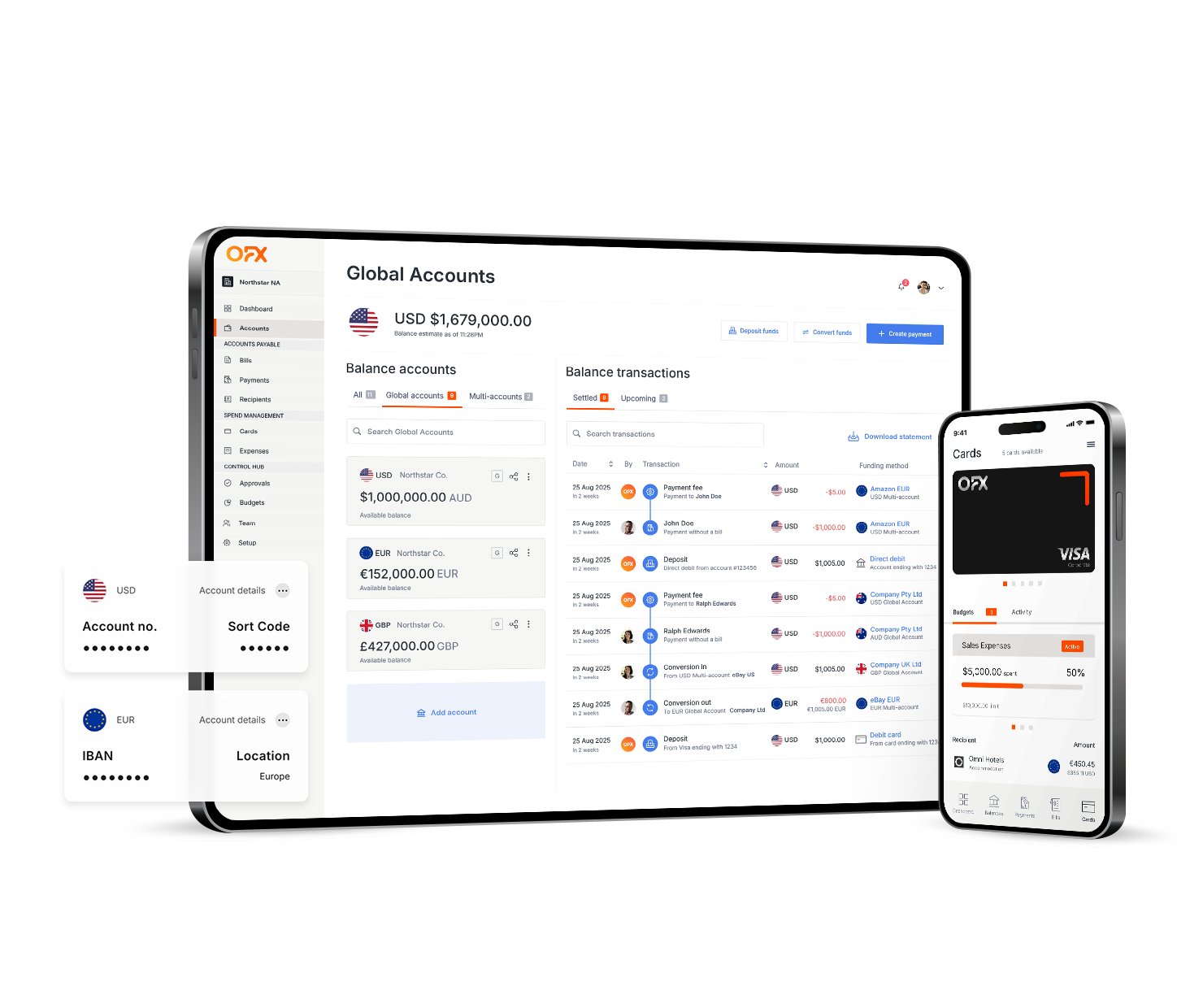
OFX Global Business Account
Receive, hold, convert, and send funds across a wide range of currencies. Reduce costs and gain greater control over your international payments.
Types of international business accounts
Understanding the three main account types helps you narrow down what’s right for your business:
- Traditional bank international accounts. Offered by licensed banks such as JPMorgan Chase, HSBC, and Citibank. These accounts typically hold one or two foreign currencies alongside USD and route payments through SWIFT. They come with branch access, credit lines, and FDIC insurance, but often require higher opening deposits and charge steeper FX markups.
- Fintech international accounts. Providers like OFX, Wise, and Payoneer operate under money transmission or e-money licenses rather than full banking charters. They’re built for speed and cost efficiency, with features like batch payments, AP automation, and API integrations. Onboarding is typically digital and completed in days rather than weeks.
- Multi-currency accounts. A subset of international accounts (offered by both banks and fintechs) that lets you hold, receive, and convert balances in multiple currencies from one login. A foreign currency business account like this reduces the need to open separate accounts in each country where you do business.
International business bank accounts vs. fintech alternatives: key features
When you’re weighing up where to open an international business account, it helps to understand how fintech providers differ from traditional banks. On the surface, they may appear to offer the same thing: a place to hold multiple currencies and make cross-border payments. The structure and features, though, can be very different:
- Traditional banks issue international accounts under a full banking license, which usually means you can hold funds in foreign currencies, move money through SWIFT, and sometimes access extras such as a line of credit. These accounts often double as a business checking account, complete with debit cards, ATM withdrawals, and occasionally interest on deposits.
- Fintech providers like OFX are licensed differently. Their design philosophy is very different. Instead of forcing you into large opening deposits or strict minimum balances, they focus on speed and accessibility. This means you can get up and running quickly while still holding balances in multiple currencies, managing cross-border payments, and issuing both physical and virtual cards for your team.
- Expense management and AP automation features are also more likely to be built in with fintechs. For example, multi-currency accounts with real-time reporting, batch payments, automated invoice processing, corporate cards and in-app receipt capture let’s you track spending instantly. These are capabilities you would rarely see bundled together in a traditional international business bank account.
If you want to manage your account in a physical branch or have access to full-service credit facilities, a traditional bank may better meet your needs. If you value convenience, speed, and digital-first integration, fintechs like OFX are a stronger fit.
Top international business bank accounts and fintech alternatives
Now that you understand the major differences between these two account types, here’s how some of the most popular providers compare. Below are seven leading options available in the US right now, each with a “best for” label to help you shortlist.
OFX: best for international payments and multi-currency accounts
With OFX, you can open a multi-currency international business account built for cross-border operations. You can hold funds in 30+ currencies, access local accounts in key markets (USD, CAD, EUR, GBP, and AUD), and transfer funds using competitive FX rates via local rails to over 180 countries.
OFX also gives you Corporate Cards, Batch Payments, AI powered Accounts Payable (AP) automation and Spend Management tools to control your business finances. You can earn 1% unlimited cashback on eligible corporate card spend (terms apply).
If you’re a larger company, you can automate transfers at scale through APIs. If you’re running a startup or small business, you can apply online and enjoy fast setup with the Standard plan which is free at $0 per month.
The Full Suite plan is $75/month inclusive of 5 users, plus $10 for each additional user. With its global reach and 24/7 human support, OFX is particularly useful if you’re active in international trade.
Pros: True multi-currency account with 30+ currencies, Corporate Cards with cashback on eligible spend, batch payments, AP automation, spend management tools, Forward Contracts and Limit Orders for managing FX risk, 24/7 human support, and competitive FX margins. The ability to get through to someone on the phone when it matters sets OFX apart and there’s no minimum balance required.
Cons: As a fintech, OFX does not provide credit facilities or in-branch banking services.
Airwallex: best for e-commerce and scaling businesses
Airwallex is a digital-first platform that offers multi-currency business accounts, corporate cards, and integrated payment tools. It’s designed for businesses that need to hold, pay, and collect in multiple currencies from a single dashboard.
The Explore plan is free, while the Grow plan costs $12 per active Spend user per month and the Accelerate plan has custom pricing. FX markups sit at 0.5–1% above the interbank rate, and SWIFT transfers cost $15–$25.1
Airwallex offers cash rebates on card spend (terms apply). The platform also offers yield on idle balances (rates vary). Airwallex claims savings on currency conversion compared with traditional banks.
Pros: Free entry-level plan, competitive FX rates, multi-currency wallets, integrated cards, and payout tools for scaling businesses.
Cons: Some advanced features require the paid plan. Does not offer FX hedging tools like Forward Contracts.
Wise Business: best for simple international transfers
Wise2 is known for offering mid-market exchange rates and charging transparent FX fees. You can hold funds in multiple currencies, get local bank details, and make global transactions with no minimum deposit required.
There are no monthly fees, but there’s a $31 one-time setup fee for local account details.3 FX fees start from 0.57%4 depending on the currency pair, and card issuance costs $94. Receiving an international wire also carries a fee of $6.11 for a USD wire, and £2.16 or 2.39 EUR for GBP or EUR SWIFT payments.3
Pros: Uses the real mid-market exchange rate, charging transparent per-transaction FX fees, with local account details in multiple currencies, and no minimum deposit.
Cons: Larger businesses may find Wise limited, as it lacks many of the advanced features other fintechs offer, such as AP automation, spend management dashboards, and FX hedging tools.
Payoneer: best for freelancers and marketplace sellers
With Payoneer, you can open receiving accounts in multiple countries, accept payments from international customers and marketplaces, and withdraw funds to your local bank. Payoneer supports 70 currencies and payouts to 190+ countries.5 It’s useful if you work with global eCommerce platforms or collect payments from multiple marketplaces.
Payoneer offers 0% FX on USD and EUR for Checkout transactions only; other currency conversions carry a fee of up to 3.5% depending on the transaction type. Payoneer also offers working capital advances for eligible sellers. Fees apply for withdrawals and other transaction types.5
Pros: Ideal for freelancers and eCommerce businesses, with receiving accounts in multiple countries, marketplace integrations, and easy withdrawals to your local bank.
Cons: FX, withdrawal, and transaction fees can add up for high-volume users. Fewer integrated tools for spend management and AP automation compared with some competitors.
Revolut Business: best for fast-growing startups
Revolut Business gives you multi-currency checking accounts, debit cards, and integrated expense tools. With support for remote teams and scalable financial products, it’s designed for fast-growing companies.
The Basic plan is $10 per month, Grow $50 per month, Scale $180 per month and the Enterprise pan has custom pricing. FX is 0% within the monthly allowance, 0.6% over the allowance, and +1% out-of-hours. The free FX allowance is $1,000 on Basic, $20,000 on Grow, and $80,000 on Scale per month. International transfers cost $5 each over the allowance, local (ACH) transfers $0.20 each over the allowance, and ATM withdrawals up to 2%.
Pros: Flexible multi-currency checking accounts, debit cards, and expense tools that scale with your business. Strong mobile app and team management features.
Cons: Some advanced features are locked behind higher-tier plans, which may be costly for smaller companies. Limited FX hedging tools compared with specialist providers.
JPMorgan Chase: best for enterprise and in-person banking
JPMorgan Chase offers enterprise-level international business bank accounts, treasury management, and international wire transfers. As a full-service provider with worldwide banking capabilities, it also delivers investment banking and wealth management alongside traditional business bank accounts.
If you need access to credit, in-person banking services, or a dedicated relationship manager, this may be the right fit. Monthly fees vary by plan. Wire transfer fees apply for international payments.7
Pros: Enterprise-level global banking with treasury management, international wire transfers, FDIC insurance on eligible deposits, investment banking services, and branch access.
Cons: Higher fees, opening deposit requirements, and slower onboarding compared with more agile fintech alternatives. FX markups tend to be less competitive than fintech providers.
Bank of America: best for full-service international banking
Bank of America offers international business banking through its Global Transaction Services division, including SWIFT wire transfers, foreign exchange, trade finance, and treasury management. With over 3,700 US branches, it’s a strong fit for businesses that need both domestic and international banking under one roof.9
Pros: One of the largest US banks with a strong international payments network, dedicated relationship managers, trade finance solutions, FDIC insurance on eligible deposits, and access to credit.
Cons: Higher fees for international wire transfers compared with fintech providers. FX markups are less competitive. Multi-currency digital tools are limited compared with specialist fintechs.
Comparison: international business accounts at a glance
Overview
| Provider | Type | Best for | Currencies held | International transfers | Multi-currency cards |
|---|---|---|---|---|---|
| OFX | Fintech | International payments and FX | 30+ | Local rails + SWIFT, 180+ countries | Yes |
| Airwallex1 | Fintech | Multi-currency operations | 20+ | Local rails + SWIFT, 200 countries | Yes |
| Wise Business2 | Fintech | Transparent mid-market rates | 40+ | Local rails + SWIFT, 160+ countries | Yes |
| Payoneer5 | Fintech | Freelancers and marketplace sellers | 30+ | Local rails + SWIFT, 190+ countries | Yes |
| Revolut Business6 | Fintech | Fast-growing startups | 25+ | Local rails + SWIFT, 150+ countries | Yes |
| JPMorgan Chase7,8 | Traditional bank | Enterprise and in-person banking | USD only | SWIFT, 240+ countries | No |
| Bank of America9 | Traditional bank | Full-service international banking | Limited (major currencies) | SWIFT, 140+ countries | No |
Pricing and fees
| Provider | Monthly fee | Setup fee | Transfer fees |
|---|---|---|---|
| OFX | $0/month (Standard); $75/month Full Suite (5 users + $10/additional | None | No international transfer fee/included in margin. ($5 FedWIRE, $20 SWIFT fee) |
| Airwallex1 | 0%/month (Explore); $12/active Spend user/month (Grow);Custom pricing (Accelerate)1 | None | SWIFT $15-$25 |
| Wise Business3 | $0/month | $31 one-time | Per-transaction fees vary by currency, SWIFT payout $7.41-$35 |
| Payoneer5 | $0/mo; $29.95/yr annual fee (waived with $2,000 minimum balance) | None | 1% fee to receive payments via ACH in the US; transaction, withdrawal, and FX fees apply. |
| Revolut Business6 | Basic $10/mo; Grow $50/mo; Scale $180/mo; Enterprise custom | None | $5 per international transfer over allowance; $0.20 per local (ACH) over allowance. Varies by plan. |
| JPMorgan Chase7,8,10 | Business Complete $15/mo; Performance $40/mo; Platinum $95/mo; Analysis $25/mo8 | Opening deposit may apply | $40 outgoing international wire; $15 incoming |
| Bank of America9,10 | From $16/mo (waivable with qualifying balance) | None | $45 outgoing international wire; $16 incoming |
Feature depth
| Feature | OFX | Airwallex | Wise | Payoneer | Revolut | Chase | Bank of America |
|---|---|---|---|---|---|---|---|
| Local currency accounts | Yes | Yes | Yes | Yes | Yes | USD only | Yes |
| Forward Contracts | Yes | No | No | No | No | Yes (enterprise) | No |
| Limit Orders | Yes | No | Yes | No | Yes | No | No |
| Corporate cards | Yes | Yes | Yes | Yes | Yes | Yes | Yes |
| AP automation | Yes (AI-powered) | Yes | No | No | Limited | No | No |
| Batch payments | Yes | Yes | Yes | Yes | Yes | Yes | Yes |
| Accounting integrations | QuickBooks, Xero | QuickBooks, Xero, NetSuite, Sage, Microsoft | QuickBooks, Xero | QuickBooks, Xero | QuickBooks, Xero | QuickBooks | QuickBooks, proprietary ERP |
| 24/7 human phone support | Yes | No, via live in-app chat | Yes | Business hours | No, via live in-app chat | Business hours | Business hours |
| FDIC insured | No | No | No | No | No | Yes | Yes |
| Credit facilities | No | No | No | Capital advances (eligible sellers) | Limited | Yes | Yes |
Features to look for in an international business account
Once you’ve compared providers side by side, it helps to step back and think about the features that will make the biggest difference to your daily operations. Modern fintechs like OFX tend to go beyond facilitating simple SWIFT transfers, offering tools that make global finance more efficient.
Some of the most useful features include:
- Local currency accounts to hold USD, EUR, GBP, CAD, and more. This reduces unnecessary currency conversion and makes it easier to pay suppliers or overseas customers in their own currency.
- Multi-currency wallets that let you hold balances in different currencies, with the option to convert only when exchange rates are most favorable.
- Multi-currency Corporate Cards for you and your team, helping reduce reimbursement delays, control business expenses, and add an extra layer of fraud protection.
- Expense management dashboards that provide real-time visibility across departments and currencies, making it easier to monitor spending and stay compliant.
- Payment collection options such as invoices and checkout integrations give you flexible ways to receive money from global clients.
- Integrations with accounting software like QuickBooks Online and Xero to cut down on manual work and speed up reconciliation.
Traditional business bank accounts may offer some of these capabilities, but often with higher monthly fees, slower account opening times, and less flexibility when it comes to automation or integrations.
How to open an international business account in five steps
Opening an international business account is easier than it might sound, particularly if you know what to expect. Here’s a five-step overview:
- Choose your provider. Compare the options in this guide based on your payment volume, currency needs, and feature requirements. Decide whether a traditional bank or fintech alternative is the right fit.
- Check the requirements Each provider has its own eligibility rules. These usually depend on your business structure, registering as a US business entity, having an Employer Identification Number (EIN), your business postal address, and any relevant business licenses.
- Apply online or in person
Fintechs let you apply online in minutes, often with verification completed in just a few business days. Banks may require you to visit a branch, particularly if they follow more complex setup protocols. - Verify your documents: Expect identity verification checks as part of anti-money laundering (AML) compliance. You’ll typically need government-issued ID (like a passport or driver’s license), proof of business registration, and tax numbers. Having these ready helps to speed up the registration process.
- Fund your account and start transacting. Once approved, deposit funds or set up your first transfer. Configure any additional features like corporate cards, batch payment templates, or accounting integrations.
Why businesses are choosing OFX over traditional banks
OFX is a modern fintech alternative to traditional international business bank accounts, built for US businesses that move money globally and want competitive FX with real human support. It’s a strong fit for importers, exporters, agencies, and fast-growing teams paying overseas suppliers or collecting from global clients.
With a multi currency account, competitive FX, and 24/7 specialists, OFX gives finance teams a simpler way to manage international payments, automate payables, and control costs.
See our business pricing and take a virtual tour today.
Best international business account FAQs
What are the top international business accounts in the US in 2026?
Some of the top international business accounts in the US include:
Each provider serves different needs. OFX, Airwallex, and Wise are specialist fintechs offering competitive FX rates and digital tools, while Chase and Bank of America provide traditional full-service banking with branch access, credit facilities, and FDIC insurance.
Can a US LLC open an international business account online?
Yes. Most fintech providers allow US LLCs to register and verify entirely online. With OFX, you can apply online and the registration form takes less than 10 minutes to complete. You can typically get a multi-currency account up and running in 2–3 business days. Most fintech providers follow a similar digital-first process, while traditional banks may require a branch visit.
What documents will I need?
You’ll generally need government-issued ID, proof of business registration, your EIN, and your business address. Banks may also ask for a minimum deposit or additional financial documentation. Having these ready before you apply helps speed up verification.
Can I hold multiple currencies?
Yes. OFX offers multi-currency accounts that let you hold, convert, and pay in 30+ currencies from a single platform. Many fintech providers offer similar capabilities. Traditional banks typically support fewer currencies and may require separate accounts for each one.
How fast are transfers?
With fintechs, you can often settle transfers on the same day, thanks to local payment rails. Banks rely primarily on SWIFT, which typically takes 2–5 business days and adds wire transfer fees. Speed varies by currency pair and destination.
Are international business accounts safe and regulated?
Reputable providers are regulated and must meet licensing, anti-money laundering (AML) and know-your-customer (KYC) requirements in the jurisdictions where they operate. The specific regulatory framework and customer protections vary depending on the provider and country.
Providers like OFX operate under strict Money Transmission Licenses in every US state and are registered as a Money Serving Business with FinCEN. While fintech accounts are not FDIC insured (that applies to bank deposits), they must meet federal and state regulatory standards for transparency and compliance.
Which US banks are best for international wire transfers?
JPMorgan Chase is one of the most widely used US banks for international wire transfers, offering SWIFT-based transfers with dedicated relationship managers for enterprise clients. However, bank wire transfers come with variable fees and less competitive FX rates. For more cost-effective and faster international transfers, fintech providers like OFX use local payment rails alongside SWIFT, often resulting in lower costs and quicker delivery.
How much do international wire transfers cost?
Costs vary widely by provider and method. Traditional banks charge variable wire transfer fees per transaction between $20-$5010, plus FX markups that are typically higher than fintech rates at 2-4%10. Fintech providers like OFX charge no transfer fees $5 Fed Wire and $20 SWIFT per transaction, with competitive FX margins. Airwallex charges $15–$25 per SWIFT transfer1. Wise charges per-transaction fees between 0.57%4 ~ 2%11 of the transfer amount. The total cost depends on the amount, currency pair, and payment method.
What is the difference between SWIFT transfers and local payment rails?
SWIFT is a global messaging network that routes payments through intermediary banks, often taking 1–5 business days and incurring fees at each hop. Local payment rails use domestic clearing systems in the destination country for same-day or next-day settlement, typically at a lower cost.
What’s the difference between a business bank account and a fintech account for international payments?
A traditional business bank account is issued under a banking license, offering FDIC insurance on eligible deposits, credit facilities, and branch access. International payments go through SWIFT, which can be slower and more expensive.
A fintech account (such as OFX, Airwallex, or Wise) is licensed as a money transmitter. These accounts are built for digital-first cross-border payments, typically offering lower FX margins, faster settlement via local rails, and integrated tools like corporate cards, batch payments, and AP automation. The tradeoff is that fintech accounts don’t offer FDIC insurance or traditional lending products.
Do I need a minimum balance for an international business account?
It depends on the provider. Fintech accounts, including OFX, Airwallex, and Wise, typically don’t require minimum balances. Traditional banks often do, and falling below the threshold can trigger monthly maintenance fees. If minimizing account-keeping costs is a priority, fintech providers offer a more flexible approach.
Looking for an alternative to your bank?
References
- https://www.airwallex.com/us/pricing
- https://wise.com/us/business/
- https://wise.com/us/pricing/business/receive
- https://wise.com/us/pricing/
- https://payoneer.com/payoneer-account/
- https://www.revolut.com/en-US/business/
- https://www.chase.com/business
- https://www.chase.com/business/banking/services/collect-and-deposit/wire-transfers
- https://www.bankofamerica.com/smallbusiness/
- https://transferfees.io/wire-transfer-fees/
- https://transferfees.io/guides/wise-fees-explained/
OFX is licensed as a money transmitter by the relevant state regulatory agency in every US state. OFX is registered as a Money Service Business (MSB) at the federal level with the Financial Crimes Enforcement Network (FinCEN). OFX is not a bank and does not offer banking services. OFX’s services include money transfers and foreign exchange, which are not FDIC insured.
Your money and information sit behind strong protections. OFX is regulated by 50+ regulators globally, is ISO 27001:2022 certified, brings 25+ years of experience, and runs a risk-averse payout model, so funds are never paid out before they are received.
Learn more about how OFX keeps your money and information secure.
IMPORTANT: This article was updated in July 2026. The information is based on our online research at time of publication. This publication is provided for general information purposes and a reader should consider the specific requirements of their business when evaluating providers. This information does not constitute legal, tax or other professional advice from USForex Limited trading as OFX or its affiliates, and it is not intended as a substitute for obtaining advice from a financial advisor or any other professional. If you would like to request updated information, please contact us at business@ofx.com. Please see our pricing pages for the most up to date OFX pricing and fee information.