Key takeaways
- A no fee business bank account waives the monthly maintenance fee, but “free” rarely means zero cost. Wires, cash deposits, out-of-network ATMs, and currency conversion can still add up.
- Many free business checking account options also earn interest (APY) and drop minimum balance requirements, so compare the full fee schedule, not just the entry price.
- If you pay or get paid overseas, a multi currency business account like the OFX Global Business Account lets you hold and move money in 30+ currencies with no minimum balance and transparent pricing.
Bank fees have a way of creeping in through wires, cash handling, and currency conversion long after the monthly charge is waived, and for a growing business every one of those costs eats into cash you could put to work. This guide ranks the best no fee business accounts for 2026 and shows you exactly where the hidden fees hide and how to choose the right account.
Jump to:
• What the best business bank accounts with no fees really mean
• Hidden fees to watch for behind “free”
• Best no fee business bank accounts in 2026
• Paying and getting paid internationally without the fees
• How to choose the right no fee business account
• How to open a no fee business account (and is it safe?)
• Why OFX stands out for small business
• FAQs about the best no fee business bank accounts
What the best business bank accounts with no fees really mean
The best business bank accounts with no fees waive the monthly maintenance fee, but they do not remove every charge. A no fee business bank account cuts that recurring monthly cost, which often runs into the tens of dollars at traditional banks, and some accounts go further by dropping minimum balance requirements or incoming wire fees.
Free doesn’t mean zero cost. Many accounts still charge for outgoing wires, cash deposits, ATM access outside a partner network, or currency conversion. A no monthly fee business account may also earn interest (APY), a trade-off for fewer branch services.
The key is transparency. Know the entry price and the fees that kick in once you start using the account.
Free vs paid: when is a paid account worth it?
Paid tiers unlock perks like higher APY, more sub-accounts, lower wire fees, or dedicated support. If your business sends frequent international wires, processes heavy cash deposits, or needs multiple user seats, a paid plan can pay for itself in waived transaction costs.
For a lean, domestic-first business, a free business checking account usually covers everything you need.
Hidden fees to watch for behind “free”
Even the best no fee accounts can charge for specific transactions. Here’s what to look for when you compare a no fee business checking account.
- Outgoing wire fees. Domestic wires are a common charge. American Express Business Checking1 charges $25 for a domestic wire, and international wires cost more. U.S. Bank2 charges $75 for an outgoing international wire.
- ATM surcharges. Accounts with Allpoint or MoneyPass access are typically free in-network. Outside the network, fees apply. Bank of America3 charges $2.50 per non-BofA ATM transaction in the US and $5 internationally.
- Cash-deposit fees. High-transaction accounts may limit free cash deposits. Bank of America Fundamentals allows $5,000 per cycle free, then charges $0.30 per $100.
- Minimum-balance catches. Some accounts waive the monthly fee only when you keep a minimum balance. Wells Fargo Initiate Business Checking4 carries a $15/month fee that can be waived under certain conditions. Bank of America Fundamentals waives its $16/month fee with a $5,000 balance or $500 in debit spend.
- Overdraft and NSF fees. Overdraft protection isn’t universal. If your balance dips, some accounts charge an overdraft or non-sufficient funds fee.
- FX and currency conversion fees. This is where “free” accounts often cost the most for businesses paying suppliers overseas. Mercury5 charges a 1% conversion fee on non-USD international wires and 3% on non-USD card transactions card purchases as well. A business bank account no minimum balance still won’t protect you from FX costs, so weigh those separately.
Best no fee business bank accounts in 2026
Below are strong options for US small businesses comparing the best business checking account with no monthly fee, from an online business bank account to a traditional branch bank. All competitor figures are drawn from official pricing pages.
| Provider | Monthly fee | Minimum balance | APY | Standout no-fee feature |
|---|---|---|---|---|
| BlueVine | $06 (Standard) | $0 | 1.3% (up to $250k) | Interest-earning checking |
| Mercury | $07 | $0 | None | Free domestic wires; up to $5M8 FDIC via sweep |
| Relay | $09 (Starter) | $0 | None | No minimum balance; sub-accounts |
| American Express Business Checking | $0 | $0 | 1.30% (up to $500k) | No minimum deposit |
| U.S. Bank Business Essentials | $010 | $25 opening | None | Branch access; FDIC $250k |
| Citizens Clearly Better | $011 | None stated | None | No maintenance fee; branch network |
| Airwallex | $012 (Explore) | $0 | Up to 3.20% | Multi-currency accounts |
| OFX Global Business Account | $0 (Standard)13 | None | None | 30+ currencies14; local rails; transparent FX |
BlueVine: best for interest on checking
BlueVine offers a Standard plan at $0/month with no minimum balance and no opening deposit. You earn 1.3% APY on balances up to $250,000. Plus and Premier tiers ($30 and $95/month, often waivable) raise APY to 1.75% and 3.0%.
Outgoing domestic wires cost $15 (Standard), $12 (Plus), or $7.50 (Premier), while incoming wires are free. FDIC coverage extends to $3 million through partner banks.
Mercury: best for startups and tech companies
Mercury has no monthly fee, no minimum balance, and no overdraft fee. Domestic ACH, wires, and checks are free, and USD international wires cost $0 (SHA) or $15 (OUR). The paid Plus plan is $29.90/month, or $23.95/month billed annually, and Pro is $299/month.
Watch the FX: non-USD international wires carry a 1% conversion fee, and card purchases in a foreign currency28 add a 3% foreign transaction fee. FDIC coverage reaches up to $5 million through a sweep network of up to 20 partner banks.
Relay: best for separating funds with sub-accounts
Relay offers a Starter plan at $0/month with no minimum balance and no opening deposit. Fee-free withdrawals are available at 55,000+ Allpoint ATMs29. FDIC coverage extends to $3 million through a Thread Bank sweep.
Paid tiers (Grow at $30/month, Scale at $90/month) add higher transaction limits and team permissions.
American Express Business Checking: best for Amex cardholders
American Express Business Checking charges $0/month with no minimum deposit. You earn 1.30% APY on balances up to $500,000. Incoming wires and ACH are free, and Allpoint and MoneyPass ATMs are free. Outgoing domestic wires cost $25. FDIC coverage is $250,000.
U.S. Bank: best for branch access
U.S. Bank offers Business Essentials checking at $0/month, with tiered Gold ($20/month) and Platinum ($30/month) options. The opening deposit is $25.
Watch for a $3 non-U.S.Bank ATM fee, a $75 outgoing international wire, a $20 incoming wire, and a 3% debit international fee. FDIC coverage is $250,000.
Bank of America: best for full-service banking
Bank of America Business Advantage Fundamentals is $16/month with no fee for the first 12 statement cycles, then waivable with a $5,000 balance, $500 in debit spend, or Preferred Rewards. Outgoing domestic wires cost $30 and international wires out (USD) cost $45.
Airwallex: best for multi-currency payments
Airwallex offers an Explore plan at $0/month with a $0 opening deposit. FX conversion starts from 0.50% on major currencies, local transfers are free, and SWIFT wires15 cost $15 (SHA) or $25 (OUR). USD yield reaches up to 3.20% APY on the Explore plan, though this is a money-market feature and is not FDIC insured, but covered by SIPC protection up to $500,000.
OFX Global Business Account: best for international payments
The OFX Global Business Account runs on a Standard plan at $0/user/month with no minimum balance. It supports 30+ currencies and reaches 180+ countries¹⁶, with local account details available in USD, EUR, CAD, and GBP so you can get paid like a local. OFX uses local payment rails, not just SWIFT, for faster, lower-cost settlement, and offers competitive, transparent exchange rates with clear, upfront pricing.
OFX corporate Visa cards can earn cashback on eligible everyday business spend, with spend controls, virtual and physical cards, Apple Pay and Google Pay support, and real-time expense tracking. View cashback terms. Registration takes under 10 minutes online, with verification typically completed in 2 to 3 business days and immediate platform access while checks finish.
Honorable mentions
Credit unions like Space Coast Credit Union (SCCU)17 offer Free Business Checking with $0 monthly fees, unlimited transactions, no cash-handling fees, and a $50 opening deposit, plus access to 20,000+ Allpoint ATMs. Credit unions are NCUA-insured, not FDIC-insured.
Truist Simple Business Checking18 is $0/month with 50 free transactions per cycle, then $0.50 each, and a $100 opening deposit. High Plains Bank19 offers Free Business Checking with no monthly fee, no minimum balance, and no transaction limits. Novo is another online option worth a look for solo founders.
Paying and getting paid internationally without the fees
If you pay suppliers overseas or receive payments from international customers, the monthly fee is rarely your biggest cost. FX margins and wire fees add up fast, which is why an international business bank account or multi currency business account can matter more than a headline “$0/month”. In fact, 48% of US small employer firms sourced at least some inputs from outside the United States in 2024, and 84% of those firms said those inputs now cost more.20
The true cost of international payments
Many accounts advertise a low FX rate but show only the floor. Wise21 quotes conversion fees from 0.57%, which is accurate for major routes, but on less common corridors fees can reach about 2%22 according to third-party analysis. Always check both the floor and the ceiling.
Mercury charges 1% on non-USD wires, and card FX fees often hit 3%. Receiving money can cost too, with Wise charging $6.11 to receive a USD wire.
Multi-currency accounts: a better approach
A multi currency business account lets you hold, send, and receive in local currencies without converting on every transaction. You avoid double-conversion costs and benefit from local payment rails, which often settle the same day. A 2026 PYMNTS Intelligence and Mastercard study found that 57% of US small and mid-sized businesses sourced from international suppliers in 2025²³, so cross-border payments are now a mainstream cost to manage.
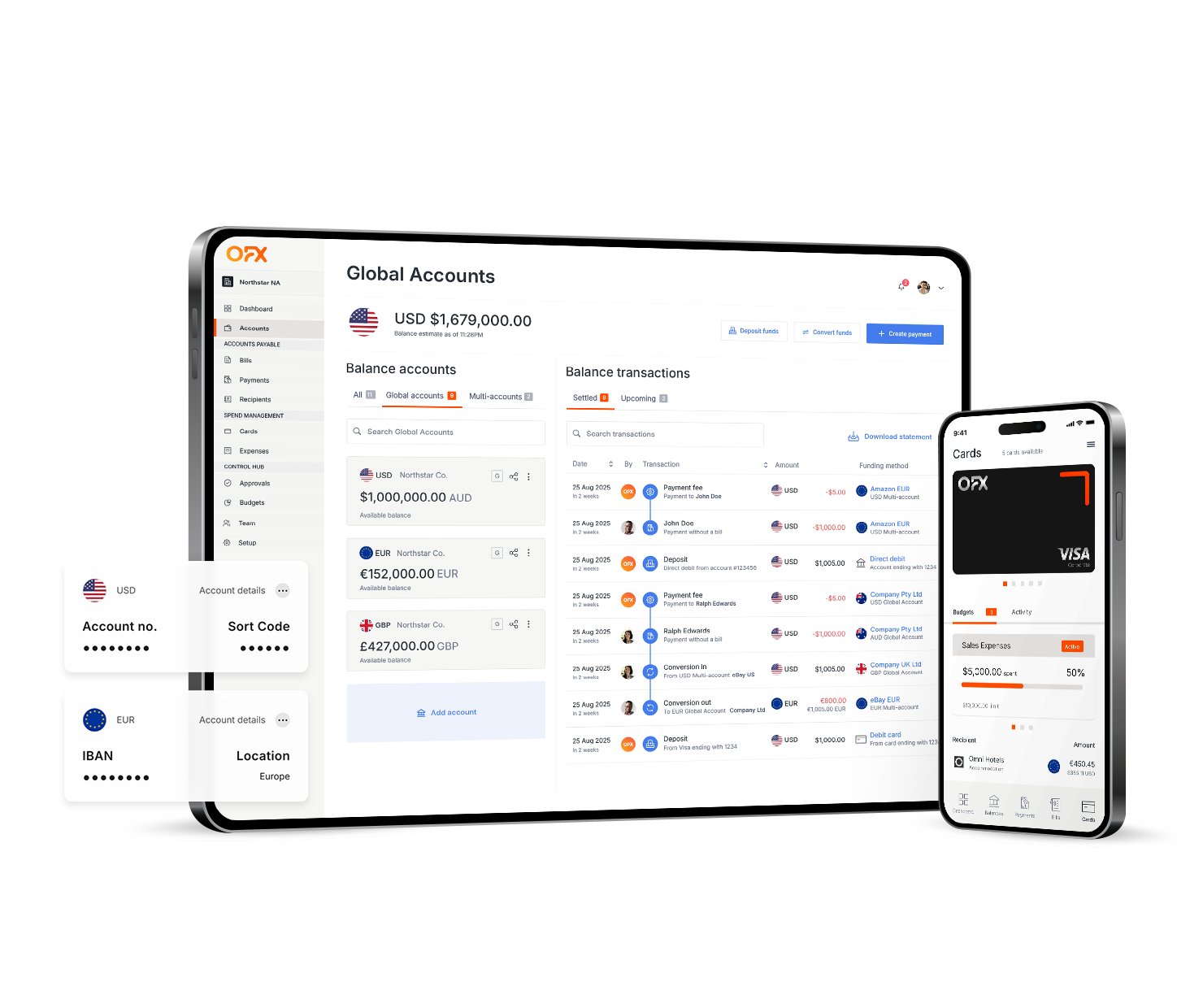
The OFX Global Business Account offers local account details in USD, EUR, CAD, and GBP. You hold balances in 30+ currencies and pay or get paid across 180+ countries, with no minimum balance and competitive, transparent exchange rates. The Standard plan is $0/user/month, and the Full Suite plan is $75/month for 5 users plus $10/month per additional user.
OFX Global Business Account
Receive, hold, convert and send funds across a wide range of currencies, reduce costs and gain greater control over your international payments.
How to choose the right no fee business account
With more than 36 million small businesses in the United States25, the number of account options can feel overwhelming. The best business checking account for you depends on how your business actually moves money, so weigh these criteria before you switch.
- Transaction volume. If you process heavy cash deposits or high transaction counts, check the free limits, because overage fees add up.
- Wire and ACH needs. For frequent domestic or international transfers, compare wire costs, not just the monthly fee.
- FX and international payments. If you pay or receive in foreign currencies, prioritize transparent FX pricing and local payment rails.
- APY. Some free accounts earn interest on balances. BlueVine, American Express Business Checking, and Airwallex all pay APY on checking.
- Integrations. QuickBooks Online and Xero integration simplifies bookkeeping. OFX integrates with both.
- Support. Round-the-clock human support matters when a payment is stuck. OFX offers 24/7 support from real people.
Online vs traditional banks
An online business bank account or fintech platform typically offers lower fees, faster onboarding, and better digital tools. You trade branch access for cost savings.
Traditional banks provide in-person service and cash-deposit infrastructure, but monthly fees are more common and waiving them often requires a minimum balance. For businesses that rarely handle cash and prioritize international payments, an online platform usually delivers better value.
How to open a no fee business account (and is it safe?)
What you need to open an account
Requirements vary, but most providers ask for:
- EIN (Employer Identification Number), or an SSN for sole proprietors
- Business formation documents, such as Articles of Incorporation, an Operating Agreement, or a DBA
- Personal identification, such as a driver’s license or passport
- Business address and contact information
Some accounts require a Social Security Number for the business owner, while others, especially fintechs, accept EIN-only applications for a business bank account for llc or corporation. LLCs and sole proprietors are eligible at most providers, though some require the business to be registered in a US state.
Is it safe? FDIC and pass-through insurance
FDIC standard deposit insurance covers $250,00026 per depositor, per insured bank, per ownership category. Fintech accounts often partner with FDIC-insured banks and sweep deposits across multiple banks to extend coverage. Mercury offers up to $5 million through a sweep network of up to 20 banks, while BlueVine and Relay extend coverage to $3 million via partner-bank arrangements.
This is called pass-through deposit insurance. Your deposits at a fintech’s partner banks are insured per depositor, as explained by the FDIC27. Credit unions are insured by the NCUA rather than the FDIC, with similar limits.
OFX is not a bank. OFX is licensed as a money transmitter in every US state and registered as an MSB with FinCEN (NMLS #1021624), so its services are not FDIC insured. OFX follows strict compliance and security protocols, including advanced encryption and 24/7 support from real people. OFX is regulated by 50+ regulators globally, is ISO 27001:2022 certified, brings 25+ years of experience, and runs a risk-averse payout model, so funds are never paid out before they are received. Learn more about how OFX keeps your money and information secure.
Why OFX stands out for small business
If you’re comparing no-fee business accounts, OFX is worth a look, especially if your business pays overseas suppliers or collects from global clients. Our standard plan is $0 per month, with no minimum balance and no account-opening fees. You get a multi-currency account, competitive FX rates, and 24/7 access to real human specialists, not a chatbot.
Where OFX goes further than a standard business account:
- Corporate Visa cards — pay suppliers and earn cashback on eligible business spend.
- Pay by Card — earn credit card reward points on supplier and expense payments, even when your suppliers don’t accept cards.
- Competitive FX — the cost some “free” accounts quietly bury in the exchange rate.
- Automated payables — batch and schedule international payments instead of processing them one by one.
Purpose-built for US importers, exporters, agencies, and fast-growing teams.
See our business pricing and take a virtual tour today.
Frequently asked questions about the best no fee business bank accounts
Are there really business bank accounts with no fees?
Yes. Several accounts waive the monthly maintenance fee entirely. BlueVine, Mercury, Relay, and American Express Business Checking all offer $0/month plans with no minimum balance. Other fees, such as wire costs or FX conversion, may still apply.
What’s the best no-fee business account for an LLC?
For domestic banking with interest, BlueVine and American Express Business Checking stand out. For a business bank account for llc that also handles international payments, the OFX Global Business Account offers multi-currency accounts, transparent FX pricing, and no minimum balance.
Can a sole proprietor open a free business account, or open with an EIN only?
Yes. Most providers accept sole proprietors using an SSN, and some fintechs accept EIN-only applications for LLCs and corporations. Check each provider’s requirements before you apply.
Are no-fee or fintech business accounts FDIC insured?
Many are. Fintech accounts often use partner banks and sweep networks to provide FDIC coverage, sometimes up to $3 million or $5 million. Credit unions are NCUA-insured. OFX is not a bank and is not FDIC insured; it is a licensed money transmitter regulated by FinCEN and US state agencies.
Which accounts have no minimum balance requirement?
BlueVine, Mercury, Relay, American Express Business Checking, Airwallex, and the OFX Global Business Account all offer a business bank account no minimum balance.
Do free business accounts earn interest (APY)?
Some do. BlueVine pays 1.3% APY on its Standard plan, American Express Business Checking pays 1.30% APY on balances up to $500,000, and Airwallex offers up to 3.20% APY through a money-market feature that is not FDIC insured but is covered by SIPC protection up to $500,000.
Looking for an alternative to your bank?
References
- https://www.americanexpress.com/en-us/business/checking/
- https://www.usbank.com/dam/documents/pdf/business-banking/business-pricing-information/deposit-products.pdf
- https://www.bankofamerica.com/salesservices/smallbusiness/resources/business-schedule-fees/
- https://www.wellsfargo.com/biz/checking/
- https://support.mercury.com/hc/en-us/articles/28772836414228-Sending-non-USD-international-wires
- https://www.bluevine.com/business-checking/plans-and-pricing
- https://mercury.com/pricing
- https://mercury.com/faq
- https://relayfi.com/pricing/
- https://www.usbank.com/business-banking/banking-products/business-bank-accounts/business-checking-account.html
- https://www.citizensbank.com/small-business/checking/overview.aspx
- https://www.airwallex.com/en-us/pricing
- https://www.ofx.com/en-us/business/pricing/
- https://www.ofx.com/en-us/business/global-business-account/
- https://www.airwallex.com/us/terms/fee-schedule
- https://www.ofx.com/en-us/business/international-payments/
- https://www.sccu.com/articles/small-business/honestly-free-business-checking
- https://www.truist.com/small-business/banking/checking/simple-business-checking
- https://www.hpbgo.com/business/bank/free-business-checking-account
- https://www.clevelandfed.org/collections/press-releases/2026/pr-20260303-fed-survey-small-business-optimism-wanes-as-performance-metrics-hold-steady
- https://wise.com/us/pricing/business
- https://transferfees.io/guides/wise-fees-explained/
- https://www.pymnts.com/study/cross-border-global-sourcing-smbs-payment-providers/
- https://www.ofx.com/en-us/legal/state-licensing/
- https://advocacy.sba.gov/2026/02/03/frequently-asked-questions-about-small-business-2026/
- https://www.fdic.gov/resources/deposit-insurance/
- https://www.fdic.gov/financial-institution-employees-guide-deposit-insurance/pass-through-deposit-insurance-coverage
- https://support.mercury.com/hc/en-us/articles/32529650270484-Understanding-conversion-fees-for-non-USD-card-transactions
- https://relayfi.com/faqs/
*If you book a Forward Contract, it may mean losing out if the market rate improves because you’re contracted to settle at the agreed rate. Read more. Forward Contracts are not available for clients in Singapore. NZForex issues derivatives to wholesale clients only. Retail clients are not permitted or eligible to enter into any forward contract.
^If you book a Limit Order, it may mean losing out if the Market Rate continues to move above your Target Rate. There is no guarantee that your desired rate will be reached. Once the order is triggered, the transfer is binding and cannot be voided.
The contents of this article are general information only and do not constitute financial advice. Consider your own objectives, financial situation and needs before acting.