Key takeaways
- The best business account depends on your stage and structure: startups, LLCs, freelancers, cash-heavy operations, and established firms each have different priorities.
- Look past the headline fee. Monthly charges, minimum balances, transaction costs, and wire fees add up fast.
- Match features to your workflow: interest on balances, lines of credit, accounting integrations, spend controls, and branch access versus online-only convenience.
- Traditional banks and many fintech partners offer FDIC coverage up to $250,000, while OFX is purpose-built for businesses moving money globally. 50+ currencies, 180+ countries, no minimum balance.
Picking the right business account means weighing monthly fees, minimum balances, the chance to earn interest, access to a line of credit, cash-handling needs, and the cost of moving money across borders. This guide compares the top banks and fintech providers so you can find the fit for how your business actually runs.
Jump to:
• Best banks for small business at a glance
• The best banks and fintech providers for small business
• Bank vs fintech: what a business account actually protects
• Can you open a business transaction account (from a fintech) alongside a business bank account?
• How to choose the best account for your small business
• How to open a business bank account
• Why OFX stands out for small business
• FAQs about the best small business bank accounts
Best banks for small business at a glance
Choosing the best banks for small business means weighing monthly fees, minimum balance requirements, transaction limits, and specialized features against your company’s actual needs. The right small business bank account can save you thousands in fees each year and streamline your financial operations. The US is home to 36.2 million small businesses, which account for almost 46% of private sector employment1, so the market for business accounts is deep and competitive. Here’s a snapshot of how the top business checking account options compare.
| Provider | Type | Monthly fee | Standout feature | Best for |
|---|---|---|---|---|
| Chase Business Complete | Bank | $15/mo (waived with $2,000 minimum daily balance)2 | Nationwide branch network | Businesses needing in-person banking |
| Bank of America Fundamentals | Bank | $16/mo (waivable)3 | Full-service branch network | Established businesses with complex needs |
| Bluevine | Fintech | $0 (Standard) / $30 (Plus) / $95 (Premier)4 | FDIC sweep up to $3M4 | Startups and growing businesses |
| Mercury | Fintech | $0 / $29.90 (Plus) / $299 (Pro)5 | FDIC sweep up to $5M5 | Tech startups and venture-backed companies |
| Novo | Fintech | $06 | Free invoicing tools | Freelancers and sole proprietors |
| Grasshopper | Fintech (bank charter) | $07 | APY 1.55% (3.00% on $25,000+)7 | Businesses seeking yield on deposits |
| American Express Business Checking | Fintech (bank charter) | $08 | 1.30% APY on balances up to $500,0008 | Businesses maximizing interest |
| Brex | Fintech | $0 (Essentials) / $12 per user (Premium)9 | Variable treasury yield (up to ~3.68%); FDIC up to $6M9 | High-growth startups and scale-ups |
| Wise Business | Fintech | $0 (one-off setup US$31)10 | Multi-currency accounts and mid-market rates | International freelancers and small teams |
| Airwallex | Fintech | $0 (Explore) / $12 per user (Grow)11 | Multi-currency collections and payouts | E-commerce and marketplace sellers |
| Revolut Business | Fintech | $10 (Basic) / from $40 (Grow) / from $140 (Scale)12 | Tiered pricing for scaling teams | Teams with high card usage |
| OFX | Fintech | $0 (Standard) / $75 (Full Suite, includes 5 users) | 30+ currencies, local account details, 25+ years FX expertise | Businesses with frequent international payments |
The best banks and fintech providers for small business
The right business checking account depends on whether you need branch access, high interest, low fees, or powerful international capabilities. Here’s how the top options stack up, grouped by what they do best.
Best traditional bank: Chase
Chase Business Complete Checking remains a go-to for businesses that value in-person banking and a nationwide branch network. Its wide network of branches and ATMs is practical for companies that deposit cash or need face-to-face service.
The monthly fee is $15, waived if you maintain a $2,000 minimum daily balance2. There’s no minimum opening deposit13. However, international payments carry costs: online domestic wires run $252, and non-USD card purchases incur a 3% foreign exchange rate adjustment2. Chase is best for established businesses that prioritize branch access and don’t regularly move money across borders.
Best for startups: Mercury and Bluevine
Mercury has become a favorite among tech startups and venture-backed companies, offering a clean interface, founder-friendly tools, and robust treasury management. Pricing starts at $0 per month5, scaling to $29.90 for Plus and $299 for Pro (billed annually)5. Mercury’s standout feature is FDIC sweep coverage up to $5M5, making it appealing for companies holding significant cash. Note that card transactions in foreign currencies incur a 3% FX fee5.
Bluevine offers similar appeal with tiered pricing: $0 for Standard, $30 for Plus, and $95 for Premier4. Its FDIC sweep coverage extends up to $3M4. Bluevine is best for startups and fast-growing businesses that want simple banking with access to lines of credit.
Best for international and multi-currency: OFX, Airwallex, and Wise
If your business regularly pays or receives money in multiple currencies, a multi currency business account built for global operations can save substantial costs compared to traditional banks.
OFX offers a Global Business Account with local account details in USD, EUR, CAD, and GBP, so you can hold, receive, and pay in 50+ currencies across 180+ countries without opening foreign bank accounts. There’s no minimum balance. Because OFX uses local payment rails rather than routing everything through SWIFT, your suppliers get paid faster and you’re not hit with unexpected intermediary fees. Forward Contracts* and Limit Orders^ help you manage currency risk on your terms.
The Standard plan is $0 per user per month; Full Suite costs $75 per month including 5 users¹⁴, plus $10 per additional user. OFX also integrates with QuickBooks Online and Xero for streamlined reconciliation. With 25+ years of FX experience, ASX listing, ISO 27001:2022-certified controls, and 24/7 human support, OFX combines fintech convenience with deep currency expertise.
Airwallex is strong for e-commerce businesses and marketplace sellers. Pricing is $0 on the Explore plan or $12 per user on Grow11. FX margins run 0.50% on major currencies and 1.00% on others15. SWIFT transfers cost $15 (SHA) or $25 (OUR)15. Airwallex also offers cashback on business cards.
Wise Business charges no monthly fee, with a one-off setup of US$3110. Conversion fees start from 0.57%10, though third-party analysis suggests some routes can rise to around 2%16. Wise is best for freelancers and small teams making regular transfers in popular currency pairs.
Best for free checking and rewards: Novo, Grasshopper, and American Express
Novo is an online business bank account with no monthly fee6 and no minimum balance. It integrates with popular accounting tools and includes free invoicing. Outgoing domestic wires cost up to $306. FDIC coverage is $250,0006. Novo suits freelancers and sole proprietors who want simple, free business checking.
Grasshopper offers an Innovator Money Market Savings account with no monthly fee7 and competitive interest: 1.55% APY, rising to 3.00% on balances of $25,000 and above7. FDIC coverage is $250,0007. Grasshopper is best for businesses that want to earn yield on idle cash.
American Express Business Checking provides no monthly fee8 and a strong 1.30% APY on balances up to $500,0008. FDIC coverage is $250,0008. It’s ideal for businesses that keep significant balances and want competitive interest without fees.
Bank vs fintech: what a business account actually protects
Understanding the difference between a traditional bank account and a fintech provider helps you evaluate what’s actually protected and what trade-offs you’re making. Fintech adoption is rising: the share of small firms applying to online lenders increased for the fifth consecutive year in the Federal Reserve’s small business credit surveys17.
What “Member FDIC” means
Banks that are members of the Federal Deposit Insurance Corporation (FDIC) insure deposits up to $250,000 per depositor, per institution, for each ownership category18. If the bank fails, the FDIC guarantees you won’t lose insured funds.
Some fintech providers partner with multiple FDIC-insured banks through sweep networks, extending coverage well beyond $250,000. For example, Brex offers FDIC coverage up to $6M9, Mercury up to $5M5, and Bluevine up to $3M4. These aren’t banks themselves but partner with banks to provide FDIC protection on deposited funds.
What a money service business is
Non-bank providers that facilitate money transfers typically register as Money Service Businesses (MSBs) with the Financial Crimes Enforcement Network (FinCEN) at the federal level and obtain money transmitter licenses from each state’s regulatory agency. This framework ensures compliance with anti-money laundering (AML) rules and consumer protection standards.
OFX is licensed as a money transmitter by the relevant state regulatory agency in every US state and is registered as a Money Service Business (MSB) with FinCEN19. OFX is not a bank and does not offer FDIC-insured deposits. However, OFX balances this with robust security: 25+ years of experience, ASX listing, ISO 27001:2022-certified controls, and 24/7 support from real specialists.
For businesses primarily focused on moving money internationally rather than storing large cash reserves, a money transmitter licensed in every US state can be a practical, cost-effective alternative to maintaining multiple traditional bank accounts.
Can you open a business transaction account (from a fintech) alongside a business bank account?
Yes. Many of our clients keep bank accounts for legal or borrowing purposes while using an OFX Global Business Account to save time and money on their financial operations and currency transfers.
I was recommended to use OFX, but honestly I wish I knew about it sooner. By far OFX is the most competitively priced and easiest platform we’ve ever used. The user experience and customer service have been a lot better for our finance teams to manage,” said Jonathon, co-founder of BikesOnline.
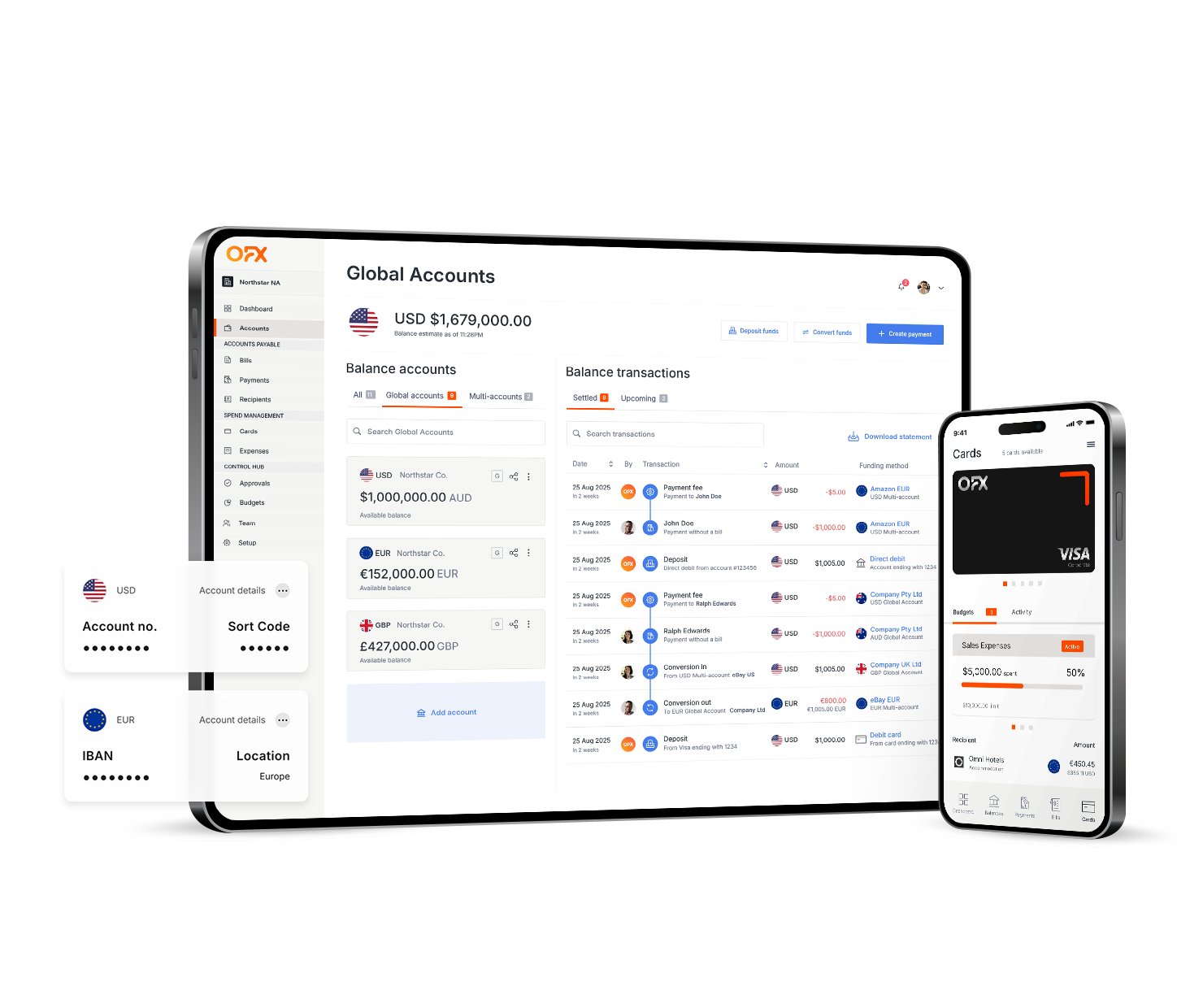
OFX Global Business Account
Receive, hold, convert and send funds across a wide range of currencies, reduce costs and gain greater control over your international payments.
How to choose the best account for your small business
The best business bank accounts aren’t one-size-fits-all. The US Small Business Administration recommends shopping around20 to compare fees, features, and services before committing. Here’s what to evaluate.
Online vs traditional (in-person) business banking
Traditional banks like Chase and Bank of America offer branch access for cash deposits, notarization, and face-to-face service. If your business handles physical cash or needs in-person support, a branch network matters.
Online business bank accounts and fintech providers typically offer lower fees, faster account opening, and better digital tools. For businesses that operate primarily online and don’t deposit cash, an online-first provider often delivers more value.
Features that matter (fees, APY, integrations, cards, spend controls)
- Monthly fees and minimum balances: Free business checking is available from providers like Novo, American Express, Grasshopper, and OFX. Others waive fees if you maintain a minimum balance. Calculate whether you’ll consistently meet the threshold.
- Transaction fees: Watch for wire fees, ACH limits, cash deposit charges, and per-transaction costs. A low monthly fee means little if transaction costs pile up.
- APY: Some providers offer interest-bearing accounts. American Express offers 1.30% APY on balances up to $500,0008. Grasshopper’s Innovator Money Market Savings Account offers 1.55%–3.00% APY7. If you keep significant balances, APY can add up.
- Integrations: Accounting integrations with QuickBooks Online and Xero save hours on reconciliation. OFX offers two-way sync with both platforms. Verify that your provider supports your accounting software before signing up.
- Cards and spend controls: Business debit and credit cards with spend limits, category restrictions, and real-time tracking help control company spending. OFX offers corporate cards with pre-spend controls, merchant category restrictions, and instant lock/cancel from mobile.
- International needs: If you pay suppliers, contractors, or employees overseas, evaluate the FX cost, available currencies, and whether the provider uses local rails or SWIFT. A best business account for international payments prioritizes low FX costs and fast settlement.
Why multi-currency still matters for small businesses
Nearly half of small employer firms say they source at least some inputs from outside the United States, according to the Federal Reserve’s 2025 Small Business Credit Survey21, so cross-border cost is a mainstream concern, not a niche one. When your business moves money across borders, the sticker price of a bank account rarely tells the full story. The true cost includes foreign exchange markups, outbound wire fees, intermediary bank charges, and receiving fees. A free business checking account can quietly cost thousands in hidden FX costs each year.
Evaluating total cross-border cost
To compare providers, calculate the all-in cost of a typical transaction: start with the exchange rate spread, add any flat send fee, then factor in how the money actually arrives. SWIFT transfers often involve intermediary banks that deduct fees along the way. Local payment rails bypass these intermediaries, delivering faster settlement and predictable costs.
“Getting paid like a local” means your customers pay into a local account in their currency, avoiding international wire fees on their end. For example, a US company with a EUR account can invoice European clients and receive euros without conversion, then convert when rates are favorable.
The details that matter most depend on your business: which currencies you actually get paid and pay in, how quickly funds need to settle, and whether you can hold a balance and convert when rates suit you. A provider built for cross-border payments will usually beat a traditional account on all three, which is why an internationally active small business should weigh this alongside monthly fees rather than after them. You will find fee specifics for each provider in the comparison table and profiles above.
How to open a business bank account
According to the SBA, you can open a business bank account once you have your federal EIN20. Here’s what you’ll typically need:
- Employer Identification Number (EIN): Your federal tax ID, obtained free from the IRS.
- Business formation documents: Articles of incorporation, operating agreement, or DBA registration, depending on your business structure.
- Government-issued ID: Driver’s license or passport for identity verification.
- Business license or permits: If required for your industry or location.
LLC vs sole proprietor
A business bank account for LLC requires your EIN and formation documents. LLCs benefit from separating business and personal finances for liability protection and cleaner bookkeeping.
Sole proprietors can often open a business account with just an EIN and personal ID, though some banks accept a Social Security Number instead. Separating business finances simplifies taxes and adds professionalism.
Why OFX stands out for small business
OFX offers a Global Business Account designed from the ground up for businesses that move money internationally. You can hold, receive, and pay in 50+ currencies22 across 180+ countries23. Local account details in USD, EUR, CAD, and GBP let you get paid like a local without opening foreign bank accounts.
OFX uses local payment rails rather than relying exclusively on SWIFT, which often means faster, cheaper settlement and same-day delivery on many routes. There’s no minimum balance22. Forward Contracts* let you lock in exchange rates for future payments, protecting margins against currency swings. Limit Orders^ execute automatically when your target rate is reached.
OFX also offers Corporate Cards that earn cashback on eligible business spend, plus Pay by Card, which lets you earn credit card reward points on supplier and expense payments
With 25+ years of FX expertise, OFX brings deep currency knowledge that pure-play fintechs often lack. The platform integrates with QuickBooks Online and Xero for real-time reconciliation. Support is available 24/7 from real specialists, not chatbots. OFX is ASX-listed and uses ISO 27001:2022-certified controls for enterprise-grade security.
The Standard plan is $0 per user per month. Full Suite costs $75 per month including 5 users, plus $10 per additional user, unlocking advanced AP automation, approval workflows, and spend management. Registration takes under 10 minutes online, with verification typically completed in 2–3 business days and immediate platform access while your identity check is finishing¹⁴. See our business pricing to learn more.
Frequently asked questions about the best small business bank accounts
Do I need an LLC to open a business bank account?
No. Sole proprietors, partnerships, corporations, and LLCs can all open business bank accounts. The documentation requirements vary: an LLC needs formation documents and an EIN, while a sole proprietor may only need an EIN and personal ID.
Can I open a business bank account with only an EIN?
Most providers require both an EIN and personal identification. Some also request business formation documents. The SBA confirms you can open a business bank account once you have your federal EIN20, though additional documentation is typically needed.
What do I need to open a business bank account?
Typical requirements include your EIN, government-issued ID, business formation documents (articles of incorporation, operating agreement, or DBA), and any required business licenses. Online providers often streamline this process with digital verification.
Are online business bank accounts and fintech providers safe?
Yes, but protections vary. FDIC-insured banks protect deposits up to $250,000. Some fintechs partner with FDIC banks to extend coverage: Mercury offers up to $5M5, Bluevine up to $3M4, Brex up to $6M9.
Money transmitters like OFX are licensed in every US state and registered with FinCEN, and back that regulation with 25+ years of experience, ASX listing, ISO 27001:2022-certified controls, and 24/7 support from real specialists. Look for state licensing, FinCEN registration, and how your funds are safeguarded when you compare providers.
How much does a business bank account cost?
Costs range from free to hundreds per month. Chase charges $15 per month, waived with a $2,000 minimum balance2. Novo is $0 per month6. OFX Standard is $0 per user per month; Full Suite is $75 per month including 5 users. Beyond monthly fees, compare wire costs, FX markups, and transaction limits.
Can I use a personal account for my business?
You can, but it’s not recommended. Mixing personal and business finances complicates taxes, weakens liability protection for LLCs, and looks unprofessional to clients. A dedicated small business bank account keeps finances organized and simplifies accounting.
Which account is best for international payments and holding foreign currencies?
The best business account for international payments depends on your volume, currencies, and destinations. OFX offers a Global Business Account that lets you hold, receive, and pay in 50+ currencies across 180+ countries with competitive exchange rates. Local account details in USD, EUR, CAD, and GBP mean you can get paid like a local. There’s no minimum balance, and OFX uses local payment rails for faster settlement. With 25+ years of FX expertise and 24/7 human support, OFX is built for businesses that move money globally.
Do business bank accounts earn interest (APY)?
Some do. American Express Business Checking offers 1.30% APY on balances up to $500,0008. Grasshopper’s Innovator Money Market Savings account offers 1.55% APY, rising to 3.00% on balances of $25,000 and above7. Brex offers a variable treasury yield (up to around 3.68%)9. Traditional banks and most fintechs focused on payments don’t offer competitive APY on checking balances. If earning interest matters, evaluate accounts specifically designed for yield.
How can I open an OFX account?
OFX registration takes under 10 minutes online. You’ll provide basic business information and identity documents. Verification typically completes in 2–3 business days, with immediate platform access while KYC finishes. There’s no branch visit, no minimum deposit, and no lock-in contract.
Looking for an alternative to your bank?
References
- https://advocacy.sba.gov/2025/06/30/new-advocacy-report-shows-the-number-of-small-businesses-in-the-u-s-exceeds-36-million/
- https://www.chase.com/content/dam/chase-ux/documents/personal/checking/biz-how-your-transaction-will-work.pdf
- https://www.bankofamerica.com/salesservices/smallbusiness/resources/business-schedule-fees/
- https://www.bluevine.com/business-checking/plans-and-pricing
- https://mercury.com/pricing
- https://www.novo.co/business-checking
- https://www.grasshopper.bank/banking-solutions/business-banking-features/
- https://www.americanexpress.com/en-us/banking/business/checking-account/agreement/rates-and-fees
- https://www.brex.com/pricing
- https://wise.com/us/pricing/business
- https://www.airwallex.com/en-us/pricing
- https://www.revolut.com/en-US/business/business-account-plans/
- https://www.chase.com/business/banking/checking/business-complete-banking
- https://www.ofx.com/en-us/business/pricing/
- https://www.airwallex.com/us/terms/fee-schedule
- https://transferfees.io/guides/wise-fees-explained/
- https://fedcommunities.org/2025-small-business-credit-survey-key-insights/
- https://www.fdic.gov/resources/deposit-insurance
- https://www.ofx.com/en-us/legal/state-licensing/
- https://www.sba.gov/business-guide/launch-your-business/open-business-bank-account
- https://www.fedsmallbusiness.org/reports/survey/2026/2026-report-on-employer-firms
- https://www.ofx.com/en-us/business/global-business-account/
- https://www.ofx.com/en-us/business/international-payments/
*If you book a Forward Contract, it may mean losing out if the market rate improves because you’re contracted to settle at the agreed rate. Read more. Forward Contracts are not available for clients in Singapore. NZForex issues derivatives to wholesale clients only. Retail clients are not permitted or eligible to enter into any forward contract.
^If you book a Limit Order, it may mean losing out if the Market Rate continues to move above your Target Rate. There is no guarantee that your desired rate will be reached. Once the order is triggered, the transfer is binding and cannot be voided.
OFX is licensed as a money transmitter by the relevant state regulatory agency in every US state. OFX is registered as a Money Service Business (MSB) at the federal level with the Financial Crimes Enforcement Network (FinCEN). OFX is not a bank and does not offer banking services. OFX’s services include money transfers and foreign exchange, which are not FDIC insured.
Your money and information sit behind strong protections. OFX is regulated by 50+ regulators globally, is ISO 27001:2022 certified, brings 25+ years of experience, and runs a risk-averse payout model, so funds are never paid out before they are received.
Learn more about how OFX keeps your money and information secure.
The contents of this article are general information only and do not constitute financial advice. Consider your own objectives, financial situation and needs before acting.