A forecast can be mathematically sound and still miss something important.
You know what you expect to sell. You know your payroll, supplier commitments and operating costs. You know when cash should come in and when it should go out.
But for businesses operating internationally, those numbers can change between forecast and payment day.
A foreign-currency supplier invoice costs more than expected. An international payment settles later than planned. A rate moves between budget approval and payment day.
Suddenly, the cash position you forecast isn’t the cash position you have.
Finance leaders already know visibility matters. OFX research among North American SMB finance leaders1 found that 99% consider real-time visibility into financial transactions important or essential for effective decision-making, while 89% say strategic cash-flow management is essential or very important.
But seeing today’s cash clearly doesn’t guarantee you can see what’s coming next.
Why a good forecast can still miss international risk.
Every forecast relies on assumptions:
- Revenue arrives around a certain date.
- Supplier payments leave according to agreed terms.
- Costs stay within an expected range.
- Exchange rates are often represented by a single budget or planning rate.
While useful, it can also hide potential uncertainty.
International operations often introduce variables that don’t always behave neatly inside a spreadsheet.
OFX research in North America1 found that among businesses affected by currency volatility, 39% report unpredictable revenues or costs, 37% report budgeting and forecasting concerns, 34% report reduced profitability and 33% report payment delays or renegotiations.
Those aren’t just FX issues. They’re forecasting issues.
A currency movement could change what a supplier payment costs in your home currency. A delay could push an expected cash movement into another week or month. A renegotiation could change both the amount and timing.
Each one widens the gap between what the forecast says and what actually happens.
So instead of only asking, “Is our forecast accurate?”, ask something more useful: What would have to change for this forecast to stop working?
Three variables that can knock your forecast off course.
1. The rate
Say your business expects to pay US$500,000 to suppliers next quarter.
The USD amount might be fixed. The cost in your home currency isn’t.
Using one exchange-rate assumption can make that uncertainty disappear from the spreadsheet. It doesn’t make it disappear from the business.
A better question is: what happens if the rate moves?
Model a few plausible movements and look at the impact on margin, cash reserves or purchasing capacity.
The goal isn’t to predict the market, but to know where the business starts to feel it.
2. The timing
Forecasts put payments into tidy weeks and months but real payments aren’t always so realistically tidy.
International payments may involve different payment systems, regulations and operational processes. Unexpected delays and budgeting concerns are complications many businesses face when making global payments.
So, pressure-test timing too.
- What happens if a large customer payment arrives five days late?
- What if an overseas supplier needs paying a week earlier?
- What if several international obligations hit at the same time?
A forecast that only works when everything happens on schedule doesn’t show resilience, but the best-case path.
3. The visibility
A forecast is only as good as the information feeding it.
When payments, expenses and cash flow sit across disconnected systems, maintaining visibility becomes harder. OFX research among North American SMBs1 found that fragmented financial operations can make it more difficult to maintain visibility, control and efficiency.
Australian businesses report a similar challenge. Nearly three in four say real-time visibility of transactions and consolidation of expenses, treasury and accounts payable are essential or very important. The same research shows siloed systems as a barrier to real-time financial control.2
If a committed international payment reaches your forecast too late, visibility becomes the problem.
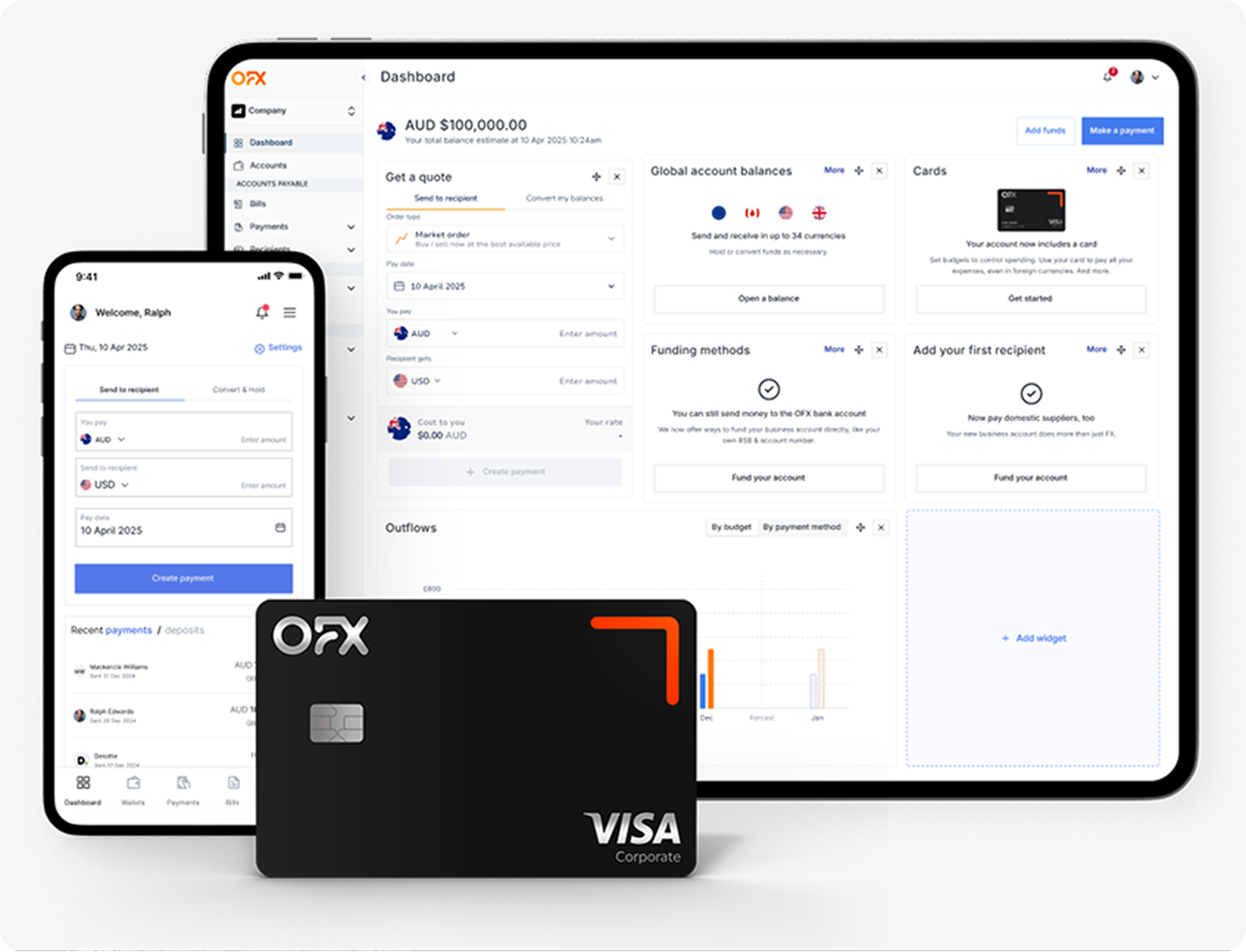
Take control of your global finances. See how OFX can help your business.
One forecast isn’t enough.
A single forecast can create a false sense of certainty. One number starts to look like the answer. Instead, finance teams can model a small range of outcomes.
- Base case: What happens if today’s assumptions broadly hold?
- Pressure case: What happens if rates, payment timing or costs move against you?
- Opportunity case: What happens if conditions move to benefit you?
You don’t need dozens of scenarios. You need enough to see which assumptions matter.
If a relatively small currency movement turns a comfortable cash position into a tight one, that’s useful information.
If a one-week payment delay barely changes anything, that’s useful too.
The goal isn’t to make the forecast certain. It’s to know what could knock it off course.
That matters because cash-flow management is already a major priority. In OFX’s Australian research2, 75% of respondents said cash-flow management is essential or very important to expense and payment improvement. Yet 34% of businesses take no proactive measures to manage currency volatility on international payments.
That’s a common blind spot. A business can care deeply about cash flow while leaving one of the variables capable of changing it outside the planning process.
Knowing the exact cost of the bikes we have purchased in advance allows for more accurate cash flow forecasting. This predictability helps in planning for other expenses and investments.”
— Jonathon Allara, Co-founder, BikesOnline
Four questions to pressure-test your forecast.
You don’t necessarily need a more complicated model. You need better questions.
1. Which assumptions could materially change our cash position?
Not every line in a forecast carries the same risk. Start with:
- Large foreign-currency supplier payments
- Overseas revenue
- Significant customer receipts
- Concentrated payment dates.
Find the numbers that can actually move the outcome.
2. What does our international exposure look like by currency and timing?
Don’t only look at total international spend. Break it down by currency, amount and expected payment date.
That makes it easier to see where obligations are concentrated and where a change in rates or timing could have the biggest effect.
3. At what point would we need to act?
Decide which thresholds matter before you reach them.
That might be a currency move that pushes input costs outside budget, a minimum cash buffer, or a payment delay that creates pressure elsewhere.
You don’t need to know exactly what will happen. You need to know when it matters.
4. How quickly do actual transactions make it back into the forecast?
A monthly forecast built on stale information can look precise and still be too late.
As payment dates shift, invoices change, or actual international costs differ from assumptions, update the model to reflect the latest information.
The forecast should learn from what happened, not just explain it at month end.
Turn your forecast into an early-warning system.
Effective forecasts don’t remove uncertainty. They expose it early enough to do something about it.
Instead of saying:
“This is what will happen.”
A better forecast tells you:
“This is what we’re expecting. These are the assumptions behind it. These are the variables that could change it. And this is the point where we need to make a decision.”
It comes from understanding how your business responds when conditions change.
UK finance leaders surveyed by OFX3 are already looking to technology to improve that process, including better reporting and insights, data analytics and AI-powered financial forecasting tools.
The next step is a forecast that can see more of the business.
See the variables before they become variances.
International payments add moving parts to cash-flow planning. Currency, timing and visibility can all change what happens between forecast and actual.
Understanding those variables earlier can help finance teams spend less time explaining surprises and more time planning around them.
OFX specialists can help businesses understand their international payment requirements and the FX considerations that may affect cash flow, giving finance teams greater visibility as conditions change.
See what your forecast is missing
Sources: