
Key Takeaways
- You can pay overseas suppliers by telegraphic transfer, an international money transfer specialist, a multi-currency account, card, or letter of credit. Each suits a different supplier and invoice size.
- The real cost sits in the exchange rate margin plus transfer fees, not just the headline fee. Compare both before you send.
- Bank transfers can take several business days, while specialist providers using local rails often settle sooner.
- Keep clear records and check your GST and withholding obligations with the ATO before you pay.
Paying an overseas supplier from Australia can quietly cost more than the invoice once marked-up exchange rates, transfer fees, and slow settlement are counted, and a single wrong bank detail can stall the whole payment. This guide walks through the payment methods, the step-by-step process, the true cost, how to manage currency risk, and your Australian tax obligations, to help protect your margins and pay with confidence.
Jump to:
• How to pay overseas suppliers from Australia: the essentials
• Overseas supplier payment methods compared
• How to pay international suppliers step by step
• Manage currency risk with forwards and a foreign currency account
• Tax and compliance when you pay overseas suppliers
• Choosing the best way to pay overseas suppliers
• FAQs about how to pay an overseas supplier
How to pay overseas suppliers from Australia: the essentials.
Knowing how to pay overseas suppliers from Australia comes down to three things: the method, the true cost, and the compliance steps. Get those right and you help protect your margins and your supplier relationships.
At a high level, you confirm the supplier’s banking details and invoice currency, pick a provider, then send the funds. The right choice depends on the invoice size, the currency, the supplier’s timeline, and the total cost once fees and the margin are counted.
The stakes are rising for importers. Australia’s total goods and services imports rose 6.9% to AU$658.3 billion in 20251, and China was Australia’s largest import partner in 2025 at AU$130.2 billion1. When you move that much money across borders, small differences in cost and speed add up fast.
Most Australian importers pay overseas suppliers in the supplier’s local currency. That gives you clearer pricing and often a better rate than letting the supplier’s bank convert Australian dollars at the other end.
Cross-border payments also carry timing and paperwork that domestic transfers don’t. Building a simple, repeatable process for your international business payments saves time and reduces errors as your volume grows.
The true cost of a supplier payment.
Two costs decide how much you really pay. The first is the transfer or transaction fee. The second, and usually the larger one, is the exchange rate margin added on top of the mid-market rate.
A low or zero transfer fee can still hide a wide exchange rate margin, so a “free” transfer is rarely the cheapest. Compare the total landed cost of moving AU$10,000, not just the advertised fee.
Banks tend to build a larger margin into the rate than specialist providers do. Ask any provider for the full rate you’ll receive, plus all fees, before you commit.
Watch for third-party charges too. On a SWIFT payment, an intermediary bank can deduct a fee in transit, which means your supplier receives less than the invoice amount. Ask whether those charges are covered so the payment lands in full.
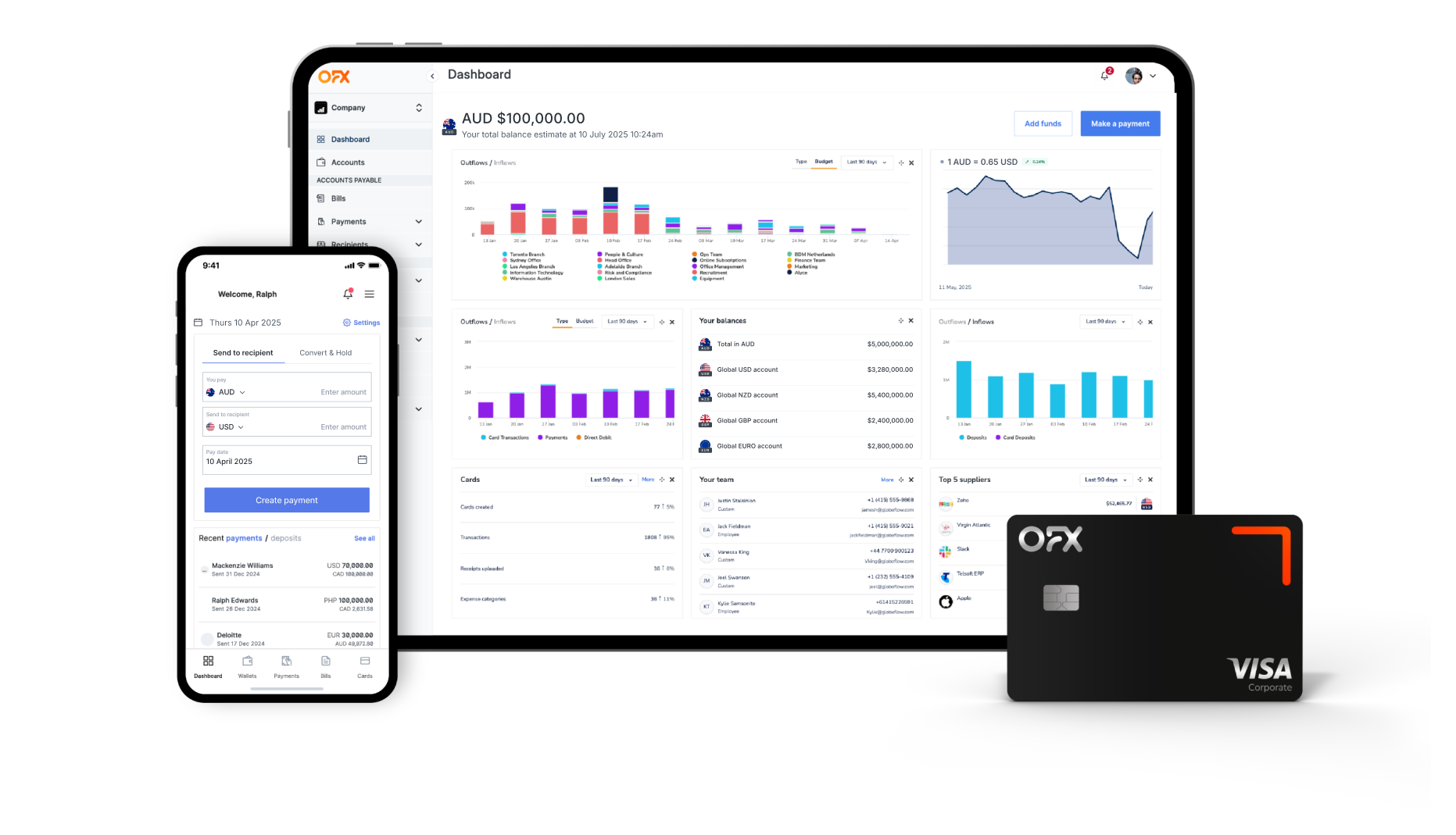
OFX Global Business Account
Receive, hold, convert and send funds across a wide range of currencies, reduce costs and gain greater control over your international payments.
Overseas supplier payment methods compared.
There are several overseas supplier payment methods, and the best fit changes with the size and frequency of your invoices. The value of cross-border payments is estimated to rise from almost US$150 trillion in 2017 to over US$250 trillion by 20272, so choosing well matters more each year.
| Method | Typical speed | Best suited to | Main cost to watch |
|---|---|---|---|
| Bank telegraphic transfer (SWIFT) | 2-5 business days | One-off or occasional payments through your existing bank | Exchange rate margin and intermediary bank fees |
| International money transfer specialist | Often 1-2 business days | Regular supplier payments and multiple currencies | Exchange rate margin |
| Multi-currency account | Same day where local rails are used | Businesses paying and getting paid in several currencies | Conversion cost when you switch currencies |
| Card payment | Fast, where the supplier accepts cards | Smaller invoices and suppliers set up for card | Card and cross-border surcharges |
| Letter of credit | Slower, document-driven | Large first orders with new or higher-risk suppliers | Bank issuing and handling fees |
Telegraphic transfer and SWIFT payments.
A telegraphic transfer is the traditional way banks send money overseas. It usually travels over the SWIFT network, where the payment can pass through one or more intermediary banks before it reaches your supplier.
Each intermediary can take a fee, and a SWIFT payment often takes a few business days to land. Swift reports that 90% of cross-border payments sent over the Swift network reach the destination bank within an hour3, though final crediting to your supplier’s account can still take longer. It’s a dependable option for the occasional invoice, though the exchange rate margin is where the cost tends to add up.
Specialists, multi-currency accounts, and cards.
A specialist provider or a multi-currency account for business can route many payments over local rails instead of SWIFT. That often means faster settlement and a tighter rate.
Cards can work for smaller invoices when the supplier accepts them. With OFX Pay by Card, you can settle supplier invoices using an eligible rewards credit card, even when the supplier doesn’t usually accept cards. You earn reward points as you go. OFX does not guarantee points accrual; this depends on the card issuer’s rewards program terms.
Letter of credit.
A letter of credit is a bank’s promise to pay the supplier once agreed conditions are met, such as proof of shipment. It gives both sides confidence on large or first-time orders, and it’s common in trade with new suppliers.
The trade-off is cost and paperwork. Issuing and handling fees apply, so a letter of credit tends to suit high-value orders rather than routine invoices.
How to pay international suppliers step by step.
Once you’ve picked a method, the process for how to pay international suppliers is straightforward. Follow these 5 steps for each payment.
- Confirm the invoice details. Check the amount, the currency, and the payment terms against your purchase order.
- Collect the supplier’s banking details. You’ll need their account name, account number or IBAN, and their bank’s SWIFT/BIC code.
- Verify the details independently. Confirm any new or changed bank details by phone using a number you already hold, not one from the invoice.
- Choose your currency. Decide whether you pay in the supplier’s currency or Australian dollars, and check the rate and fees before you confirm.
- Send and keep the record. Make the payment, save the confirmation, and share it with the supplier so they can match it to the invoice.
Payment fraud is a real risk on cross-border payments, so that verification step matters. In 2025, payment redirection scams cost Australians AU$166.8 million, according to the ACCC4. Invoice redirection scams rely on a business paying a changed bank account without checking, so a quick call can save a costly mistake.
How to pay international supplier with OFX.
Getting started is quick, and you can begin before verification is complete. Here is how to pay overseas suppliers through an OFX Global Business Account.
- Register online: create your account and add your business details.
- Get verified: the OFX team confirms your identity, usually within a couple of business days, while you explore the platform.
- Add and hold funds: top up in the currencies you need and hold balances until the rate suits you.
- Add your recipients: save each supplier’s bank details once, then reuse them for future payments.
- Pay and track: send single or batch payments, sync them with Xero or QuickBooks Online, and follow each transfer to completion.
Because OFX uses local payment rails rather than SWIFT alone, many payments settle the same day. That speed matters when a business international money transfer is holding up a shipment or a supplier relationship.
Beneficiary details you’ll need by corridor.
Different corridors ask for different details. To pay Chinese suppliers, you’ll usually need their account with a Chinese bank, the bank’s SWIFT code, and sometimes the CNAPS code. Many businesses pay Chinese suppliers in Chinese yuan or US dollars, depending on what the supplier invoices in.
To pay a supplier in the United States, you’ll need their account number and the bank’s routing number or SWIFT code. For European suppliers, an IBAN and BIC are standard. Match the details to what the supplier lists on the invoice.
Manage currency risk with forwards and a foreign currency account.
Exchange rates move daily, and that movement can quietly erode your margins between quote and payment. A few tools help you stay in control.
A Forward Contract* lets you lock in an FX rate today for a payment you’ll make later, up to an agreed date. Using a Forward Contract* to lock in an FX rate gives you a known cost for a future invoice. That makes budgeting easier when the Australian dollar is volatile.
A multi-currency account for business lets you hold funds in the currencies you trade in, such as USD, GBP, EUR, or CAD. When you hold a balance in the supplier’s currency, you can pay from it directly and convert only when the rate suits you. Matching the money you receive in a currency with the suppliers you pay in it creates a natural hedge.
A multi-currency account for business brings these together, so you can hold, convert, and pay from one place instead of juggling separate foreign bank accounts.
These tools suit businesses with steady cross-border payments and thin margins. Say you import stock priced in US dollars. A Forward Contract* locks in an FX rate and helps protect you if the Australian dollar dips before you pay.
Tax and compliance when you pay overseas suppliers.
Paying suppliers abroad comes with a few Australian obligations worth understanding. Under the GST reverse charge on offshore purchases (Division 84), the GST payable is 10% of the amount you paid5, and the law requires the Australian business purchaser, not the overseas supplier, to pay it on certain imported services and intangibles.
For imported goods, the ATO treats those valued at AU$1,000 or less5 as “low value goods”. AUSTRAC anti-money-laundering rules can also apply to how funds move, so it helps to keep clean records of each payment.
The details depend on what you’re buying and from where, so treat this as an area to check rather than a set answer. We sourced this information via the Australian Governments ATO website page for Australian business importing goods and services.
For guidance on your situation, review the current rules on the ATO website or consult with a local tax professional to determine your obligations. OFX is not licensed to provide tax advice and while every effort is made to keep this information up to date, tax policies may change without notice.
Handling this, however, doesn’t need to be a manual job. With OFX Full Suite two-way sync integration to Xero and QuickBooks Online, every overseas payment reconciles automatically: GL and GST coded, matched to its invoice, and recorded at the exact exchange rate that’s paid.
Choosing the best way to pay overseas suppliers.
For regular international business payments, a multi-currency business account or a specialist provider usually gives the strongest mix of cost, speed and control. Weigh these criteria as you compare providers.
- Total cost. Look at the exchange rate margin and all fees together, not the headline price.
- Currency reach. Check the provider supports the currencies and countries you pay into, and whether it offers a foreign currency account for business.
- Speed and rails. Local rails often settle faster and cheaper than SWIFT for regular payments.
- Risk tools. Forward Contracts* and multi-currency holdings support currency risk management when rates swing.
- Security and support. Look for strong regulation, fraud controls, and access to real people when you need them.
For regular international business payments, a multi-currency business account or a specialist provider usually gives the strongest mix of cost, speed and control. OFX combines these with local payment rails, transparent pricing and 24/7 human support. That lets you pay suppliers confidently and keep more of your money working for the business.
See how straightforward paying overseas suppliers can be. Registration takes under 10 minutes. See our business pricing for more details.
Frequently asked questions about how to pay an overseas supplier:
What is the best way to pay overseas suppliers from Australia?
There’s no single answer, because the best way to pay overseas suppliers depends on the invoice size, currency, and how often you pay. For regular payments, a specialist provider or multi-currency account usually beats a bank telegraphic transfer on both cost and speed.
Is a telegraphic transfer the same as a SWIFT payment?
They’re closely related. A telegraphic transfer is the bank service that sends money overseas, and it typically travels as a SWIFT payment across the international banking network. In everyday use, businesses often use the two terms to mean the same thing.
How long does it take to pay an international supplier?
A bank telegraphic transfer usually takes 2-5 business days. Specialist providers using local rails can often settle in 1-2 business days, and same-day settlement is sometimes possible depending on the corridor and cut-off times.
Can I pay Chinese suppliers in their local currency?
Yes. You can pay Chinese suppliers in Chinese yuan or in US dollars, depending on what they invoice in. Paying in the supplier’s currency can give you clearer pricing and avoid a conversion at the supplier’s bank.
What is a letter of credit?
A letter of credit is a bank’s written promise to pay a supplier once agreed conditions are met, such as proof of shipment. It’s mainly used for large or first-time orders where both sides want extra security.
Which accounting platforms does OFX integrate with?
OFX integrates with Xero, QuickBooks Online, and Employment Hero for two-way sync, so your supplier payments reconcile automatically and month-end close is faster.
Looking for an alternative to your bank?
References
- https://www.abs.gov.au/statistics/economy/international-trade/international-trade-supplementary-information-calendar-year/latest-release
- https://www.bankofengland.co.uk/payments/cross-border-payments
- https://www.swift.com/news-events/press-releases/swift-cross-border-payment-processing-speed-stretches-further-ahead-g20-target
- https://www.accc.gov.au/media-release/continued-action-critical-to-combat-fraud-as-annual-scam-losses-exceed-2-billion
- https://www.ato.gov.au/businesses-and-organisations/gst-excise-and-indirect-taxes/gst/in-detail/rules-for-specific-transactions/international-transactions/australian-business-importing-goods-and-services
- https://www.ofx.com/en-au/legal/financial-services-guide/
- https://www.ofx.com/en-au/about-us/
- https://www.ofx.com/en-au/business/global-business-account/
- https://www.ofx.com/en-au/business/multi-currency-account/
- https://www.ofx.com/en-au/business/pricing/
*If you book a Forward Contract, it may mean losing out if the market rate improves because you’re contracted to settle at the agreed rate. Read more. Forward Contracts are not available for clients in Singapore. NZForex issues derivatives to wholesale clients only. Retail clients are not permitted or eligible to enter into any forward contract.
In Australia, OFX is registered as a financial service provider and regulated by ASIC (AFS Licence number 226 484)6. OFX is not a bank, and so you are not protected by the Financial Claims Scheme when you send money with OFX. That status is balanced by advanced transaction monitoring, OFX Specialists, oversight from financial regulators in the markets where it operates, 25+ years of experience7, and a risk-averse payout model.
Learn more about how OFX keeps your money and information secure.
The contents of this article are general information only and do not constitute financial advice. Consider your own objectives, financial situation and needs before acting.