
Key takeaways
- A foreign currency account lets your business hold, send, and receive payments in currencies other than AUD, helping you reduce conversion fees and control exchange rate timing.
- Comparison criteria that matter most: number of supported currencies, monthly fees, international transaction costs, multi-currency card availability, and access to local account details.
If your business works internationally, you know the challenges of dealing with different currencies, fluctuating exchange rate movements, and high conversion fees. Managing separate accounts, reconciling payments across platforms, and absorbing inflated bank markups can quietly erode your margins.
Foreign currency accounts and multi-currency accounts are designed to help Australian and international businesses save money, manage multiple currencies, and simplify international transactions.
However, opening a foreign currency account with your bank can come with a range of international fees, a cost consideration to be aware of.
In this guide, we’ll give you a clear and simple explanation of what foreign currency accounts are, outline the benefits they offer, and compare popular bank and digital-first foreign currency accounts available in Australia to help you find the best fit for your needs.
Jump to:
• What are foreign currency accounts?
• Foreign currency accounts vs multi-currency business accounts.
• Benefits of foreign currency accounts for business
• Best foreign currency accounts in Australia 2026
• How do I compare foreign currency accounts in Australia?
• What is the eligibility for a foreign currency account?
• How to open a foreign currency account
• Open an OFX Multi-Currency Account for free
• Best foreign currency account FAQs
What are foreign currency accounts?
A foreign currency account is a financial account that allows you to process payments in currencies other than Australian dollars. Unlike a regular bank account, a foreign currency account helps you avoid repeated currency conversion fees and offers more control over when and how you exchange funds.
As well as helping you reduce the fees for making payments in different currencies, a foreign currency account means you can receive payments in a client’s local currency and hold it until the exchange rate suits you.
Because some multi-currency accounts let you handle multiple currencies in a single platform, they have the potential to make your global transactions more efficient and improve your money transfer speed. This makes them popular with businesses that operate across borders.
Foreign currency accounts vs multi-currency business accounts.
Foreign currency account.
Not all foreign currency accounts are created equal. Traditional banks offer foreign currency accounts, often with limited currencies and features. These accounts usually come with a monthly account-keeping fee and may require visiting a local branch to open or manage.
Additionally, bank foreign currency accounts often have additional fees. This means you should read the fine print before opening one.
Multi-currency global business account.
Multi-currency global business accounts, like the one offered by OFX, are built for today’s international business needs. They are digital-first, provide access to multiple major currencies in one place with one account login, and come with these handy features:
- Multi-currency Corporate Cards linked to your account so you can spend from held balances and avoid FX fees.
- Batch/bulk payment capabilities.
- Currency risk management with Forward Contracts.
- Real-time exchange rate tools.
- 24/7 support from a real person.
Essentially, the key differences between these two types of accounts are:
- Traditional bank foreign currency accounts often only support one currency per account. They also may include higher monthly fees and could require an in-person setup. In many cases, additional fees will apply.
- Multi-currency accounts support multiple currencies under one master global account. They often have lower transaction costs and offer greater control over international payments.
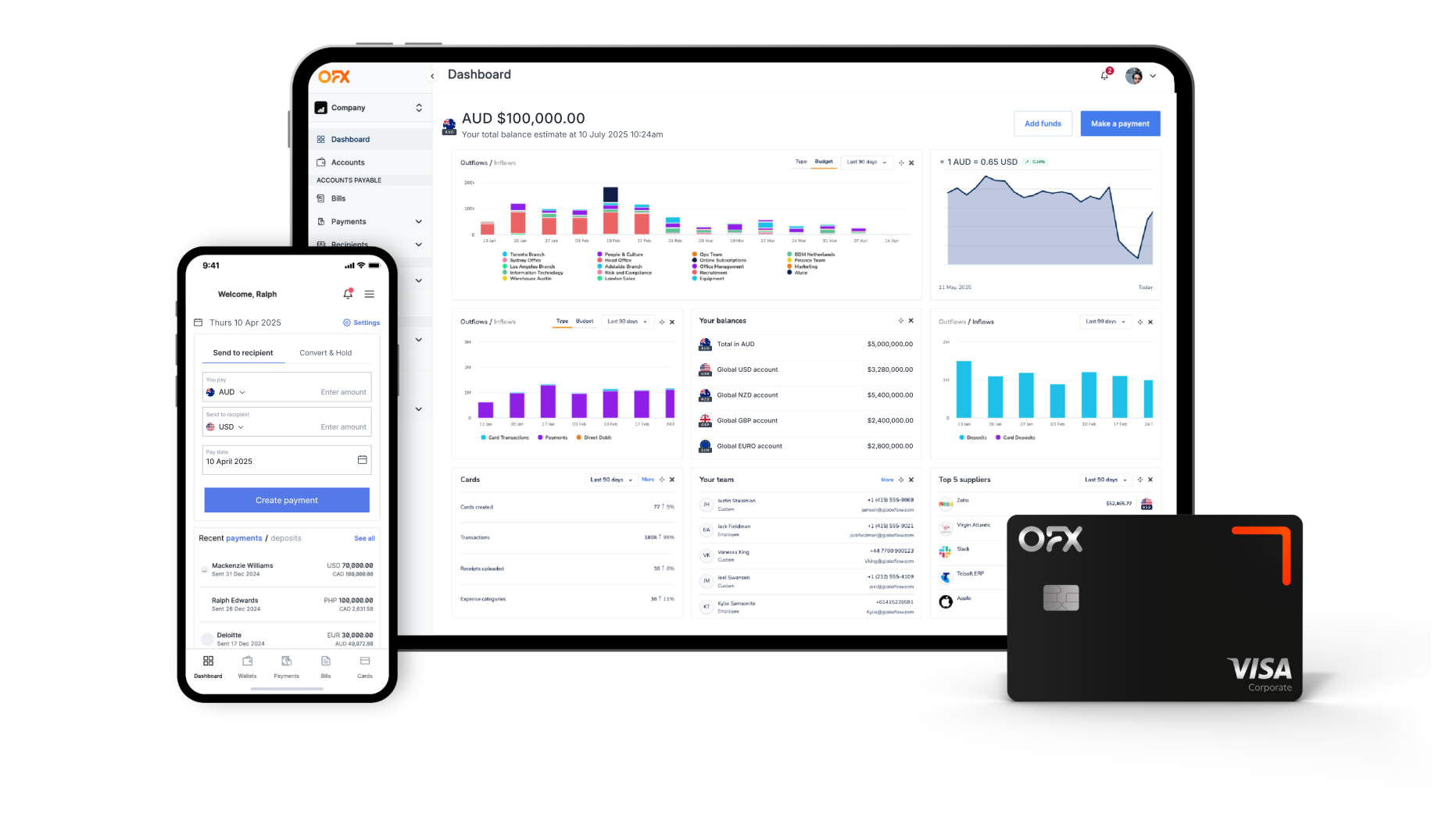
OFX Multi-currency Account
Receive, hold, convert and send funds across a wide range of currencies, reduce costs and gain greater control over your international payments.
Benefits of foreign currency accounts for business
A well-chosen foreign currency account can give your business a real competitive edge. Here are 6 key benefits:
- Save on currency conversion fees by holding funds in foreign currencies and avoiding repeated conversions every time you make or receive a payment.
- Hold multiple currencies in one account so you can manage your global cash positions without juggling separate bank accounts in each country.
- Greater control over exchange rate timing lets you convert funds when rates are favourable rather than being forced into conversions at the point of each transaction.
- Faster international payments through local payment rails and digital-first platforms, reducing delays compared to traditional SWIFT-based bank transfers.
- Simplified global cash flow management with a centralised view of your balances across currencies, making forecasting and reconciliation significantly easier.
- Access to risk management tools such as Forward Contracts and Limit Orders, which help you protect your margins against currency volatility.
Best foreign currency accounts in Australia 2026
Choosing the right provider can make all the difference when managing foreign currency. Here’s an overview of some of the most popular bank and digital-first account options:
Compare foreign currency accounts
| Provider | Currencies available | Monthly account fee | Setup required | Additional fees | Business suitability |
|---|---|---|---|---|---|
| OFX1 | 30+ currencies | $0 | Online. | No international transaction or conversion fees when paying in or receiving AUD, NZD, USD, CAD, GBP, EUR using local account details. Others margin on FX rates. | Ideal for small to medium-sized businesses; no minimum balance required. |
| Commonwealth Bank2 | 14 currencies | $0* per month (*minimum deposit and age rules apply). | In branch or online. | International transaction fee to send $30, to receive $11, margin on FX rates. | Best for customers already banking with CBA. |
| Westpac3 | 12 currencies | $12 per month. | In branch. | International transaction fee to send $20, to receive $12, margin on FX rates. | Suitable for businesses with low-volume needs. |
| NAB4 | 19 currencies | $0 | In branch or online. | International transaction fee to send $30, to receive $15, margin on FX rates. | Strong support for importers and exporters. |
| ANZ5 | 11 currencies | $0 | In branch. | International transaction fee to send up to $28, to receive $15, margin on FX rates. | Best for businesses transacting with Asia-Pacific. |
| HSBC6 | 9 currencies | $0 | Online. | No international transaction fee, margin on FX rates. | Suitable for businesses with UK or EU clients. |
| Wise | 40+ currencies7 | $0 | Online. | AUD 65 one-time setup fee, 0.63% conversion fee8 (varies by currency pair), mid-market rate. | Good for businesses with frequent low-value transfers. |
| Airwallex | 20+ hold currencies9 | A$0–999/month10 (Starter plan free with A$5K monthly deposit or A$10K balance) | Online | Interbank FX rates with margin, payment fees vary by corridor. | Suited to high-growth e-commerce and tech businesses. |
| WorldFirst | 15+ currencies11 | $0 | Online | Cross-border fees from 0.4% capped at AUD 1512 zero receiving fees. | Popular with marketplace sellers and importers. |
Overview of the best foreign currency accounts.
OFX
OFX offers 30+ currencies with $0 monthly fees1 on the Standard plan, no minimum balance, and online setup in under 10 minutes. Businesses also get access to Corporate Cards, Forward Contracts for managing FX risk, and 24/7 human support. Local account details in AUD, USD, GBP, EUR, CAD, and NZD means your clients can pay as if you’re a local.
Commonwealth Bank
CommBank offers foreign currency accounts in 14 currencies2 with no monthly fee (subject to minimum deposit and age rules). International transaction fees of $30 to send and $11 to receive apply2. Setup can be completed in branch or online, making it a straightforward option for businesses that already bank with CBA.
Westpac
Westpac provides foreign currency accounts in 12 currencies with a $12 monthly account fee3. Sending internationally costs $20 per transaction and receiving costs $12. Account setup requires a branch visit, which may suit businesses that prefer face-to-face support.
NAB
NAB supports foreign currency accounts in 19 currencies with no monthly fee. International transaction fees are $30 to send and $15 to receive4. NAB offers both in-branch and online setup, with particular strengths for importers and exporters.
ANZ
ANZ offers foreign currency accounts in 11 currencies5 with no monthly fee. Sending fees are up to $28 and receiving fees are $15 per transaction. Account setup requires a branch visit. ANZ is a solid option for businesses transacting within the Asia-Pacific region.
HSBC
HSBC provides foreign currency accounts in 9 currencies with no monthly fee and no international transaction fees6. A margin on FX rates applies. Online setup makes it accessible, and it’s a natural fit for businesses with UK or EU clients.
Wise
Wise supports 40+ currencies7 with no monthly fee and a one-time setup fee of AUD 658. Conversion fees start at around 0.63% and vary by currency pair. Wise uses the mid-market exchange rate with no additional markup. A Mastercard debit card is available for spending from held balances.
Airwallex
Airwallex lets businesses hold 20+ currencies9 with plans ranging from A$0 to A$999 per month10 (the Starter plan is free when you maintain an A$5K monthly deposit or A$10K balance). Airwallex uses interbank FX rates with a margin and offers Visa corporate cards. It’s well suited to high-growth e-commerce and tech businesses.
WorldFirst
WorldFirst supports 15+ currencies11 with zero monthly fees and zero receiving fees. Cross-border payment fees start at 0.4% and are capped at AUD 1512 per transaction. Businesses can issue up to 20 World Cards for team spending. WorldFirst is particularly popular with marketplace sellers and importers.
While major banks may offer foreign currency accounts, they often require separate accounts for each currency. Additionally, they may charge a monthly account fee, conversion fees, or impose minimum balance requirements.
If you want to reduce fees, speed up transactions, and manage multiple currencies from one account, digital-first options like OFX are worth exploring.
How do I compare foreign currency accounts in Australia?
Businesses need to consider account features like the number of supported currencies, the flexibility of the platform, any monthly fees, access to multi-currency debit cards and whether the account is easy to open and maintain.
- Monthly fees – Monthly fees vary widely. Some accounts waive them based on minimum balances, while others charge regardless. Check the fee structure to avoid unexpected costs.
- International transaction fees and other costs – Watch for hidden costs like fees for sending, receiving, or holding funds. These can add up quickly, so review all account activity charges before signing up.
- Currency conversion rates – Many banks apply a markup on exchange rates. Compare rates and look for providers offering rates closer to the interbank rate to save more on every conversion.
- Minimum account balance – Some banks require a minimum balance to open or maintain the account. Review your cash flow to see if it can meet these requirements to avoid penalties or account closure.
- Security – Choose a provider with strong security features like two-factor authentication, fraud monitoring, and regulatory oversight.
- Money transfer speed – Delays can impact operations. Look into how long it takes for payments to clear, both incoming and outgoing. Being able to send payments and get support outside of banking hours is particularly important in times of high volatility.
- Multi-currency debit cards – Not all foreign currency accounts offer a linked debit card. If you need one for spending in multiple currencies, confirm availability before opening the account.
- 24/7 support – Reliable customer support matters, especially when dealing with cross-border transactions. Check for 24/7 access, business account specialists, and fast resolution times.
How FX works with foreign currency accounts
Understanding how foreign exchange works with your account helps you make better decisions and keep more of your money.
- Spot rate vs provider markup: The interbank (or mid-market) rate is the benchmark rate banks use between themselves. Most providers add a markup on top of this rate, which is how they earn revenue on conversions. Comparing this markup across providers is one of the most effective ways to lower your FX costs.
- Local payment rails vs SWIFT: Traditional bank transfers often use the SWIFT network, which can involve intermediary banks and additional fees. Digital-first providers frequently use local payment rails, routing payments through domestic banking networks in each country for faster, cheaper delivery.
- Holding and converting at the right time: Multi-currency accounts let you receive funds in a foreign currency and hold them until rates move in your favor. This flexibility means you can choose when to convert rather than accepting the rate at the moment of each transaction.
- Instant conversion between held balances: Many platforms allow you to convert between currencies you hold within your account in real time, giving you greater control over your global cash positions.
Fees to watch out for
Foreign currency accounts can carry several types of fees. Knowing what to look for helps you avoid surprises and choose a provider that fits your business.
- Monthly account fees: Some providers charge a flat monthly fee regardless of activity. Others waive fees based on minimum balances or deposit thresholds. Check whether the fee applies per account or per currency.
- International payment and transfer fees: Per-transaction charges for sending or receiving funds internationally can range from $0 to $30 or more. These add up fast for businesses making frequent cross-border payments.
- FX conversion markups: The difference between the interbank rate and the rate you receive is often the largest hidden fee. Even a small markup of 1–2% on large transfers can cost thousands over a year.
- Card fees and international transaction fees: If your account includes a multi-currency card, check whether cross-border transactions carry additional surcharges when spending in currencies you don’t hold.
- Holding or deposit maintenance fees: Some banks charge fees for maintaining balances in certain currencies or for accounts that fall below a required minimum.
What currencies are usually available for Australians in foreign currency accounts?
Most foreign currency accounts offer popular currencies such as:
- US dollars (USD)
- British pounds (GBP)
- Euros (EUR)
- Japanese yen (JPY)
- Canadian dollars (CAD)
- New Zealand dollars (NZD)
- Swiss francs (CHF)
- Hong Kong dollars (HKD)
- Singapore dollars (SGD)
- Chinese yuan (CNY)
The exact selection depends on the provider. Traditional banks tend to offer between 9 and 19 currencies, while digital-first platforms can support significantly more.
OFX, for example, provides access to 30+ currencies through the Multi-Currency Account, giving your business broader reach across global markets.
What is the eligibility for a foreign currency account?
Eligibility depends on the provider, but most foreign currency accounts in Australia require:
- A valid ABN (Australian Business Number) or ASIC registration
- Proof of identity for directors and beneficial owners
- Business address in Australia
- Completed identity verification (typically online)
Some banks may impose additional requirements such as minimum opening deposits, existing banking relationships, or in-branch appointments.
Digital-first providers like OFX typically have simpler eligibility criteria. You can register online and download the OFX Business App to manage your account from anywhere.
How to open a foreign currency account
Opening a foreign currency account is straightforward with most providers. Here’s the general process:
- Choose a provider that matches your currency, fee, and feature requirements.
- Complete the application online or in branch, depending on the provider. Digital-first platforms like OFX let you complete registration in under 10 minutes.
- Verify your identity by providing required documents (ID, ABN, business details).
- Fund your account and begin holding, sending, or receiving payments in your chosen currencies.
If you’re looking to open a USD account in Australia, most digital-first providers allow this entirely online without needing a US address. OFX, Wise, Airwallex, and WorldFirst all support USD accounts for Australian businesses.
Why OFX stands out for business
The OFX Multi-Currency Account is built for businesses that want to manage global payments, hold funds in 30+ currencies, and reduce FX costs from a single platform.
Here’s what’s included:
- Standard plan1: $0/month with access to multi-currency wallets, corporate cards and batch payments.
- Full Suite plan1: $75/month with advanced spend management features including forward contracts, expense management and AP automation.
- 30-day free trial on the Full Suite plan so you can explore every feature before committing.
- 24/7 support from real people: Get help when you need it, with human support available around the clock.
- Accounting Integration with Xero and QuickBooks for seamless reconciliation.
Check OFX pricing for full plan details, or request a demo to see the platform in action.
Best foreign currency account FAQs
How do foreign currency accounts work?
Foreign currency accounts let you hold, send, and receive funds in currencies other than AUD. The core mechanics are:
- You deposit or receive funds in a foreign currency and hold them without automatic conversion.
- You choose when to convert between currencies based on prevailing exchange rates.
- You send payments to international recipients directly from your foreign currency balance.
Some providers also offer tools like Forward Contracts and Limit Orders to help you manage rate fluctuations.
How are foreign currency accounts different to regular bank accounts?
A regular Australian bank account holds AUD and converts foreign payments automatically at the bank’s exchange rate, which typically includes a markup. A foreign currency account lets you hold funds in specific currencies, giving you control over conversion timing. Unlike standard savings or term deposit accounts, foreign currency accounts are designed for transactional use across borders, not for earning interest on deposits.
Which banks have foreign currency accounts in Australia?
Major banks offering foreign currency accounts include Commonwealth Bank (14 currencies), NAB (19 currencies), Westpac (12 currencies), ANZ (11 currencies), and HSBC (9 currencies). Digital-first providers like OFX (30+), Wise (40+), Airwallex (20+), and WorldFirst (15+) also serve Australian businesses with broader currency access and lower fees.
What are the top foreign currency accounts in Australia in 2026?
Based on currency range, fees, and features, the top foreign currency accounts for Australian businesses in 2026 include OFX, Wise, Airwallex, WorldFirst, Commonwealth Bank, NAB, Westpac, and ANZ. Digital-first providers tend to offer more currencies, lower monthly fees, and online setup, while traditional banks may suit businesses that prefer in-branch support.
Which Australian bank has no international fees?
Several banks offer fee-free international transactions in specific scenarios. HSBC charges no international transaction fees on its Everyday Global Account, though a margin on FX rates still applies. CommBank waives transfer fees between linked CommBank accounts. For consistently low international fees across a wide range of currencies, digital-first providers like OFX are worth comparing.
Can I open a USD account in Australia?
Yes, multiple providers allow you to open a USD-denominated account from Australia entirely online, without needing a US address or visiting a branch. OFX, Wise, Airwallex, and WorldFirst all support USD accounts with local US account details, meaning your American clients can pay you as if you’re based in the US.
Is it worth having a foreign currency account?
For businesses that regularly pay or receive funds in currencies other than AUD, a foreign currency account can significantly reduce conversion fees and give you more control over exchange rate timing. If your business makes even a handful of international payments each month, the savings on FX markups and per-transaction fees can be substantial.
Who cannot open a business foreign currency account in Australia?
Providers may decline applications from businesses in high-risk industries (such as gambling or unregulated crypto), businesses without valid ASIC registration or an ABN, or applicants who fail identity verification requirements. Sole traders and individuals may also face restrictions depending on the provider’s eligibility criteria.
Do I need a separate foreign currency account for each currency?
Traditional banks typically require a separate account per currency, each with its own monthly fee and management requirements. Digital-first multi-currency platforms like OFX let you hold 30+ currencies under a single account login, making it far simpler to manage global payments and balances.
Looking for an alternative to your bank?
References
- https://www.ofx.com/en-au/business/pricing/
- https://www.commbank.com.au/content/dam/commbank/personal/apply-online/download-printed-forms/ADB1784.pdf
- https://www.westpac.com.au/content/dam/public/wbc/documents/pdf/bb/international-service-fees.pdf
- https://www.nab.com.au/important-information/business/banking-fees-charges#5-international-payments
- https://www.anz.co.nz/rates-fees-agreements/foreign-exchange-international/
- https://www.hsbc.com.au/content/dam/hsbc/au/docs/accounts/transaction-savings-terms-and-conditions.pdf
- https://wise.com/au/business/account
- https://wise.com/au/pricing/
- https://www.airwallex.com/au/business-account
- https://www.airwallex.com/au/pricing
- https://www.worldfirst.com/au/business/multi-currency-account/
- https://www.worldfirst.com/au/pricing/
In Australia, OFX is registered as a financial service provider and regulated by ASIC (AFS Licence number 226 484). OFX is not a bank, and so you are not protected by the Financial Claims Scheme when you send money with OFX. Learn more about how OFX keeps your money and information secure here.
IMPORTANT: The contents of this blog do not constitute financial advice and are provided for general information purposes only without taking into account the investment objectives, financial situation and particular needs of any particular person. OzForex Limited (trading as “OFX”) and its affiliates make no recommendation as to the merits of any financial strategy or product referred to in the blog. OFX makes no warranty, express or implied, concerning the suitability, completeness, quality or exactness of the information and models provided in this blog.