Finance leaders already manage budgets, suppliers, and cash flow with precision. FX strategy is not about fixing mistakes. It’s about adding another layer of control to international payments so fewer variables are left to chance.
Foreign exchange often runs quietly in the background of finance operations. Payments are made, invoices are settled, and currency is converted as needed. But as global activity increases, that background process can start to introduce hidden costs, forecasting noise, and unnecessary operational effort.
An FX strategy brings clarity. It helps finance teams manage international payments with intention, not urgency, and gives leaders greater confidence in how currency impacts performance.
What is an FX strategy?
An FX strategy is often misunderstood as something complex or reserved for treasury teams at large multinationals. In reality, it is simply a structured approach to managing how currency movements affect your business.
At its core, an FX strategy defines:
- How and when you convert currency
- How you protect against adverse movements, and
- How you align FX decisions with broader financial goals.
Without a strategy, FX decisions tend to be reactive. Payments are made when invoices are due. Conversions happen at spot rates. Exposure multiplies quietly across months and currencies.
A defined FX strategy introduces consistency. It sets clear rules for managing risk, choosing conversion timing, and deciding when protection tools like Forward Contracts* make sense.
An FX strategy doesn’t eliminate volatility, but it gives finance leaders confidence that currency risk, and your budget, is being managed deliberately rather than left to chance.
Get started today. The saving lasts forever.
You have nothing to lose, and so much time and money to save. Your all-in-one control platform is ready.
Why FX risk is growing for finance teams.
Currency volatility is no longer an occasional disruption. It has become a constant pressure that quietly affects budgeting, forecasting, and cash flow planning. As businesses expand globally, FX risk touches more parts of the finance function than ever before.
Global supply chains, international payroll, overseas customers, and foreign currency expenses all increase exposure. Even small percentage movements can compound into material impacts on margins over time. Add rising interest rate divergence and geopolitical uncertainty, and month-end results can become harder to explain and forecasts harder to trust.
These pressures rarely show up as a single, obvious problem. Instead, FX challenges tend to surface gradually across workflows, systems, and reconciliation processes. Here are some common pain points and the opportunities they create for FX strategy:
- FX is often handled ad hoc: Payment decisions are made in isolation. Convert now. Pay now. Move on. Over time, this creates fragmented exposure across suppliers, currencies, and payment dates.|
Opportunity: Create a holistic view of FX exposure across the business.
- Timing creates hidden costs: Delays between placing an order and settling a payment can expose budgets to negative rate movements. Without forward-looking visibility, these costs often come as a surprise.
Opportunity: Plan FX timing alongside cash flow needs.
- Multiple tools, scattered data: ERPs, bank portals, and spend management tools each hold part of the FX picture. When information is siloed, forecasting accuracy and risk management suffer.
Opportunity: Create a single view of FX without replacing existing systems.
- Reconciliation effort inflates the true cost of FX: Every conversion adds manual reconciliation work, increasing operational effort well beyond the exchange rate itself.
Opportunity: Reduce transaction volume and simplify reporting.
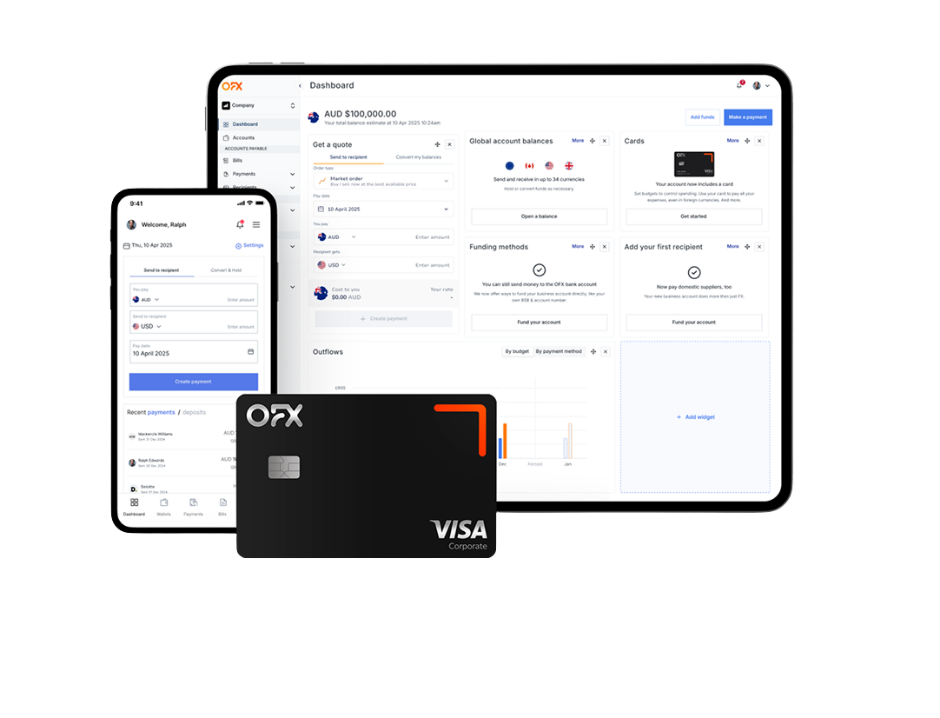
Tools like OFX’s Global Business Account can reduce friction and costs when moving money globally, but without an overarching FX strategy, exposure can still accumulate in the background.
Building a practical FX strategy with OFX.
A good FX strategy should support how your business actually operates. It should be simple enough to maintain and flexible enough to scale as your needs evolve.
OFX helps finance leaders build practical FX strategies through a combination of competitive rates, risk management tools, and visibility across currencies.
A practical framework for building an FX strategy
Step 1: Review and audit your FX exposure
Start by identifying where your profits are most exposed to currency movements. Look across suppliers, customer receipts, recurring payments, and future obligations. Group payments by frequency, size, and risk. Determine which are candidates for Spot Transfers, Multi-currency accounts, or Forward Contracts*. This early segmentation helps highlight where flexibility is sufficient and where greater certainty may be required. Highlight where exchange rates are applied or locked.
Step 2: Set clear objectives
Once exposure is clear, define what you are trying to achieve. Some finance leaders focus on protecting forecast accuracy. Others focus on margin protection, cost predictability, or reducing reconciliation effort. What is your top priority?
Step 3: Develop an FX strategy
With goals established, build a simple plan that combines the right mix of tools to reduce currency exposure and create greater certainty around profit margins. This may include a blend of spot transfers for flexibility, Forward Contracts to lock in rates for future payments, and multi-currency accounts to reduce repeated conversions. The objective is not to eliminate all risk, but to manage it intentionally.
Step 4: Execute with the right tools and refine
Implement the right combination of hedging and payment tools to support your goals.
- Forward Contracts* to lock in exchange rates for future payments and protect margins.
- Multi-currency accounts to hold, receive, and pay funds in local currencies without unnecessary conversions.
- Global Business Account to support consolidated visibility across payments, exposures, and settlement dates through one platform.
These tools work together to reduce uncertainty and give finance teams greater control over timing and outcomes. FX strategy is not a one time decision. Regular assessment ensures your approach continues to support growth, supplier changes, and shifting market conditions.
Access to 30+ currencies directly linked to your business account, reducing unnecessary exchange conversions when you spend in those currencies.
Reducing friction in everyday spending.
FX risk does not only come from large payments. Everyday spending in foreign currencies can quietly erode value through repeated conversions and fees.
OFX Corporate Cards allow businesses to spend in over 30 currencies directly from their business account. This reduces unnecessary conversions when paying suppliers, travel expenses, or subscriptions in local currencies.
Consider this scenario: your business operates outside the United States and in Australia. You receive a monthly US$10,000 invoice from a global provider, such as Meta, which you pay directly.
In February 2026, the AUD/USD market was highly volatile due to new tariff announcements, and the market rate dropped from US$0.62 to as low as US$0.5950.
Continuing with a Spot Transfer (i.e. paying for this invoice directly at the time) with the market rate at 0.5950, would’ve cost AU$16,806.72.* By locking in 0.62 ahead of time with a Forward Contract, it would’ve cost AU$16,129.03*, saving $678.
If you’re managing recurring USD payments, the impact of volatility compounds quickly. Over a year, this market rate could cost your business more than AU$8,100 extra on the same US$120,000 monthly invoices.
*The cost comparison is based on the Market Rate for demonstration purposes only. Client Spot Transfers use OFX’s guaranteed rate and this combined with other factors such as different currency exchange amounts, currency types, dates and times will result in different actual costs.
By aligning spending with currency holdings, finance teams gain clearer oversight of FX exposure and reduce avoidable costs. Managing FX at the transaction level is just as important as managing it at the strategic level.
Turning FX from risk into insight.
An effective FX strategy creates visibility, not just protection. It helps finance leaders explain outcomes and make better forward-looking decisions.
With OFX, finance teams can see upcoming exposures, track historical rates, and align FX decisions with cash flow forecasts. This turns FX from a reactive task into a source of insight that supports planning and stakeholder confidence.
When FX is visible and understood, it becomes easier to manage and easier to justify at board level.
A strategy that scales with your business.
As businesses grow, FX exposure rarely stays static. New markets, suppliers, and revenue streams introduce new currencies and new risks.
OFX is designed to scale alongside your business. Whether you are making occasional international payments or managing complex multi-currency flows, the same platform adapts to your needs without adding operational burden.
A scalable FX strategy ensures growth doesn’t come with unnecessary financial stress.
Completing your finance toolbox.
FX volatility is not going away, and finance leaders already know that. What can change is how much time, effort, and uncertainty it introduces into day-to-day decision-making.
A clear FX strategy brings structure to that uncertainty. It helps protect margins, support more reliable forecasts, and reduce surprises across international payments, without adding unnecessary complexity. With OFX, finance teams can manage currency exposure deliberately and confidently, using tools that fit naturally alongside existing processes.
The result is not just better FX outcomes, but greater control, clarity, and peace of mind. A stronger finance function starts with a more complete toolbox.
*If you book a Forward Contract, it may mean losing out if the market rate improves because you’re contracted to settle at the agreed rate. Read more.
*Forward Contracts are not available for personal clients in Hong Kong. If you book a Forward Contract, it may mean losing out if the market rate improves because you’re contracted to settle at the agreed rate. Read more. Terms and conditions apply.