
Key takeaways
- A$0 monthly fee business accounts are available from Australia’s Big Four banks and several fintechs, but transaction fees, ATM charges, and foreign exchange costs can affect the total cost.
- The best no fee account depends on how your business operates. Businesses that regularly handle cash may value bank branch access, while digital-first businesses may prefer an online provider like OFX or Zeller.
- Some Australian businesses use more than one provider for example, a bank for cash handling and a specialist provider for payments, cards or foreign exchange.
Managing cash flow is challenging enough without unnecessary banking costs. This guide compares the best no fee business accounts available in Australia in 2026, from the Big Four banks to non-bank providers and fintechs, to help you can find an option that matches your businesses needs and preferences.
Jump to:
• What the best no fee business accounts have in common (and the fees to know)
• Best no fee business accounts in Australia compared (2026)
• Is a “no fee” business account really free? Hidden costs to watch
• Which no fee account is right for your business?
• How to choose the right no fee business account
• Why consider OFX (on its own or alongside your bank)
• FAQs about the best no fee business bank accounts
What the best no fee business accounts have in common (and the fees to know)
The best no fee business accounts (sometimes called a free business account or business transaction account) share one thing in common: no monthly account-keeping fee. It’s important to keep in mind that a A$0 per month does not necessarily mean there are no other costs involved.
Business accounts can carry several types of fees. The monthly or account-keeping fee is the one you see advertised. Transaction fees apply per payment. Electronic transfers are usually free, but assisted or in-branch transactions can be charged at an additional cost. For example, select Big Four products typically charge between A$2.501 to A$52 for certain staff-assisted transactions.
International and foreign exchange (FX) fees apply when you pay overseas suppliers or receive foreign revenue, and traditional banks tend to charge a percentage on every card transaction and conversion. ATM fees, paper-statement fees, and minimum-balance conditions round out the picture.
With around 2.73 million actively trading businesses in Australia, about 97.3% of them small businesses,3 a no monthly fee business account is what many SME’s consider when starting out.
Best no fee business accounts in Australia compared (2026)
If you’re hunting for the best best business bank account with no ongoing monthly fees, the table below compares several A$0-monthly options across Australia’s major banks and leading fintechs.
| Provider | Monthly fee | Assisted/in-branch fee | Corporate Card | Accounting integration | Branch/cash access | International transfer & card fees | Best for |
|---|---|---|---|---|---|---|---|
| NAB Business Everyday | A$04 | A$3 for certain assisted transactions; additional cheque/item fees may apply4 | Yes | Xero, QuickBooks Online | Yes | 3% international card transaction fee; international-transfer fees vary by method4 | Businesses wanting digital banking with branch access |
| CommBank Business Transaction | A$0 option available2 | A$5 for certain assisted transactions2 | Yes | Xero, QuickBooks Online | Yes | 3.5% international transaction fee on relevant card transactions2 | Large branch network |
| Westpac Business One | A$05 | Staff-assisted A$35 | Yes | Xero, QuickBooks Online | Yes | 3% foreign transaction fee where applicable; 2.2% in specified Australian-processed foreign-currency circumstances6 | Businesses needing overdraft options |
| ANZ Business Essentials | A$01 | A$2.50 for specified staff-assisted transactions1 | Yes | Xero, QuickBooks Online | Yes | 3% international transaction fee on relevant card transactions;1 some international-transfer methods attract separate fees18 | Businesses that occasionally need branch assistance |
| Zeller Transaction Account | A$08 | n/a (digital only) | Yes | Xero QuickBooks Online | No | AUD only account. FX margin charged on international purchases. Invoice payments received from international cards incur a fee of 2.9% + 25c (incl. GST) per transaction. | Domestic-first digital businesses |
| Wise Business | A$0 (A$65 one-off)9 | n/a (digital only) | Yes | Xero, QuickBooks Online | No | Sending and conversion fees vary by currency, from 0.63%11to 2%12by route; card spend in a currency already held is free⁸ | Businesses making simple money transfers |
| Airwallex Explore | A$0 (conditional)10 | n/a (digital only) | Yes | Xero, QuickBooks Online | No | FX margin 0.50%–1.00%; SWIFT A$10–A$309 | Ecommerce businesses |
| OFX (Standard plan) | A$011 | n/a (digital only) | Yes | Xero, QuickBooks Online | No | A$10 SWIFT fee; A$0 foreign transaction fee on OFX Corporate Card purchases, with a 1.50% FX margin where conversion is required10 | Businesses looking for multi-currency payments and corporate cards at A$0 |
Note: Revolut Business does not currentlyoffer a A$0 tier in Australia. Plans start from A$15/month at the time of writing11.
Provider snapshots
- NAB Business Everyday: An A$0-monthly-fee banking option with electronic banking and access to NAB’s branch network. Certain assisted transactions attract fees.⁴
- CommBank Business Transaction: Offers an A$0 monthly account option alongside branch access. Its A$5 assisted-transaction fee is the highest among the four Big Four products compared in this article.²
- Westpac Business One: Offers an A$0 monthly account fee and access to banking services including overdraft options, subject to eligibility and approval. Staff-assisted and certain international transactions can attract additional charges.⁵
- ANZ Business Essentials: Charges A$2.50 for specified staff-assisted transactions—the lowest such fee among the four Big Four products compared here.¹
- Zeller Transaction Account: An online business account with an A$0 monthly account fee, unlimited transfers at A$0 and Xero integration.⁷
- Wise Business: Designed for businesses that hold, receive and convert multiple currencies. Wise states that it uses the mid-market exchange rate and currently charges currency-conversion fees from 0.63%. An A$65 one-off setup fee applies for Wise Business features.⁸
- Airwallex Explore: The monthly fee can be waived where the business meets Airwallex’s applicable eligibility requirements. Its published international payment pricing varies by payment method and currency.⁹
- OFX: The Standard plan is A$0 month and includes a Global Business Account, corporate cards, Xero and QuickBooks Online bank feeds, and the ability to receive, hold and pay in 30+ currencies.¹⁰
Is a “no fee” business account really free? Hidden costs to watch
Not necessarily. An A$0 monthly account fee is only one part of the total cost.
For domestic banking: Assisted and in-branch transaction fees are the most common hidden cost. These range from A$2.50 at ANZ1 to A$5 at CommBank2.
Some banks also charge for over-the-counter and telegraphic-transfer transactions. Out-of-network ATM fees, paper-statement charges, and minimum-balance conditions also apply at some providers.
For international payments: FX costs are where traditional banks quietly make money. The Big Four charge a percentage on foreign card transactions, from 3%7 to 3.5%.2
Certain international-transfer methods can also attract fixed fees. The applicable charge can differ depending on the provider, payment method and currency.¹⁷ ¹⁸
Because pricing structures vary between providers and payment types, businesses should compare the total cost of the transaction, including the exchange rate and fees, rather than relying on a single headline fee.
The lowest-cost option therefore depends on your transaction mix. A business operating primarily online and domestically may pay relatively little using an A$0-monthly-fee account. A business regularly making international payments should pay particular attention to exchange rates, FX costs and transfer fees.
Fintech vs traditional bank: which suits you?
Traditional banks may have the upper hand on branch access, cash handling, and deposit protection. Funds held with an authorised deposit-taking institution (ADI) are protected by the Financial Claims Scheme (FCS) up to a capped amount per account holder.¹⁹ Banks may also offer overdrafts and business lending products.
Fintechs may have the upper hand on fees, apps, cards, and foreign exchange. Many fintechs have no monthly fees, no minimum balances, and exchange-rate margins that sit well below what traditional banks build into their card and conversion fees. Their apps tend to be faster and more feature-rich. The non-bank share of SME lending in Australia has increased strongly since the start of 2022, particularly for smaller loans, according to the Reserve Bank of Australia.13
Some businesses choose to use both types of provider for example, an ADI for cash handling and other banking services, alongside a specialist provider for international payments, cards or FX.
Which no fee account is right for your business?
The best account depends on your business structure, transaction patterns, and where your money moves.
Australian Banking Association data reported A$126 billion in mobile-wallet payments in the 2023 financial year, exceeding ATM cash withdrawals for the first time, a broader indication of Australia’s continuing shift towards digital payments.¹⁴
Customers of Australia’s major banks made A$126 billion in mobile wallet payments in the 2023 financial year, overtaking total ATM cash withdrawals for the first time, according to the Australian Banking Association,15 a sign of how quickly everyday business banking is going digital.
- Sole traders and startups (domestic, cost-first): A Big Four A$0 account (such a sNAB, ANZ) or a domestic fintech like Zeller may work well.
- Established small businesses banking mostly domestically: Look for unlimited free electronic transfers, PayID/Osko, and accounting integration with Xero or QuickBooks Online. Compare applicable transaction fees rather than the monthly fee alone.
- Cash-reliant and branch-dependent businesses: A bank account with appropriate cash-deposit and branch facilities may be more suitable. The non-bank providers compared in this article do not provide a traditional bank branch network.
- Businesses with international suppliers or foreign revenue: Compare mid-market rates, FX margins, and transfer fees. OFX, Wise, and Airwallex all offer lower FX costs than traditional banks.
- The multi-account strategy: Many businesses pair a domestic bank account with a low-fee fintech. Keep the bank account for cash handling and payroll, and use the fintech for supplier payments, corporate cards, and international transfers. For a wider view of the market, see our roundup of the best business bank accounts in Australia.
Best options for international payments and multi-currency
For businesses paying overseas suppliers or receiving foreign revenue, the monthly account fee may represent only a small part of the overall cost.
Key features to compare:
- Mid-market rates + an FX fee vs marked-up exchange rates.
- Local account details (so overseas customers can pay you in their currency)
- Local payment rails vs SWIFT (faster and cheaper).
- Supported currencies and destinations.
- Expected settlement times.
- A dedicated multi-currency account.
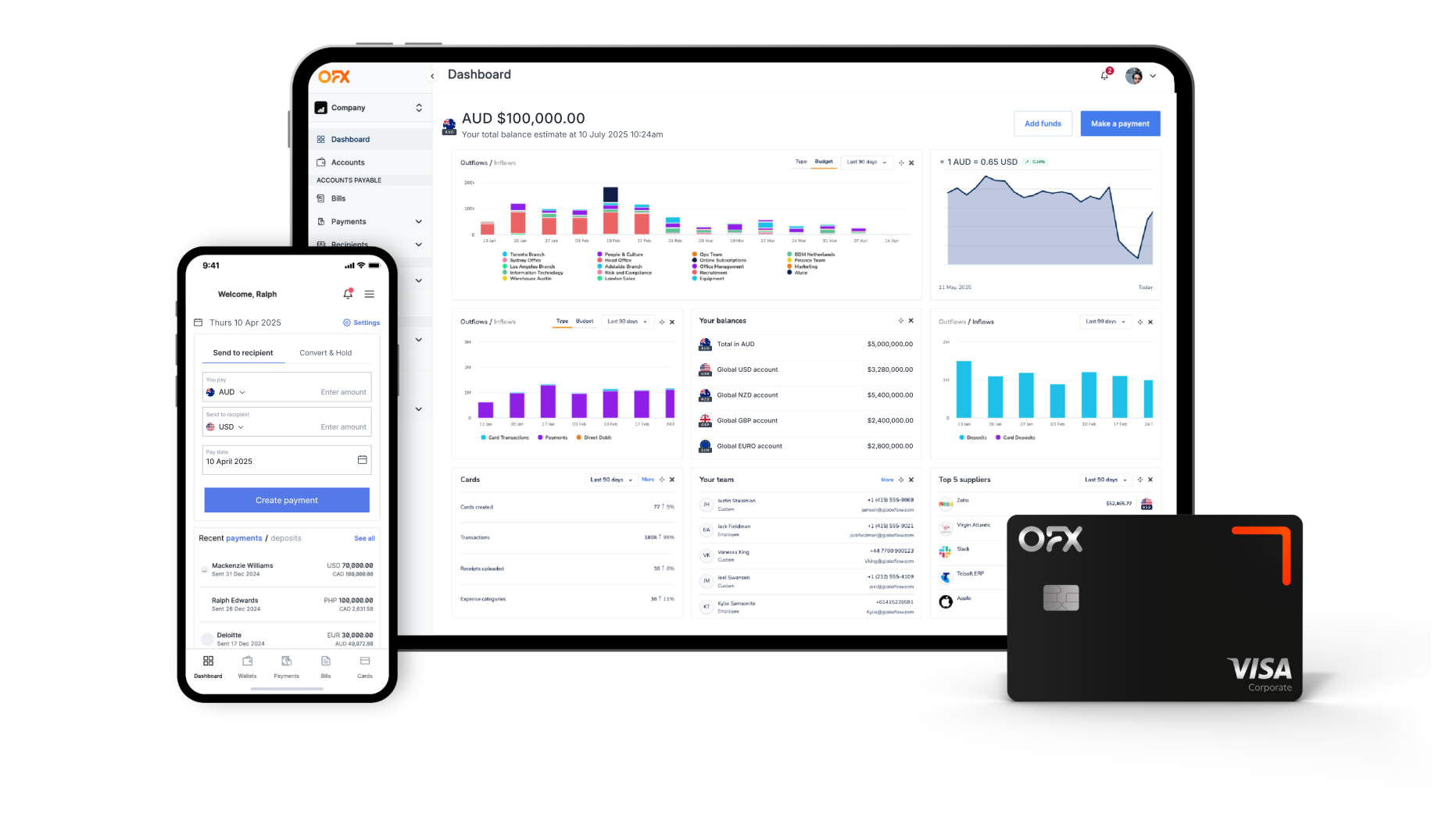
OFX Global Business Account
Receive, hold, convert and send funds across a wide range of currencies, reduce costs and gain greater control over your international payments.
How to choose the right no fee business account
Choosing the best business bank account means looking beyond the monthly fee. A business account no fees promise still needs to match your transaction mix. Consider these factors:
- Total cost: Add up transaction fees, ATM fees, and FX margins based on how you actually bank. A “free” account with high FX costs can be expensive.
- Everyday features: Debit cards and additional cardholders, mobile app quality, PayID/Osko, BPAY, sub-accounts for tracking, and real-time reporting.
- Accounting integration: Direct feeds to Xero or QuickBooks Online could save hours of manual reconciliation.
- Branch and cash access: If you handle cash, check the provider’s cash-deposit facilities rather than assuming an online account will meet this need.
- Overdraft and credit: If you require an overdraft or other credit, compare the credit products available from individual providers. Credit is subject to separate eligibility and approval criteria.
- Support: Check whether support is available 24/7 and whether you can speak to a real person.
- Safety and regulation: Check whether the provider is an ADI or non-ADI, the licences under which it operates, relevant disclosure documents and how customer funds are held.
Do you need a business account?
Partnerships, companies, and trusts must have a separate business account for tax purposes15. Sole traders aren’t legally required to have one, but separating business and personal finances makes bookkeeping and tax time simpler.
How to open an an account:
Most accounts can be opened online with an ABN or ACN, personal ID, and proof of business address. Sole traders and single-director companies typically complete the process in minutes.
Why consider OFX (on its own or alongside your bank)
OFX offers two plans designed for different needs:
Standard (A$0 month, no minimum balance): The free everyday tier includes a Global Business Account, corporate Visa Business Debit cards, and multi-currency payments to 180+ countries in 30+ currencies. Local account details in AUD, USD, CAD, GBP, and EUR let you receive funds like a local.10
Full Suite (A$75/month including 5 users; + A$10/additional user10): Everything in Standard plus enhanced controls, approval workflows, spend management, and Accounts Payable (AP) automation. Designed for finance teams that need visibility and control across multiple users. A 30-day free trial is available.
Both plans offer competitive exchange rates with local rails for faster and cheaper settlement, and 24/7 access to OFX Specialists when you need human support.
OFX works on its own for digital-first businesses that don’t need branch access. It also works alongside a bank account: keep the bank for cash handling, and use OFX for payments, cards, and foreign exchange.
See our business pricing page for more details.
Frequently asked questions about the best no fee business bank accounts
Is a no fee or free business account really free?
Not always. A$0 monthly fee accounts can still charge transaction fees, assisted/in-branch fees, ATM fees, and FX margins on international payments. The total cost depends on how you bank.
Which banks offer A$0 monthly fee business accounts in Australia?
NAB (Business Everyday), CommBank (Business Transaction), Westpac (Business One), and ANZ (Business Essentials) all offer A$0-monthly-fee options. Conditions and transaction fees vary.
Do sole traders need a business bank account?
Sole traders aren’t legally required to have a separate business account. However, partnerships, companies, and trusts must have one for tax purposes15. Even for sole traders, separating business and personal finances makes bookkeeping simpler.
What fees do business bank accounts charge?
Depending on the provider, charges can include monthly account fees, assisted-transaction fees, ATM fees, international transfer charges, card fees and foreign exchange costs.
For the selected Big Four accounts in this article, specified assisted-transaction fees range from A$2.50 at ANZ to A$5 at CommBank.¹ ² Relevant foreign card transaction fees range from 3% to 3.5%.¹ ²
Always check the provider’s current fee schedule because the applicable fee can depend on the account, currency and transaction method.
Can I use more than one business account?
Yes. Many Australian businesses pair a Big Four bank account with a fintech. Keep the bank for cash handling and payroll; use the fintech for payments, cards, spend management, and international transfers.
Which business account is best for international payments?
Look for low FX margins and local payment rails rather than SWIFT. OFX, Wise, and Airwallex all offer lower FX costs than traditional banks.
Are fintech (non-bank) accounts safe?
Regulatory arrangements differ between providers.
Check the provider’s regulatory licences, disclosure documents, customer-fund arrangements and security measures. Also determine whether the product is an eligible deposit with an Australian ADI and therefore potentially covered by the Financial Claims Scheme.¹⁹
What documents do I need to open a business account?
Most providers require an ABN or ACN, personal identification for directors or owners, and proof of business address. Sole traders and single-director companies can usually apply online in minutes.
Looking for an alternative to your bank?
References
- https://www.anz.com.au/content/dam/anzcomau/documents/pdf/transaction-accounts-fees-charges.pdf
- https://www.commbank.com.au/business/bank-accounts/business-transaction-account/rates-and-fees.html
- https://www.abs.gov.au/statistics/economy/business-indicators/counts-australian-businesses-including-entries-and-exits/latest-release
- https://www.nab.com.au/content/dam/nab/documents/rates-and-fees/banking/nab-business-banking-guide-to-fees-charges.pdf
- https://www.westpac.com.au/business-banking/transaction-accounts/business-one/
- https://www.westpac.com.au/business-banking/bank-accounts/debit-card/
- https://www.myzeller.com/au/business-transaction-account
- https://wise.com/au/pricing/business
- https://www.airwallex.com/en-au/terms/fee-schedule
- https://www.ofx.com/en-au/business/pricing/
- https://www.revolut.com/en-AU/business/business-account-plans/
- https://www.ofx.com/en-au/business/global-business-account/
- https://www.rba.gov.au/publications/bulletin/2025/oct/pdf/small-business-economic-and-financial-conditions.pdf
- https://www.ausbanking.org.au/wp-content/uploads/2024/06/Bank-On-It-Report-2024.pdf
- https://business.gov.au/finance/set-up-your-finances/set-up-your-business-bank-account
- https://www.ofx.com/en-au/faqs/will-my-money-be-safe/
- https://www.nab.com.au/important-information/personal/international-transfers-terms-conditions
- https://www.anz.com.au/content/dam/anzcomau/documents/pdf/anz-business-general-service-fees-charges.pdf
- https://www.apra.gov.au/financial-claims-scheme-banks-building-societies-and-credit-unions
In Australia, OFX is registered as a financial service provider and regulated by ASIC (AFS Licence number 226 484). OFX is not a bank, and so you are not protected by the Financial Claims Scheme when you send money with OFX.
Learn more about how OFX keeps your money and information secure here.
IMPORTANT: The contents of this blog do not constitute financial advice and are provided for general information purposes only without taking into account the investment objectives, financial situation and particular needs of any particular person. OzForex Limited (trading as “OFX”) and its affiliates make no recommendation as to the merits of any financial strategy or product referred to in the blog. OFX makes no warranty, express or implied, concerning the suitability, completeness, quality or exactness of the information and models provided in this blog.