
Key takeaways
- Corporate cards give a business real-time spend visibility, built-in controls, and no out-of-pocket employee reimbursements.
- The best business corporate cards balance monthly fees, FX cost, rewards, spend controls, and whether you want a debit, charge, or credit product.
- The OFX Corporate Card is a multi-currency Visa Business Debit Card inside a connected platform, with spend controls, virtual and physical cards, and Xero and QuickBooks Online sync.
For many Australian finance teams, keeping company spend under control means wrangling personal cards, paper receipts, and unexpected foreign transaction fees. This guide compares the best business corporate cards in Australia for 2026 to help you find spend control, rewards, real-time visibility, and multi-currency spending.
Jump to:
• What are business corporate cards, and how do they work?
• The best business corporate cards in Australia
• Compare the best business corporate cards: fees and features
• How to choose the right corporate card for your business
• Why finance teams choose OFX for corporate cards
• FAQs about the best business corporate cards
What are business corporate cards, and how do they work?
The best business corporate cards are payment cards issued to a business or its employees for work spending. The company, not the individual, is responsible for the balance. In plain terms, a commercial card is a business debit or credit card issued to a company or its employees to buy goods and services for work.
In practice, you set a card up under the business, assign it to a person or a purpose, and give it a spending limit. Transactions flow into one view. Finance teams can track spend in real time and reconcile it against the accounting system at month-end.
The first decision is the repayment model: a credit line you pay back later, or a debit card that draws on money you already hold. That choice shapes your cost, your risk and your reconciliation work more than the brand on the card.
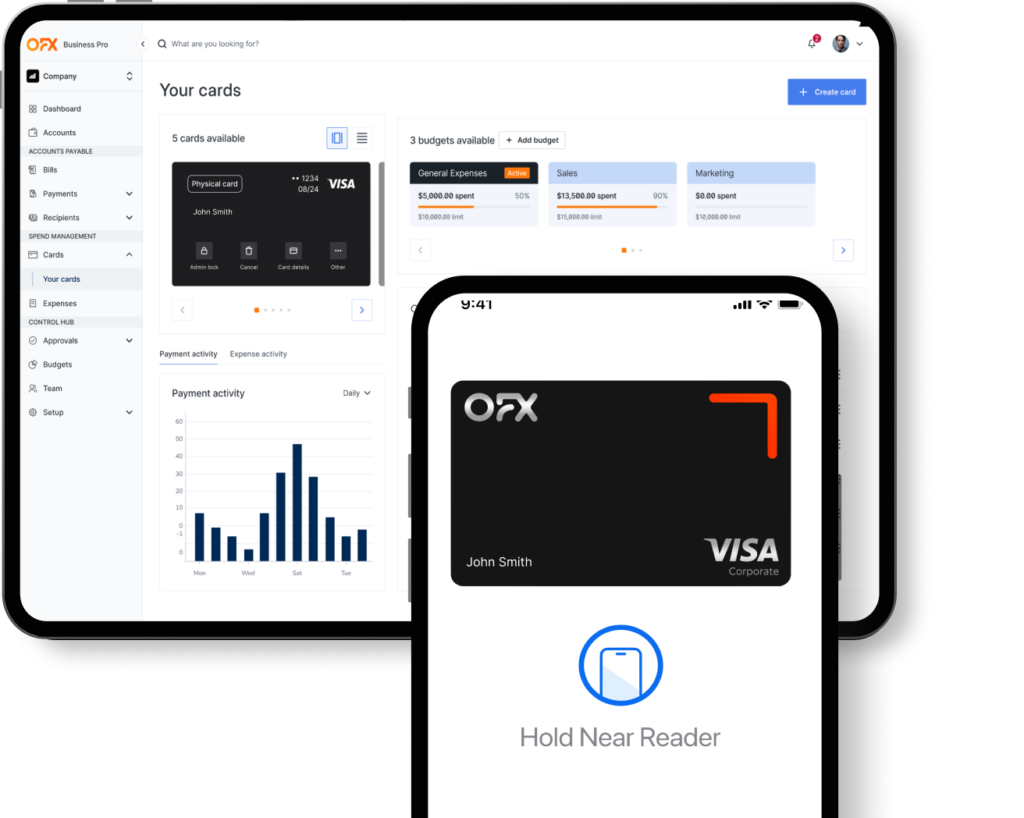
The OFX Corporate Card sits on the debit side. It’s a Visa Business Debit Card that draws on available funds in your OFX Global Business Account. That means no interest and no debt to manage.
Revolut now operates as an authorised deposit-taking institution (ADI) in Australia. APRA granted the banking licence on 21 July 20264, which means eligible deposits are covered by the Financial Claims Scheme up to A$250,0002.
OFX Corporate Card
Gain greater control and visibility by managing your domestic and international expenses and approvals all in one place.
Corporate card vs business credit card vs debit card.
A corporate card vs business credit card comparison comes down to whose money you spend. A business credit card lets you borrow and repay later, usually with interest after an interest-free window. A business charge card is similar, but you clear the full balance each month. A corporate credit card is simply a corporate card that runs on a shared business credit line.
Business debit cards work differently: you spend your own funds, so there’s nothing to repay and no interest to track. OFX takes the debit route deliberately, giving finance teams control first and keeping debt off the table.
Credit, charge, debit, prepaid and virtual cards: which type suits your business.
Beyond credit, charge and debit, there are two more types worth knowing. A prepaid business card is loaded with a set amount and stops when the balance runs out, which suits tight, one-off budgets. A corporate purchasing card, or P-card, is built for procurement and recurring supplier spend.
Virtual cards sit across all of these. A virtual card has its own 16-digit number, expiry date and CVV for online or in-app purchases. That makes it ideal for subscriptions and per-vendor control. Virtual cards are now a core business payment rail, with Juniper Research expecting global B2B virtual card payments to reach US$14.6 trillion by 2029, about 83% of the total virtual cards market.2 OFX issues both physical and virtual company cards, and multi-currency debit fits neatly here for businesses that spend across borders.
The best business corporate cards in Australia.
Here are our picks for the best business corporate cards, each with a clear best-for angle. Our shortlist spans fintech corporate debit cards and some of the best business credit cards Australia offers, so you can compare across models. Full pricing matters, so we list the tiers rather than only the entry price.
OFX Corporate Card: best for control and multi-currency spend.
The OFX Corporate Card is a corporate debit card linked to a multi-currency business account and spend management. You spend available funds, so there’s no interest and no debt. It comes on two plans: Standard at AU$0 per user per month, and Full Suite at AU$75 per month including 5 users, then AU$10 per additional user.3
You get local currency accounts in AUD, USD, CAD, GBP and EUR,4 plus spend across 30+ currencies with no international transaction fee when paying from held balances.1 Add per-card limits, approval workflows and instant lock or cancel. It suits businesses that want tight control and multi-currency spend in one platform.
Airwallex: best for scaling global operations.
Airwallex pairs global business accounts with cards. Its Explore plan is AU$29 per month, waived to AU$0 with at least AU$5,000 in monthly deposits or an AU$10,000 balance.5 Grow is AU$99 per month and Accelerate starts from AU$999 per month.6
FX runs at 0.50% on major currencies and 1.00% on other currencies, with 1.00% card auto-conversion and 0% when you spend from a held balance.5 Explore includes 10 free company cards and 2 free spend users, then AU$15 per user per month, across 20+ currencies.6
Wise: best for simple pay-as-you-go payments.
Wise Business has no monthly fee and a one-off AU$65 setup fee,7 with the first card free.8 Currency conversion starts from 0.19%7 and can rise to about 2% depending on the route.9 Spending funds in the account using the same currency with a Wise Card is free, while card spend in a currency not held incurs a conversion fee.8
ATM withdrawals are free up to AU$400 per month, then 2.69%.8 Wise suits businesses that want straightforward international payments without a subscription.
Revolut: best for app-first team budgeting.
Revolut Business runs on tiers. Basic is AU$15 per month and Grow AU$30 per month (AU$360 per year). Scale is AU$150 per month (AU$1,800 per year) and Enterprise starts from AU$1,250 per month.10
FX is 0% within a monthly allowance, then 0.6% over it and 1% out of hours, with card spend at 0%. The FX allowance ranges from AU$2,000 to AU$400,000 per month by tier.11 Revolut suits teams that like app-first budgeting and quick card issuing.
WorldFirst: best for importers and exporters.
The WorldFirst World Card has a AU$0 annual fee and AU$0 card issuance, with up to 20 virtual cards and access to 150+ currencies. FX is 0% on 15+ supported currencies spent from your balance, up to 0.6% on other currencies and up to 1.5% on unsupported ones.12
WorldFirst suits importers, exporters and marketplace sellers who collect and spend in many currencies.
American Express: best for points maximisers.
American Express is a strong pick if points drive the decision. The Qantas Business Rewards Card is AU$450 per year and earns 1.25 Qantas Points per AU$1 on general spend; up to 4 points on eligible Qantas purchases. Business Gold Plus is AU$395 per year with 3 points per AU$1 at Xero, Google Ads, Meta, AWS and Dell. Platinum Business is AU$1,750 per year.13
Note the foreign transaction (currency conversion) fee of 3.5%, effective 4 May 2026,14 which can offset points on overseas spend.
NAB: best for a traditional bank credit line.
For businesses that want a bank-issued credit line, the NAB Qantas Business Signature card charges 19.50% p.a. and AU$295 per card. It earns 1 Qantas Point per AU$1.50, with up to 44 interest-free days and up to 200,000 bonus points as part of a sign up offer. The NAB Low Rate Business Card charges 13.99% p.a. and AU$60 (AU$0 in the first year), with up to 55 interest-free days.15
Compare the best business corporate cards: fees and features.
This side-by-side view sets the fee against the running costs, so a low headline price doesn’t hide a high foreign-transaction bill.
| Provider | Monthly or annual fee | Card type | Foreign-transaction / FX | Rewards / points | Multi-currency accounts | Spend controls | Best for |
|---|---|---|---|---|---|---|---|
| OFX Corporate Card | Standard AU$0 per user/month; Full Suite AU$75/month (5 users, then AU$10/user)3 | Corporate debit (Visa Business Debit) | No international transaction fee on 30+ held currencies; auto-conversion for currencies not held1 | No card rewards or points; you can earn points on business expenses via Pay by Card | 30+ currencies1; local accounts in AUD, USD, CAD, GBP, EUR4 | Per-card limits, approvals, virtual cards, instant lock/cancel | Control and multi-currency spend |
| Airwallex | Explore AU$29/month (waived at AU$5,000 deposits or AU$10,000 balance)5; Grow AU$99/month; Accelerate from AU$999/month6 | Debit (multi-currency) | 0.50% major / 1.00% other; card auto-conversion 1.00%; 0% from held balance5 | Limited | 20+ currencies6 | Budgets, approvals, virtual cards | Scaling global operations |
| Wise | No monthly fee; AU$65 one-off setup7 | Debit (multi-currency) | Conversion from 0.19%7up to about 2%9; card spend 0% from held balance8 | None | Many currencies | Basic team cards | Simple pay-as-you-go payments |
| Revolut | Basic AU$15/month; Grow AU$30/month; Scale AU$150/month; Enterprise from AU$1,250/month10 | Debit (multi-currency) | 0% within allowance; 0.6% over; 1% out of hours; card spend 0%11 | Tier-based perks | 2 local accounts GBP, EUR, 30+ currencies, Allowance AU$2,000–AU$400,000/month by tier11 | Budgets, approvals, virtual cards | App-first team budgeting |
| WorldFirst | World Card AU$0 annual; AU$0 issuance12 | Debit (multi-currency) | 0% on 15+ supported currencies from balance; up to 0.6% other; up to 1.5% unsupported 12 | None | 150+ currencies12 | Up to 20 virtual cards12 | Importers and exporters |
| American Express | Qantas Business Rewards AU$450/year; Business Gold Plus AU$395/year; Platinum Business AU$1,750/year13 | Charge / credit | Currency conversion fee 3.5% (effective 4 May 2026)14 | Up to 4 Qantas Points per AU$1 (Qantas Business Rewards)13 | No | Card-level controls | Points maximisers |
| NAB (bank credit card) | Qantas Business Signature AU$295/card; Low Rate Business AU$60 (AU$0 first year)15 | Credit | Foreign transaction fee applies on overseas spend | 1 Qantas Point per AU$1.50 (Qantas Business Signature)15 | No | Card-level controls | A traditional bank credit line |
Fintech multi-currency cards and bank credit cards price risk in different ways. When you compare corporate cards Australia businesses rely on, read the fee against the FX cost and the rewards together. The sections below unpack what those numbers mean for your running costs.
What the fees really cost.
The annual or monthly fee is only the start. Credit cards add purchase interest once the interest-free days lapse, plus cash-advance fees and additional-cardholder fees. A low sticker price can hide a high running cost.
There are genuine no-annual-fee options among the best business credit cards, such as the CommBank Business Low Rate card at 14.55% p.a. with a AU$0 annual fee.16 Fintech cards like WorldFirst and Wise also skip the subscription. For comparison, the NAB Low Rate Business Card sits at 13.99% p.a.15 and the ANZ Qantas Business Rewards card at 20.24% p.a. with AU$300 plus AU$75 per card in rewards fees.17
The OFX Corporate Card takes interest out of the equation. As a debit card, there’s no interest and no debt. Plan fees stay transparent at AU$0 for Standard and AU$75 per month for Full Suite.3
Foreign transaction fees and multi-currency spend.
A foreign transaction fee is what a card adds when you spend in a currency other than Australian dollars. It matters most for businesses buying overseas stock, ads or SaaS, where the cost stacks up on each renewal. Australian businesses import heavily, with goods and services imports rising to AU$629.9 billion in 2024-25 according to the Australian Bureau of Statistics,18 and much of that is paid in other currencies. Many corporate cards Australia providers offer now compete hard on this fee.
Bank-issued cards commonly add a foreign transaction fee. For example, American Express moves to a 3.5% currency conversion fee from 4 May 2026.14
Multi-currency fintech cards can avoid that fee when you spend a currency you already hold. You convert once, hold the balance, then pay like a local.
OFX gives you local currency accounts in AUD, USD, CAD, GBP and EUR.4 You can spend across 30+ currencies with no international transaction fee when paying from held balances.1 When you spend a currency you don’t hold, competitive FX auto-conversion applies.
Regulation is shifting here too. From 1 October 2026, businesses will no longer be able to add surcharges on Visa, Mastercard, Amex and eftpos card payments.19 Commercial credit card interchange is capped at 0.80% from the same date, and foreign-issued card interchange is capped at 1.0% from 1 April 2027.20 The Reserve Bank of Australia has noted that foreign-currency conversion charges are a rising cost on cards.21
How to choose the right corporate card for your business.
The best corporate cards match your spending model rather than just the lowest fee. Work through five questions in order, and the shortlist narrows quickly.
- Repayment model: do you want a credit line to repay later, or a debit card that spends funds you hold?
- Fees and FX: add the subscription to the foreign-transaction cost, since a low fee can hide a high FX bill.
- Spend controls: can you set per-card limits, approvals and virtual cards for each vendor or person?
- Rewards vs cost: do the points beat the annual fee and FX cost, or just offset them?
- Accounting fit: does the card reconcile cleanly with Xero or QuickBooks Online?
If your business spends across currencies, runs on tight reconciliation and wants control without debt, a corporate debit card is a strong fit. OFX adds 24/7 human phone support and no minimum balance, which helps growing finance teams move faster.
Spend controls, employee cards and expense management.
Business travel is climbing again. SAP Concur’s Global Business Travel Report found Australian outbound business travel grew 12.4% in the first half of 2025,22 which makes strong employee card controls more important. Good spend controls turn a card program from a risk into a tool. Look for per-card budgets and limits, merchant-category controls, approval workflows and instant lock or cancel when someone leaves.
Company expense cards and employee expense cards work best when receipts capture automatically and expenses reconcile in real time. OFX supports receipt capture, categorisation and real-time visibility, with two-way sync to Xero and QuickBooks Online for faster month-end close.
You can also issue employee and virtual cards quickly, giving each vendor, subscription or person its own card. That keeps expense management tidy and cancellations clean, without sharing one card across a team.
Rewards and points: are they worth it?
Qantas Points, Velocity Points and American Express Membership Rewards can add real value. The catch is that the earn rate has to beat the annual fee and any foreign transaction cost. On many business credit cards, high overseas spend quietly erodes the points you earn.
OFX AU corporate debit cards don’t earn card rewards or points directly. Instead, Pay by Card lets you earn reward points on expenses suppliers don’t usually accept on card, such as rent, tax bills or supplier invoices. You use an eligible American Express, Visa or Mastercard rewards credit card routed through OFX. OFX doesn’t guarantee points accrual, which depends on the card issuer’s rewards program terms.
Why finance teams choose OFX for corporate cards.
The OFX Corporate Card brings spending, FX and expense control into one platform. As a corporate debit card, it draws on funds you hold, so there’s no interest, no debt and no impact on anyone’s personal credit.
You get local currency accounts in AUD, USD, CAD, GBP and EUR, and reach 170+ countries.4 You can spend across 30+ currencies with no international transaction fee from held balances.1 Spend management, per-card controls and two-way sync with Xero and QuickBooks Online keep reconciliation clean. Pay by Card helps you earn points on payments suppliers don’t accept on card.
Getting started is quick. Registration takes under 10 minutes online, verification is typically 2–3 business days, and you get immediate platform access while KYC completes. See our business pricing for more details.
Frequently asked questions about the best business corporate cards.
What’s the difference between a corporate card and a business credit card?
A corporate card is any card issued to a business or its employees, and it can be debit or credit. A business credit card is one type: it lends you money to repay later, usually with interest, while a corporate debit card spends funds you already hold. Put simply, a corporate credit card borrows, and a debit card doesn’t.
Should I choose a corporate debit card or a credit card for my business?
Choose a corporate debit card if you want spend control without debt or interest, and clean reconciliation against funds you hold. Choose a credit card if you need a short-term credit line or want to maximise points, and you can clear the balance to avoid interest. Business debit cards suit teams that want tight oversight without carrying debt.
How much do business corporate cards cost in Australia?
Business credit cards Australia businesses use range from no subscription to premium annual fees. Fintech options like WorldFirst and Wise charge no monthly fee. OFX offers a AU$0 Standard plan and a AU$75 per month Full Suite plan.3 Bank and charge cards such as NAB (AU$295 per card)15 or American Express (from AU$395 per year)13 charge more but add points.
Do business corporate cards charge foreign transaction fees, and which avoid them?
Many bank cards charge a foreign transaction fee, such as American Express at 3.5% from 4 May 2026.14 Multi-currency cards can avoid it when you spend a currency you already hold. That’s how the OFX Corporate Card works across 30+ currencies from held balances.1
Can a small business get a corporate card, and how do I apply?
Yes. Many of the best corporate cards for small business are open to sole traders and companies, and fintech providers let you apply online in minutes. You’ll usually need business details and identity documents, then verification before your cards go live.
Does a business corporate card affect my personal credit, and who is liable?
It depends on the card. A corporate debit card like OFX links to the business account, not the individual, so it doesn’t affect an employee’s personal credit. Some business credit cards rely on a personal guarantee, so check who carries liability before you apply.
Are there business corporate cards with no annual fee?
Yes. There are genuine business credit cards with no annual fee, such as the CommBank Business Low Rate card. Fintech cards like WorldFirst and Wise also skip the monthly subscription. The OFX Standard plan is also AU$0 per user per month,3 so weigh the fee against the FX cost before deciding.
Try OFX Corporate Cards today for greater spend control.
References
- https://www.ofx.com/en-au/business/corporate-cards/
- https://www.juniperresearch.com/press/b2b-spending-to-dominate-global-virtual-cards-market/
- https://www.ofx.com/en-au/business/pricing/
- https://www.ofx.com/en-au/business/global-business-account/
- https://www.airwallex.com/en-au/terms/fee-schedule
- https://www.airwallex.com/en-au/pricing
- https://wise.com/au/pricing/business
- https://wise.com/au/pricing/business/card-fees
- https://transferfees.io/guides/wise-fees-explained
- https://www.revolut.com/en-AU/business/business-account-plans/
- https://www.revolut.com/en-AU/legal/business-basic-fees/
- https://www.worldfirst.com/au/insight/virtual-cards/best-corporate-credit-cards-australia/
- https://www.americanexpress.com/en-au/credit-cards/all-cards/business/
- https://www.americanexpress.com/au/credit-cards/about-credit-cards/fees/
- https://www.nab.com.au/business/business-credit-cards
- https://www.commbank.com.au/business/business-credit-cards.html
- https://www.anz.com.au/business/credit-cards/
- https://www.abs.gov.au/statistics/economy/international-trade/international-trade-supplementary-information-financial-year/latest-release
- https://www.accc.gov.au/business/pricing/card-surcharges
- https://www.rba.gov.au/payments-and-infrastructure/credit-cards/regulatory-framework.html
- https://www.rba.gov.au/publications/bulletin/2026/may/bank-fees-in-australia.html
- https://travelweekly.com.au/sap-concurs-7th-annual-global-business-travel-report-shows-increase-in-aussie-outbound-travel/
- https://www.ofx.com/en-au/legal/regulation/
- https://www.ofx.com/en-au/blog/best-business-bank-accounts/
- https://www.ofx.com/en-au/legal/complaints-policy/
Visa is a trademark owned by Visa International Service Association and used under license.
Apple Pay is a service provided by certain Apple affiliates, as designated by the Apple Pay privacy notice. Neither Apple Inc. nor its affiliates are a bank. Any card used in Apple Pay is offered by the card issuer.
Google Play and Google Pay are trademarks of Google LLC.
In Australia, OFX is registered as a financial service provider and regulated by ASIC (AFS Licence number 226 484). OFX is not a bank, and so you are not protected by the Financial Claims Scheme when you send money with OFX. To balance that, OFX is a member of AFCA and holds ISO 27001:2022 certification in Australia. It runs advanced transaction monitoring and a risk-averse payout model that releases funds only once received, backed by 24/7 human phone support from real Specialists. Learn more about how OFX keeps your money and information secure.
IMPORTANT: The contents of this blog do not constitute financial advice and are provided for general information purposes only without taking into account the investment objectives, financial situation and particular needs of any particular person. OzForex Limited (trading as “OFX”) and its affiliates make no recommendation as to the merits of any financial strategy or product referred to in the blog. OFX makes no warranty, express or implied, concerning the suitability, completeness, quality or exactness of the information and models provided in this blog.