
5 Things That Surprised Us in Our SME Confidence Survey
The results are in from our annual UK SME confidence survey. Each year we take a pulse-check on how UK businesses are feeling about international trade to better inform us of our client’s needs. Plus, we share the results to offer clients insight into what their peers are thinking. Here’s what surprised us this year.
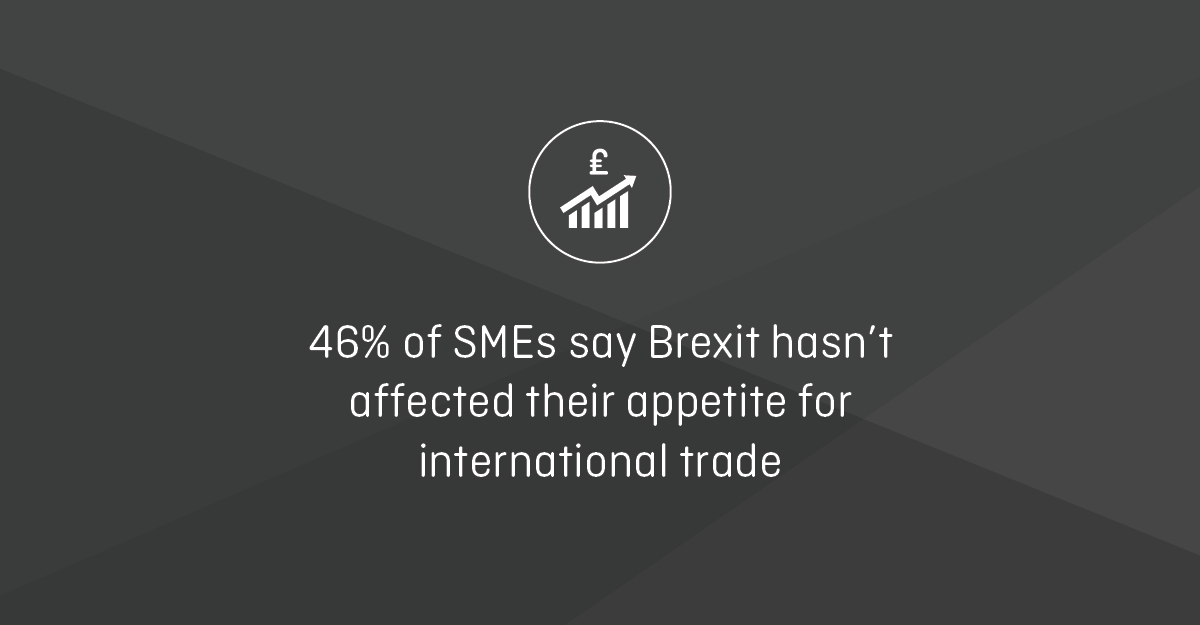
1. 46% say Brexit uncertainty has had no effect on their appetite for international trade
Despite uncertainty surrounding the terms of Brexit, small British businesses are increasingly optimistic about international trade. In fact, the majority expect to increase overseas sales in the next year. And it’s not all talk. Since 2017, 47% increased overseas sales, growing international revenues by an average of £50,000. It’s good to know that political uncertainty hasn’t dampened the spirits of UK businesses.

2. Europe regains popularity as an export market
45% chose Western Europe as their favoured market for international growth, giving the region a 25% boost in popularity up from last year’s survey. Again it seems that Brexit-related uncertainty is no longer holding small businesses back from their EU trade ambitions.
3. USA fell out of favour
Last year 62% voted USA as the most attractive market for exports. This year only 36% favoured the USA – down 26%, perhaps because President Trump’s tough trade strategy has spooked foreign businesses.
4. Brexit leavers are the most confident about international sales
England had the highest percentage of leavers in the EU referendum compared to other UK countries (with 53.4% voting leave). In the OFX SME survey, English respondents felt the most confident about international trade. In Scotland (where only 44.4% voted to leave the EU) respondents feel the least confident about international trade. Just 40% said they felt confident vs. 72% of England-based SMEs. Seemingly, Brexit opinion and confidence levels are linked.
5. Brand Britain is boosting international sales
This year, more than half of small businesses trading internationally (53%) said that their company’s ‘Britishness’ is a valuable asset when selling goods and services outside the UK.
Jake Trask FX research director said: “The rise of marketplaces like eBay and Amazon means it’s now easier than ever for small businesses to start selling overseas, no matter where they are based. This year, events like the Royal Wedding have shown that there’s a real opportunity to tap into the global appeal of Brand Britain. London brands don’t have the monopoly on ‘Britishness’, so I’d expect businesses across the UK to leverage their unique heritage and boost their international sales in the next twelve months.”
Find out what Jake Trask, FX Research Director, and Hamish Muress, Senior Analyst, think about the results in this special episode of Currency Corner, our video series looking at what’s impacting the pound today
OFX commissioned OnePoll to conduct a survey of 500 owners and senior managers at UK businesses with between 10 and 249 employees.
IMPORTANT: The contents of this blog do not constitute financial advice and are provided for general information purposes only without taking into account the investment objectives, financial situation and particular needs of any particular person. OzForex Limited (trading as OFX) and its affiliated entities make no recommendation as to the merits of any financial strategy or product referred to in the blog. OFX makes no warranty, express or implied, concerning the suitability, completeness, quality or exactness of the information and models provided in this blog.