
As companies grow and operate across borders, corporate cards are becoming more than just a payment tool. They help businesses manage international expenses, reduce FX costs, and keep cross-border payments simple.
Corporate cards have evolved far beyond booking flights and hotels. Today, they’re a flexible tool that businesses of all sizes use to manage spending, support global teams, and streamline operations.
Here are four practical ways companies are using corporate cards and why they are becoming an essential part of modern business finance:
- Improving visibility and financial reporting
- Managing everyday business and operational expenses
- Supporting global and remote teams
- Managing travel and entertainment (T&E) spend
Let’s take a closer look at how corporate cards are helping businesses simplify spending and stay in control.
1) Improving visibility and financial reporting.
In OFX’s 2025 reports, 100% of finance leaders in the UK1 and 99% of finance leaders in North America2 noted that real-time visibility over their business’s transactions was important to their role. In Australia, 71% of finance leaders say real-time visibility over their business’/client’s transactions is essential or very important.3 Corporate cards aren’t just for payments anymore, they’re a powerful tool for improving financial oversight and reporting.
Corporate cards are now a key driver of better financial oversight. Businesses are using them to:
- Gain real-time visibility over business spend.
- Track expenses across teams, departments, and locations.
- Simplify reconciliation and month-end reporting.
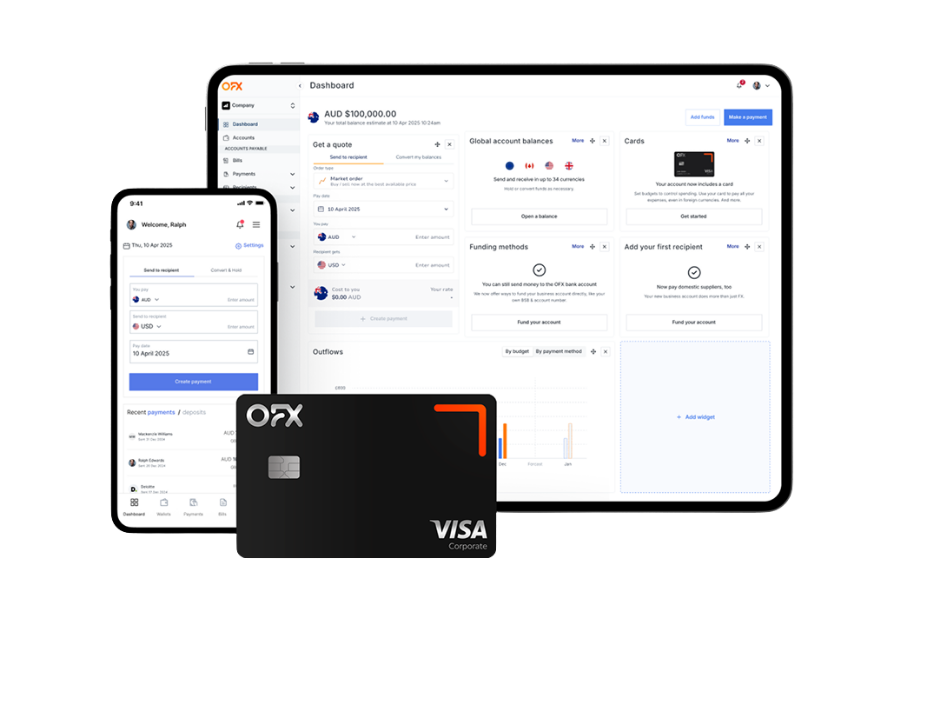
As part of OFX’s Global Business Account, corporate card transactions sit alongside international payments, domestic transfers, and multi-currency balances in one central platform giving finance teams real-time visibility over how money moves across the business.
For example, a finance manager can instantly see card spend by employee or department, track travel expenses against budgets, and reconcile card payments with incoming and outgoing transfers from the same dashboard. This reduces visibility black holes and the ability to stay in control of spend without waiting for month end.
Furthermore, with automated transaction tracking and consolidated reporting across currencies, businesses can reduce manual reconciliation, improve reporting accuracy, and make faster, more informed cashflow decisions as they scale.
Get started today. The saving lasts forever.
You have nothing to lose, and so much time and money to save. Your all-in-one control platform is ready.
2) Managing everyday business and operational expenses.
For many businesses, corporate cards are now the go-to solution for day-to-day payments. Instead of juggling reimbursements or multiple payment methods, companies can issue physical or virtual cards to cover routine costs like:
- Office supplies and equipment
- Software subscriptions and digital tools
- Marketing, advertising, and professional services
Businesses are increasingly using one card per recurring expense to gain fully traceable and accountable spend. By assigning a dedicated card to each subscription, such as Google Ads or SaaS tools, finance teams can clearly see what is being spent, by who, and on what.
If an expense is no longer needed, the card can be instantly paused or cancelled. This prevents unwanted renewals and overspending.
When these expenses involve overseas providers, FX costs can add up quickly. Using an OFX Corporate Card as part of OFX’s Global Business Account helps businesses unify spending and better understand how international expenses and exchange rates impact cashflow.
With one login to track corporate card spend and international payments, your finance team gets clearer oversight, can set limits, track payments in real time, and avoid unnecessary surprises at month-end.
3) Supporting global and remote teams.
As businesses expand across borders, supporting employees and contractors in different countries becomes increasingly complex. In fact, according to 2025 OFX Reports, 43% of North American businesses4 and 64% of UK businesses5 said that paying contractors is one of the most difficult categories to reconcile.
Likewise, 36% of Australian businesses experience payment delays due to manual approval bottlenecks, creating friction for remote employees and overseas contractors who depend on timely access to funds.6
Corporate cards help simplify this by giving global and remote teams access to funds without relying on slow, manual reimbursement processes. Companies are using cards to:
- Cover local expenses for international employees
- Support remote teams and overseas contractors
- Reduce the administrative burden of cross-border reimbursements
Budgets and approval policies can be set card by card, helping teams stay within limits automatically. When a team member leaves, their assigned card can be cancelled instantly. This avoids chasing expenses or loose ends.
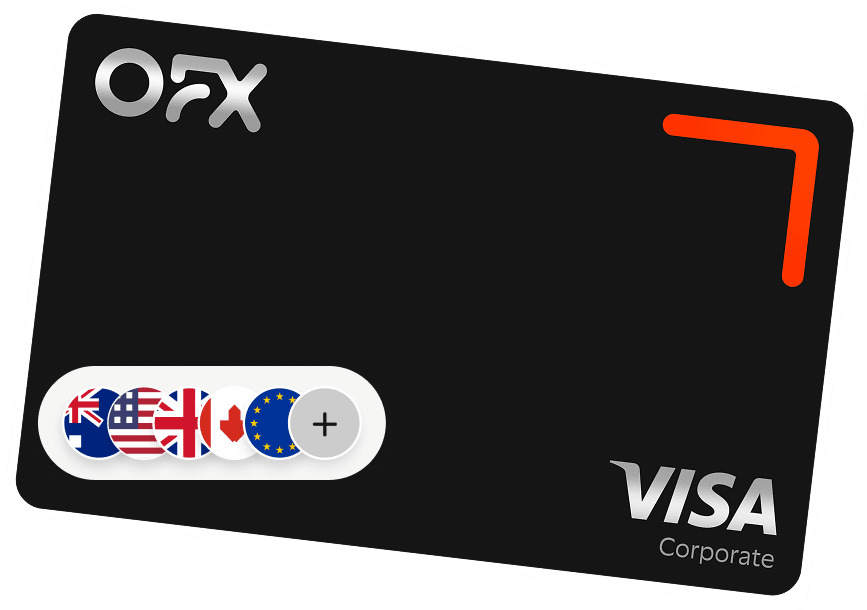
When combined with OFX’s international payment and FX solutions, corporate cards become a powerful way to support global and remote teams while keeping costs and complexity under control. Businesses can convert and hold funds in multiple currencies, pay overseas employees or contractors at competitive exchange rates, and pay with corporate cards in multiple currencies.
This reduces the need for frequent conversions or reimbursements. For example, a US-based business can pay a UK contractor in GBP and track all related spend in one place. This integrated approach helps finance teams maintain visibility across currencies, reduce FX costs, and simplify compliance as teams scale globally.Additionally, knowing exchange rates ahead of time and leveraging tools like OFX’s forward contracts can help lower the risk of foreign payments and protect budgets from currency fluctuations. Businesses can also benefit from $0 FX fees when using held balances, making cross-border payments more predictable and cost-effective.
Access to 30+ currencies directly linked to your business account, reducing unnecessary exchange conversions when you spend in those currencies.
4) Managing travel and entertainment (T&E) spend.
Travel and entertainment remains one of the most common uses for corporate cards, but companies are managing it more strategically than ever, particularly as teams travel more frequently and across borders.
Corporate cards are commonly used to:
- Book flights, accommodation, and transport.
- Pay for client entertainment, events, and conferences.
- Track travel spend by employee, department, or project.
Virtual cards can be issued in minutes, ensuring teams are ready to travel or book expenses without delay. Finance teams can monitor and approve spend before it happens, view pending transactions, and see what needs approval. This helps maintain control at every tap and swipe.
OFX Corporate Cards also simplify international T&E spend by allowing employees to pay directly from multi-currency accounts, such as AUD, GBP, or CAD. This helps avoid unnecessary FX fees. With spend limits and travel budgets set in advance, businesses can stay in control of travel spend before, during, and after every trip.
A more connected approach to cross-border business payments.
Corporate cards are no longer just a convenience. They’re an essential part of how modern businesses manage everyday spending, support global teams, handle travel costs, and gain clearer visibility into finances.
When used alongside OFX’s Global Financial Platform, OFX Corporate Cards bring these benefits together in one connected experience. That means less complexity, more control, and a practical way to manage spending as your business scales.
Sources:
1, 4 From Complexity to Control. This research was commissioned by OFX and conducted by market research specialist Vitreous World. The anonymous survey took place online from 8-16 April 2025. 150 SME finance leaders in the UK were surveyed across industries including retail, eCommerce, software, tech, media, advertising and marketing, hospitality, and more.
2, 5 This research was commissioned by OFX and conducted by market research specialist Vitreous World. The anonymous survey took place online from August 4-13, 2025. 300 SMB finance leaders in the United States and Canada were surveyed across industries including retail, eCommerce, software, tech, media, advertising and marketing, hospitality, and more.3, 6 ‘From manual drag to strategic finance’. This research was commissioned by OFX and conducted by market research specialist Vitreous World. The anonymous survey took place online in October, 2025. 500 SMB finance leaders in Australia were surveyed across industries including retail, eCommerce, software, tech, media, advertising and marketing, hospitality, and more.
3, 6 ‘From manual drag to strategic finance’. This research was commissioned by OFX and conducted by market research specialist Vitreous World. The anonymous survey took place online in October, 2025. 500 SMB finance leaders in Australia were surveyed across industries including retail, eCommerce, software, tech, media, advertising and marketing, hospitality, and more.