
Remittance advice might sound like some complex financial jargon, but it’s actually a simple and practical concept that works together with an invoice. While a supplier sends an invoice to request payment for goods or services, remittance advice comes from the customer, confirming that a payment has been processed and often specifies which invoice it’s for.
Though it may seem like just a formality, remittance advice plays a key role in helping both parties keep their financial records organised, making it easier to track payments and ensure everything matches up.
In this article, we’ll break down exactly what remittance advice is, how it differs from remittance, and why it’s so valuable for businesses.
What’s on this page
• What is remittance advice and why does it matter?
• What’s the difference between remittance and remittance advice?
• What should be included on remittance advice documents?
• Example of how OFX sends remittance advice
• Why is remittance advice important in business transactions?
• What are the benefits of remittance advice?
• What are the different types of remittance advice?
• Common challenges with remittance advice
• Automated remittance advice?
• FAQ
What is remittance advice and why does it matter?
Remittance advice is the information a customer provides alongside their payment to let their supplier know which invoice the payment is for. The term “remittance” refers broadly to a payment made for goods or services. It comes from the idea of “sending back,” so when we talk about “remittance advice,” we’re referring to those extra details that help clarify what the payment is covering.
Some businesses refer to it as a remittance slip. Typically, the customer (or recipient) fills out this slip and sends it back to the seller with their payment. It’s a small but a helpful step in keeping transactions clear and organised.
Read on to understand what remittance advice actually looks like and how it fits into payment processes.

What is the difference between remittance and remittance advice?
To “remit” a payment simply means to send it back, whether that’s paying a supplier, settling an invoice, or transferring money for goods or services. Remittance advice, on the other hand, is a little different. It’s a notification or document that provides proof that a remittance has been made (or is about to be made).
Now, you might wonder: is remittance advice proof of payment? The short answer is no. While it lets the payee know that a payment has been sent, it’s not official proof that the payment has been made. Auditors, for example, are unlikely to rely on remittance advice to confirm cash receipts. Instead, they are likely to turn to the transactions recorded in the ledger and the bank statement for that kind of verification.
So, while remittance advice is helpful for communication, it’s not the same as proof that payment has been made.
In short:
- Remittance – Refers to the actual transfer of money from one party to another, whether it’s paying an invoice or sending money to a friend or family member.
- Remittance advice – Is a document sent to your supplier or vendor when you pay (or partially pay) an invoice. It lets them know that payment is on the way and helps them match the payment to their invoice by including details like the payment date, method, and invoice number.
What should be included on remittance advice documents?
Remittance advice documents generally include a few key details, and many businesses use a standard template to make sure nothing is missed. It’s a good idea to include a reference or purchase order number alongside the vendor’s invoice number, making it easier to track the remittance advice later if needed.
A remittance generally includes:
- Buyer contact details
- Seller contact details
- Invoice number
- Payment date
- Reference number
- The goods or services being paid for
- Amount outstanding or balance paid
- Payment method
- Finance team contact details
Keep it simple, a basic Word document or PDF works just fine for most small businesses.
Example of how OFX sends remittance advice
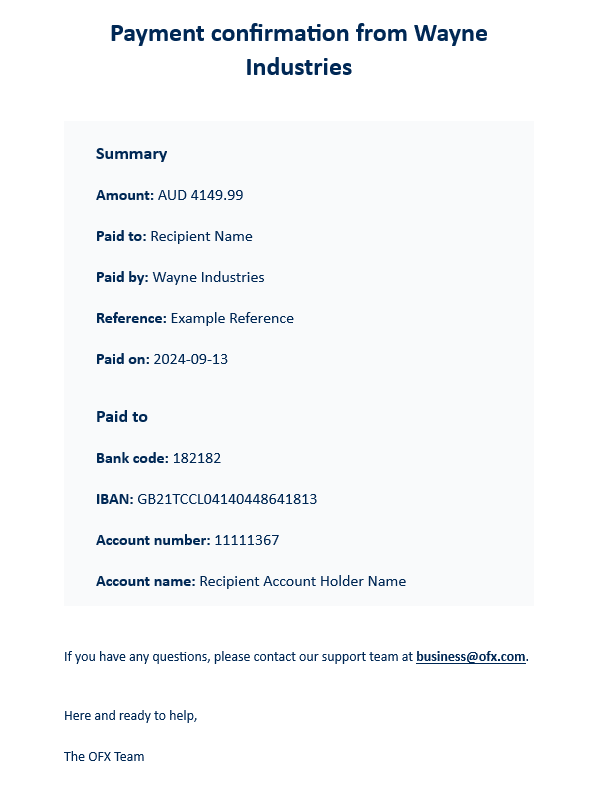
At OFX we take care of sending remittance advice on your behalf. We will send a remittance advice directly to your suppliers when you send a payment. We also include the information of the beneficiary details.
See what a remittance advice sent from OFX looks like:
Pay thousands of vendors and employees within minutes with OFX
Simplify your global batch payments and pay thousands of vendors, suppliers and employees in 30+ currencies, with automatic reconciliation in your accounting software.
Learn how to simplify your batch and payroll payments with OFX
Why is remittance advice important in business transactions?
Remittance advice plays an important role in helping both the seller and buyer keep track of their finances. It’s a standard part of record-keeping. Remittance advice makes it easier for sellers to match payments with their financial records, keeping everything organised.
What are the benefits of remittance advice?
Remittance advice simplifies record management and reconciliation for both buyers and sellers
For the seller:
- Better planning
It gives early notice of an upcoming payment, helping you plan your finances. - Record of payment
It provides a clear record, making it easier to reconcile transactions with invoices and identify where payments came from.
For the buyer:
- Improved communication
Let your vendor know a payment is coming, so they can stop sending reminders. - Track payments
Helps your accounts team track specific payments easily.
- Stronger internal controls
Ensures invoices match payments, reducing the risk of overpayment or duplicate payments.
What are the different types of remittance advice?
Let’s talk about the different types of remittance advice and how they’re sent, it’s a bit more flexible than you might think.
Remittance advice can come in various forms, either as a physical document sent through the mail or a digital version delivered electronically. Here are some of the most common types:
- Email remittance advice: This is a popular option, where the remittance details are sent via email, either in the body of the email or as an attachment. As businesses move away from paper-based processes, this method is becoming more and more common.
- Paper-based remittance advice: The more traditional approach, where remittance slips are handwritten or printed, then mailed to the recipient.
- EDI-based remittance advice: For businesses using electronic data interchange (EDI), remittance advice is transmitted directly through these systems, offering a fast and potentially more secure option.
The method of how to create a remittance advice depends on how you’re sending it:
- Via email (in the body or as an attachment)
- As a paper document (posted through the mail)
- In an Excel sheet
- Using EDI systems
- Written directly on a cheque
- Through an accounts payable portal
The format and delivery method depend on what works best for both the sender and the recipient.
Common challenges with remittance advice
Remittance advice is crucial, but managing it is often tricky. Why? It arrives through various channels and formats, mail, email, Excel, or AP portals, and there’s no standardised format. This can make it a slow and frustrating process.
Adding to the challenge, many payments today are digital, and remittance advice may not be provided. Unmatched payments can sit unresolved for days or weeks, creating headaches for accounts payable teams.
Three common challenges are:
- Varied sources and formats
Accounting staff often juggle multiple portals with different logins or sift through misaligned spreadsheets and PDFs. The lack of consistency makes retrieving and interpreting remittances time-consuming. - Illegible remittance data
Poorly formatted or unreadable remittance slips, like those with misaligned columns or missing characters, make it hard to apply payments correctly. - Complex cash application
Matching payments to invoices can be a challenge, especially with bulk payments or deductions. For example, you could receive a bulk payment for $100,000 that comes with 50+ pages of remittance advice relating to payment of 50 different invoices. The manual process of matching these isn’t scalable and could take many hours to resolve.
When all these challenges overlap, multiple invoices, deductions, and missing remittances, it becomes a major obstacle for accounts payable teams.
Automated remittance advice
There are a lot of advanced cash application tools and AP automation software, powered by AI and machine learning, that can now match incoming payments to open invoices without needing remittance advice.
As more businesses adopt accounts payable software, you’ll likely see more customers sending remittance advice directly through their accounts payable systems for seamless integration.
FAQs
Who prepares and sends remittance advice?
The buyer prepares and sends remittance advice when or after an invoice is paid.
What is the difference between remittance advice and an invoice?
- An invoice requests payment
- A remittance advice confirms that payment has been made
Is sending remittance advice mandatory?
No, it’s not mandatory to send remittance advice after payment of an invoice, however it’s considered a courtesy to the seller.
Is remittance advice proof of payment?
Remittance advice lets the seller know that an invoice will be paid soon, while proof of payment or a receipt confirms that the payment has already been made.
The buyer sends remittance advice to show their intention to pay, but it doesn’t guarantee the payment has gone through—payments can still fail afterwards. Proof of payment, on the other hand, is a receipt or record confirming the payment was successful.
What are the different types of remittance advice?
- Paper document
- Via email
- Via accounting software.
What information does remittance advice contain?
Remittance advice generally includes:
- Buyers contact details
- Vendor contact details
- Invoice number
- Payment date
- Reference number
- The goods or services being paid for
- Amount outstanding or balance paid
- Payment method
- Finance team contact details