
Most finance transformation conversations start in the wrong place.
They focus on automation, AI tools, or system upgrades, as if the core challenge is a lack of capability.
But in practice, finance teams already have more systems, more data, and more tools than ever before.
The problem is not the absence of technology. It’s the structure underneath it.
Finance teams are running ERPs, accounting platforms, spreadsheets, approval emails, banking portals, and payment files. Each one solving a local problem. None of them talk to each other.
AI struggles to operate effectively across broken workflows. It only amplifies what already exists, and in many finance teams, what exists is manual complexity.
Fragmentation is the real problem.
Finance is rarely redesigned. It gets patched. A new tool here, a workaround there. Until going digital means six different systems that don’t talk to each other.
From the outside, the invoices still get paid, the reports still get filed, and month-end gets closed — eventually. But the dysfunction doesn’t disappear. It just becomes someone’s full-time job.
Why AI alone doesn’t fix broken workflows.
Everyone’s betting on AI to fix finance. Here’s the problem: AI can only effectively speed up finance processes when platforms are actually talking to each other.
The constraint isn’t intelligence, it’s integration.
AI-enabled finance requires operational cohesion — not just smarter tools layered on top of fragmented processes.
To deliver meaningful outcomes, AI needs a foundation of reliable, accessible data. If information is trapped in disconnected systems, spread across spreadsheets, or requires manual intervention to move from one platform to another, AI has limited context to work with. The result is often faster processing of the same underlying inefficiencies.
Before finance teams can unlock the benefits of AI, systems must be connected, information must be consistent, and workflows must flow seamlessly across the finance function. Without that foundation, AI can generate insights, but it cannot solve the operational bottlenecks that prevent teams from acting on them.
What changes when finance operations are structurally connected?
When finance workflows are unified across systems, from invoice intake to approval to payment and reconciliation, something fundamental shifts.
Finance teams stop spending time on coordination and start spending time on strategic control.
AI-enabled leadership in finance means something more specific and more demanding:
- From chasing transactions to orchestrating them. Leaders manage exceptions and decisions, not every individual invoice and approval.
- From assembling visibility to embedding it. Status lives inside the workflow — who approved what, what’s due, what’s paid — rather than being reconstructed by hand in a spreadsheet.
- From processing payments to controlling them. Domestic and international payments, approvals, and accounting entries flow through one connected layer instead of three disconnected ones.
- From reactive reporting to decision support. With time freed and data trustworthy, finance can shift focus toward cash strategy, risk management, and supplier relationships.
This is the real promise of AI in finance. It’s not a replacement of human judgement, but restoration of it.
By minimising the operational friction around finance work, teams regain the capacity to lead.
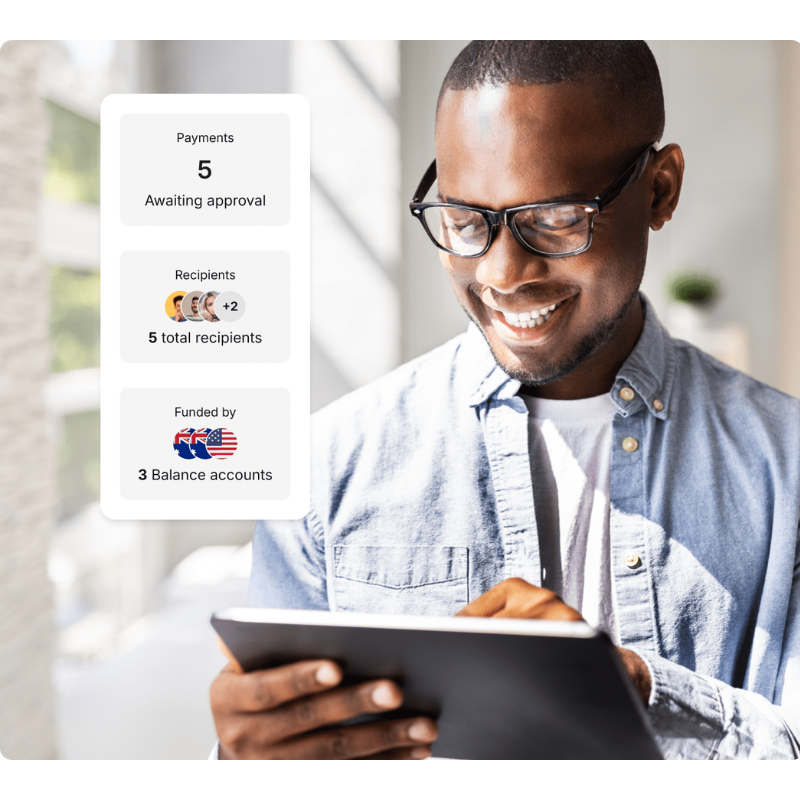
End the invoice scavenger hunt.
Replace fragmented approval chains and spreadsheets with a connected, automated AP workflow.
*AP Automation is available on our Full Suite plan.
What needs to change?
The answer isn’t more tools. It’s fewer steps.
Reducing the number of steps required to execute and approve payments can help finance teams improve speed and control, without increasing complexity.
The payment process moves from being a fragmented, multi-system exercise to a unified operational flow.
This is where OFX can play an important role. Invoice capture, approval workflows, domestic and international payments, accounting software integration, and financial controls — all in the one place.
The result isn’t simply faster AP processing. It’s operational capacity. Finance leaders can spend less time administering processes and more time on cash flow, risk management, supplier relationships, and strategic decision-making — the activities where human judgement creates the greatest value.
What to do differently.
If your finance function feels stuck, start reframing the problem. Here are four things worth doing now:
- Audit your workarounds. Map where spreadsheets and manual follow-ups are bridging gaps between tools. That map is your transformation roadmap.
- Judge tools by connectivity, not features. The question isn’t “What can this software do?” It’s “What does this connect?”
- Connect before you automate. AI is most impactful when workflows already flow end to end. Sequence accordingly.
- Measure reclaimed judgment, not just saved hours. The real return is the strategic work your team can finally do.
Manual operations don’t fail loudly, they fail quietly, piece by piece. Delayed strategy. Strained suppliers. Talented people running on empty. The move to AI-enabled leadership is, at its core, a decision about where your team’s energy goes — toward the grind, or toward the work only they can do.
The real questions for finance leaders.
The future of finance isn’t just faster automation or smarter AI. It’s operational design.
How much of your team’s potential is your own financial structure holding back?
In fragmented environments, even the best tools will only ever deliver incremental improvement. But when finance operations are consolidated, connected, and designed for flow rather than friction, AI doesn’t just improve the process. It unlocks the function.
Your team didn’t get into finance to chase approvals. Give them back the work that actually matters.

Still chasing approvals manually?
OFX AP Automation helps finance teams reduce admin, consolidate approvals (available on OFX’s Full Suite Plan) and keep payments moving without the endless follow-ups.