
Key takeaways
- Canadian businesses can choose between traditional banks (BMO, TD, RBC, CIBC and Scotiabank) and fintech providers (OFX, Wise and Venn), and each suits a different way of running a business.
- Monthly fees range from C$0 (OFX and Wise’s entry plan) to C$65 and above (CIBC), so the right choice depends on your transaction volume and balance.
- If you pay or get paid overseas, a multi-currency account can reduce the conversion costs and international fees that traditional accounts often add.
- OFX is a fintech alternative rather than a bank, built for cross-border businesses, combining multi-currency accounts, corporate cards and spend management in one platform.
Finding the best business bank account in Canada isn’t as straightforward as it used to be. With traditional banks, fintechs and non-bank alternatives all offering business account features, it’s less about picking the biggest name and more about finding a solution that fits how you actually run your business.
Whether you’re a startup owner looking for low fees, or a growing business that needs more control over its finances, the right account can help you save time, cut costs and simplify operations.
In this guide, we’ll walk through the different types of business accounts available in Canada, what to look for and which providers stand out, including how modern, non-bank solutions like OFX can give you more flexibility and value than you might expect.
Summary:
• What is a business bank account?
• Do you need a separate business bank account in Canada?
• Types of business bank accounts
• Top business bank accounts and alternatives in Canada
• What to consider when choosing a business bank account
• Why OFX stands out for Canadian businesses
• Best business banks accounts FAQs
What is a business bank account?
A business bank account is a dedicated account used for business transactions. It keeps your business’s funds separate from your personal finances, which makes it easier to manage expenses, monitor cash flow and prepare for tax filing.
Do you need a separate business bank account?
Business bank accounts are important for partnerships, corporations and registered entities. This is because Canadian business regulations require these businesses to have separate accounts solely for business use. Even sole traders benefit from the simplicity of a clear divide between their personal and business finances.
Benefits of opening a business bank account
Opening a separate business account is more than best practice. It’s a foundational move that supports your business’s financial health and credibility. Here are six strong reasons to make it a priority:
- Simplifies tax reporting by keeping business income and expenses in one place
- Boosts your credibility with clients, suppliers and lenders
- Supports regulatory compliance for registered entities
- Improves financial visibility so you can track performance clearly
- Unlocks business-specific features like corporate cards and integrations
- Helps build your business credit profile over time
Business bank account vs personal bank account
While a personal account is designed for your individual expenses, a business bank account helps you manage the financial complexities of running a business.
A business account is registered under your business name and used for receiving customer payments, sending supplier payments and running payroll.
A business account package often includes tools that help with daily banking needs, such as business savings accounts, corporate cards, accounting software integrations and the ability to make bulk payments.
Types of business bank accounts
Most banks typically offer the following types of business bank accounts:
| Business transaction / chequing account | For daily banking needs, like receiving and making payments. Some are online-only, while others also allow in-person banking and cash deposits. These accounts usually offer little to no interest on your balance. |
| Business savings account | Lets you earn interest on your balance. May have requirements, such as a minimum monthly deposit or a linked product. Some accounts offer high introductory rates that drop after six or nine months. |
| US dollar and foreign currency account | Ideal for businesses with international transactions. Use it to save or send and receive payments in foreign currencies like USD, and to help avoid foreign exchange fees. |
Are there alternatives to a business bank account?
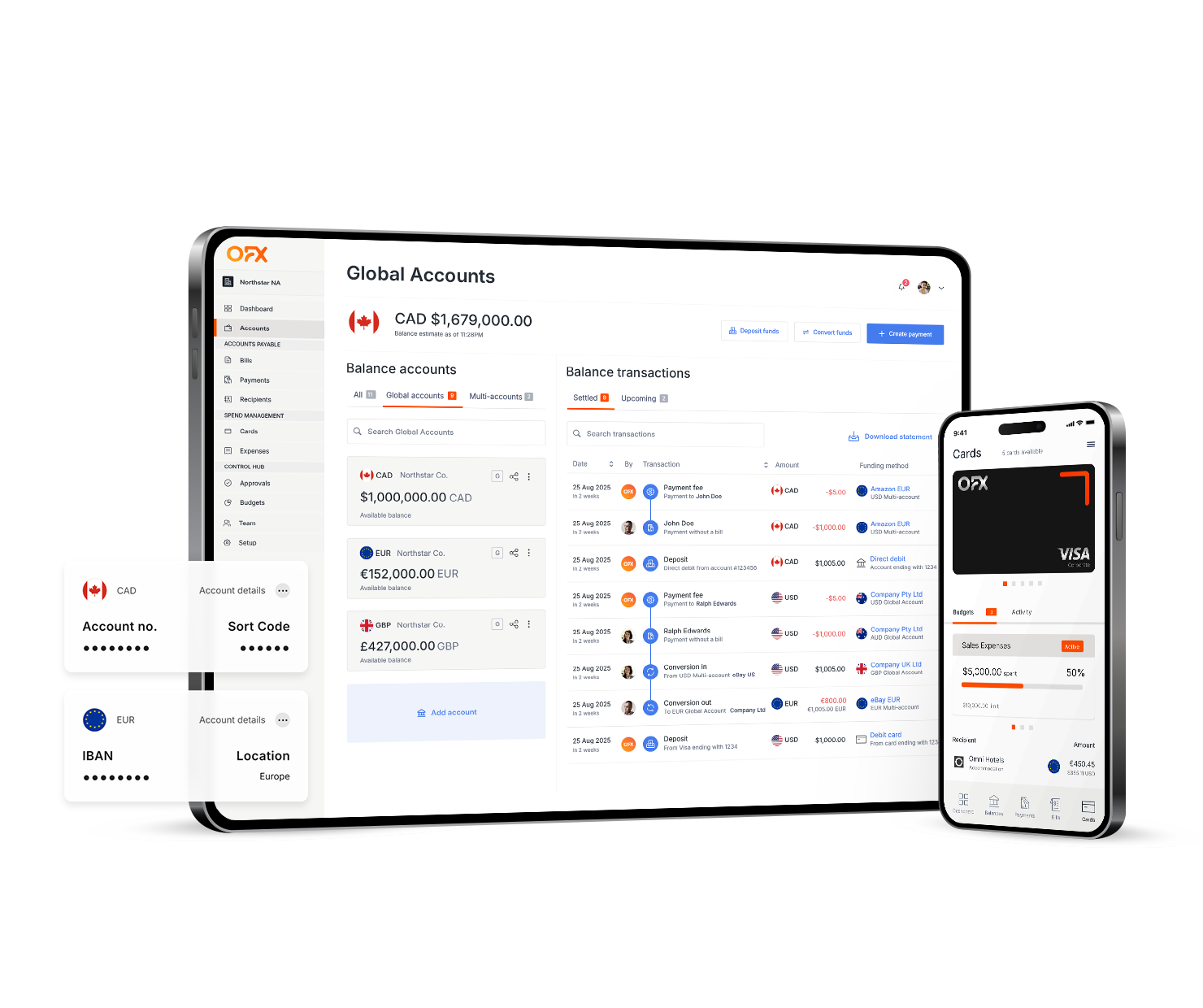
Yes. Alternatives include non-bank business transaction account providers such as OFX, which offer an all-in-one global business account. They can give you control over your finances and help you operate globally, with features such as instant virtual corporate cards, multi-currency accounts, spend management software, and batch and payroll payments.
Many businesses now pair a traditional bank account for domestic needs with a fintech account for cross-border payments, getting the branch access and lending products of a bank alongside the lower fees and multi-currency flexibility of a platform like OFX.
OFX Global Business Account
Receive, hold, convert and send funds across a wide range of currencies, reduce costs and gain greater control over your international payments.
Business bank account fees: what to expect
Fees are where business accounts differ the most, and a low monthly fee doesn’t always mean a cheap account. It helps to look at the full picture: the monthly plan fee, per-transaction charges, Interac e-Transfer fees, and the cost of moving money across borders.
- Monthly plan fees range widely. Some plans start from C$5 or C$6 a month, while high-volume plans can run to C$65 or more.
- Per-transaction fees apply once you exceed an included allowance, often around C$1.25 per extra transaction.
- Interac e-Transfer fees are commonly around C$1.50 to send, though some providers include a monthly allowance.
- International wire fees are charged on both outgoing and incoming transfers, and typically range from around C$30 to C$50 to send.1
- Foreign exchange costs are the fee that’s easiest to miss. Banks usually build a markup into the exchange rate on top of any wire fee. Independent comparisons put a typical Canadian bank wire at 2.5% to 4% margin buried in the exchange rate, so it pays to compare the FX cost alongside the headline fees.1
Because FX markups and transfer fees are separate costs that add up, businesses that pay overseas often save the most by comparing the exchange rate itself, not just the monthly fee.
Top business bank accounts and fintech alternatives in Canada (2026)
Here’s a closer look at some of the strongest business bank accounts and fintech alternatives available to Canadian businesses right now.
BMO business accounts
Best for: Small businesses wanting low-fee Big Five banking.
BMO offers a range of business plans to match your activity. Monthly fees run from C$5 for Essential, C$25 for Everyday, C$50 for Enhanced (waived with a C$35,000 balance) and C$75 for Elite (waived with a C$75,000 balance).2 Interac e-Transfers cost C$1.50 to send, and an international wire is around C$50 to send (C$40 plus a C$10 commission) and C$16.75 to receive.3
TD Basic Business Plan
Best for: Businesses banking through self-serve channels.
A good fit for low-volume businesses. For C$5 a month you get 5 transactions, with extra transactions at C$1.25 each.4 Interac e-Transfers are C$1.50 to send, outgoing wires are a flat C$50 and incoming wires are C$17.50.5 On card and ATM spending abroad, TD adds 3.5% over the mid-market rate.6
RBC Digital Choice Business Account
Best for: Digital-first businesses needing Big Five credibility.
Built for digital-first businesses at C$6 a month.7 International wires start from C$15 online (C$45 in-branch) to send and C$17 to receive, cross-border debit and point-of-sale purchases carry 2.5% over the interbank rate plus C$1, and Interac e-Transfers are C$1.50 to send with 10 free each month.8
CIBC Unlimited Business Operating Account
Best for: High-volume businesses needing in-branch service
Aimed at high-volume businesses at C$65 a month (waived with a C$65,000 balance), covering unlimited transactions.9 Outgoing international wires are tiered at C$30, C$50 or C$80, and incoming wires are C$15.9
Scotiabank Right Size Account for Business
Best for: Businesses with Caribbean and Latin American connections.
A flexible, pay-as-you-go option that charges the greater of C$6 a month or your per-transaction total.10 Per-transaction fees step down from C$1.25 (1–15 transactions) to C$1.15 (16–50) to C$1.00 (51+), sending an Interac e-Transfer is C$1.00 and an incoming wire is C$18.10 Scotiabank’s international network is particularly strong in the Caribbean and Latin America, which can be an advantage for businesses with trade connections in those regions.8
Wise business account
Best for: International-focused freelancers and agencies.
An established fintech with no monthly subscription and a one-off C$55 setup fee.11 Currency conversion fee range from 0.48%11 to 2%12 depending on currency pairs and volumes, and Wise pays 2.22% APY on eligible CAD balances.13 It’s often chosen for simple, low-cost transfers.
Venn
Best for Startups and solopreneurs that want a plan-based growth account.
Venn offers tiered plans at C$0 (Essentials), C$40 (Plus) and C$100 (Pro) a month.14 FX fees range from 0.25% to 0.45% depending on tier, international wires are C$10, C$8 or C$6 by tier (receiving is free), and it pays 2% interest on CAD and USD balances.14
OFX Global Business Account
Best for: Growing businesses with international payments needs and multi-currency spend management
A fintech alternative built for cross-border businesses, and a good option for startups and growing companies with overseas suppliers, staff or customers. Pricing is simple: the Standard plan is free, C$0 month and comes with cards and unlimited users (on fair use), while the Full Suite plan is C$75 a month including 5 users, with each additional user at C$10 a month. Custom plans are also available.15
There are no international transaction or conversion fees when you pay in or receive CAD, USD, GBP or EUR using local account details.16 Open domestic and foreign-currency accounts in minutes, spend in major currencies with a multi-currency corporate card, set budgets for teams or projects, automate approvals, and capture receipts in-app for effortless expense tracking.
Compare the best business accounts and fintech providers in Canada
| Provider | Monthly fee | Included transactions | International and FX fees | Interac e-Transfer | Multi-currency account |
|---|---|---|---|---|---|
| BMO | From C$5 (Essential) to C$75 (Elite)2 | Varies by plan | Wire around C$50 to send / C$16.75 to receive, plus a markup on the exchange rate3 | C$1.50 to send3 | No |
| TD | C$5 (Basic Business Plan)4 | 5 included4 | Wire C$50 to send / C$17.50 to receive,5 3.5% over mid-market on cards6 | C$1.50 to send5 | No |
| RBC | C$6 (Digital Choice)7 | Unlimited electronic cheque deposits7 | Wire from C$15 online / C$17 to receive, 2.5% + C$1 on cross-border purchases8 | C$1.50 to send, 10 free per month8 | No |
| CIBC | C$65 (Unlimited Operating)9 | Unlimited9 | Wire C$30–C$80 to send / C$15 to receive9 | Included in unlimited plan9 | No |
| Scotiabank | Greater of C$6 or per-transaction total10 | Pay per transaction10 | Incoming wire C$1810 | C$1.00 to send10 | No |
| Wise | C$0 (C$55 one-off setup)11 | Pay as you go | Conversion fee from 0.48%11 to 2%12 | Not applicable | Yes |
| Venn | C$0 / C$40 / C$10014 | By plan tier | FX 0.25%–0.45%, wire C$6–C$10 by tier14 | Free | Yes |
| OFX | C$0 (Standard) to C$75 (Full Suite)15 | Unlimited users on Standard (fair use)15 | No international transaction or conversion fees in CAD, USD, GBP or EUR via local account details16. Others the cost is in the exchange rate, shown before you book. Competitive FX rates. | Free | Yes |
Compare business savings accounts
| Account | Interest rate | Details |
|---|---|---|
| RBC Business Essentials Savings Account | 1.75% to 2.19%17 | Free transfers between RBC accounts, 2 free cheques or debits, 999 credits and deposits |
| Scotiabank Right Size Savings for Business | 1.50% to 2.15%18 | Free transfers between Scotia accounts, unlimited free transactions via online or mobile banking (CAD) |
| Tangerine Business Savings Account | 1.95% to 2.55%19 | No transaction fees |
The alternative business transaction account
| Feature | OFX Global Business Account — Standard | OFX Global Business Account — Full Suite |
|---|---|---|
| Monthly fees | No monthly cost15 | C$75 per month, including 5 users15 |
| Users | Cards and unlimited users (fair use)15 | 5 users included, then C$10 per additional user per month15 |
| Additional plans | Custom plans available15 | Custom plans available15 |
| International FX fees | No international transaction or conversion fees when paying in or receiving CAD, USD, GBP or EUR using local account details.16 Custom pricing available for clients with large, ongoing FX transfers. | No international transaction or conversion fees when paying in or receiving CAD, USD, GBP or EUR using local account details.16 Custom pricing available for clients with large, ongoing FX transfers. |
| Corporate Cards | Yes – multi-currency, no fx fees when spending from held balances | Yes – multi-currency, no fx fees when spending from held balances |
| Multi-currency accounts | Yes | Yes |
| Spend management | No | Yes – AI powered expense management and ap automation |
| Other features | Batch payments, FX Solutions, multi-currency cards, accounting software integrations | Batch payments, FX Solutions, multi-currency cards, accounting software integrations, spend management, accounts payable automation software |
What to consider when choosing a Canadian business account
The right business checking account depends on how your business operates day to day. Here are the key factors to weigh:
- Transaction volume: If your business processes more than 50 transactions a month, look for accounts with unlimited transactions included in the monthly fee. Per-transaction fees add up quickly.
- Monthly fees: many accounts come with base fees, but some providers waive them if you hold a minimum balance or make only a limited number of transactions.
- FX costs on international payments: Big Five banks typically mark up foreign exchange rates by 2.5–4%1. If you’re paying overseas suppliers or receiving international payments, a provider like OFX or Wise can deliver meaningful savings.
- Interac e-Transfer transactions: if your business often makes domestic digital payments, consider an account with high or unlimited e-Transfer limits to avoid charges that add up.
- Accounting software integration: Look for accounts that sync with Xero, QuickBooks, or your existing accounting platform. Manual data entry creates errors and eats into your team’s time.
- Branch access vs. digital-only: decide whether you truly need branch access, or whether you can run your business on an online platform and benefit from the savings.
- Lending and credit access: Traditional banks are still the primary source for business lines of credit, term loans, and commercial mortgages. If borrowing is on your roadmap, maintaining a bank relationship has strategic value.
- 24/7 support: If you’re planning to expand into in-person or online sales, consider a provider that supports these options as your business grows
- Cash flow management tools: sub-accounts by employee or team can help you track performance, allocate funds and control spending.
- Scalability: as your business grows, look for multi-user access, multi-currency support and time-saving tools like expense management so you don’t have to switch providers later.
How are businesses using multiple business accounts?
- Easier accounting: multiple accounts simplify financial tracking, especially at tax time. Set up separate buckets for expenses, income, payroll and savings for a clearer view of cash flow.
- Savings interest and rewards: earn interest on surplus funds with a business savings account, or benefit from reward programs such as cashback on card purchases.
- Manage spend with virtual corporate cards: track specific expenses like travel or subscriptions using an account that supports multiple virtual or employee-issued cards.
- Better budgeting: separate accounts, or a finance platform that segments spend by team or project with automatic spend rules, make it easier to monitor budgets.
- Added security: spreading funds across accounts may help limit potential losses if your business is targeted by a scam or fraud attempt.
Can you open a business transaction account (from a fintech) alongside a business bank account?
Yes. Many of our clients keep bank accounts for legal or borrowing purposes while using an OFX Global Business Account to save time and money on their financial operations and currency transfers.
“I was recommended to use OFX, but honestly I wish I knew about it sooner. By far OFX is the most competitively priced and easiest platform we’ve ever used. The user experience and customer service have been a lot better for our finance teams to manage,” said Jonathon, co-founder of BikesOnline.
Opening and managing your account online
One of the biggest differences between providers is how quickly and easily you can open and run an account. Most banks and fintechs now let you open a business account online, though some banks may still ask for an in-person visit to verify details. Fintech providers like OFX are fully digital, so you can register in minutes and manage everything from an app.
Opening a business account in Canada is fairly simple but requires a few essential documents. Here’s what you’ll usually need:
- Government-issued ID (such as a driver’s licence or passport)
- Business registration documents or articles of incorporation
- Canada Revenue Agency (CRA) business number
- Partnership or shareholder agreements (if applicable)
- A minimum deposit (some banks require this to open the account)
If you’re planning to open more than one account, such as a savings account alongside your operating account, double-check any linked-account conditions. It’s also worth checking whether the provider offers promotional discounts for new customers, which can help offset your initial monthly fees.
Are business accounts protected? CDIC and FINTRAC
Deposits held at Canadian banks are generally covered by the Canada Deposit Insurance Corporation (CDIC) up to eligible limits. Fintech providers are regulated differently, so it’s worth understanding how your money is safeguarded.
In Canada, OFX is registered with the Financial Transactions and Reports Analysis Centre (FINTRAC) under registration number M08560392. OFX is registered as a money services business with Revenu Québec under registration number 10713. OFX is not a bank so you are not protected by the Canada Deposit Insurance Corporation (CDIC) when you send money with OFX.
Learn more about how OFX keeps your money and information secure.
To balance that, OFX brings more than 25 years of experience, is regulated by 50+ regulators worldwide, holds ISO 27001:2022 certification, and uses advanced transaction monitoring and fraud controls. OFX also follows a risk-averse payout model, so funds are never paid out before they are received.
Why multi-currency accounts matter for modern businesses
These days, more Canadian businesses are working with international suppliers, clients and contractors. If you’re importing or exporting goods, offering services abroad, managing remote teams or simply paying for Google ads in USD, foreign transactions can quickly become part of your daily operations.
A multi-currency account lets you hold and move money in different currencies, like USD, EUR and GBP, alongside Canadian dollars. This can reduce exchange rate conversion fees and give you better control over when and how you make payments in different currencies.
Why OFX stands out for Canadian businesses
The big banks like RBC, TD Canada Trust, BMO and CIBC offer trusted services, though they often come with higher FX fees and fewer features for businesses that operate globally.
Fintech companies like OFX offer an all-in-one global business account built to help businesses expand and operate internationally without the hassle. With one platform for greater visibility and control, you can track every expense in one place, control spending before it happens, and get 24/7 support from real people, without high monthly fees.
Achieve more with the OFX Global Business Account:
- Open domestic and multi-currency business accounts within minutes
- Spend like a local with a multi-currency corporate card that saves on currency conversions
- Track all your expenses in one place and control spend before it happens
- Gain more budget control with employee and company, physical and virtual cards
- Save time with built-in AI powered accounts payable invoice automation
- Pay invoices and employees in bulk with batch payments
- Get 24/7 support from real people who understand your needs
See our business pricing for more details.
Best business bank accounts FAQs
Which bank account is best for businesses in Canada?
The right account depends on your business’s size, transaction needs, and whether you operate locally or globally. If you’re a small to mid-sized business managing cross-border payments or remote teams, OFX could be a great alternative to a traditional bank.
Traditional banks normally offer in-person service and wider branch access, while fintech providers like OFX tend to offer flexible features and lower FX fees.
What are the top 5 commercial banks in Canada?
Canada’s Big Five banks are RBC, TD, BMO, CIBC, and Scotiabank. Together, they hold the majority of Canadian business banking deposits and offer the widest branch networks across the country.
How much does a business bank account cost in Canada?
Monthly fees range from $0 (OFX Standard plan, Wise) to $120+ (Scotiabank’s premium tier). Many accounts waive fees if you maintain a minimum daily balance between $5,000 and $75,000. Transaction fees, Interac e-Transfer costs, and FX markups are additional costs to factor in.
What is the difference between a business bank account and a fintech business account?
A traditional bank account offers branch access, lending products, and CDIC deposit insurance. A fintech account is not a bank, and they typically provide lower fees, multi-currency support, and integrated software tools like spend management and AP automation. Many businesses use both.
How can I open an OFX account?
OFX registration takes under 10 minutes online. You’ll provide basic business information and identity documents. Verification typically completes in 2–3 business days, with immediate platform access while KYC finishes. There’s no branch visit, no minimum deposit, and no lock-in contract.
Looking for an alternative to your bank?
Sources:
- https://transferfees.io/send-money/from-canada/
- https://www.bmo.com/en-ca/main/business/accounts/overview/
- https://www.bmo.com/pdf/better-business-banking-guide.pdf
- https://www.td.com/ca/en/business-banking/small-business/bank-accounts
- https://www.td.com/content/dam/tdct/document/pdf/business-banking/521998.pdf
- https://www.td.com/content/dam/tdct/document/pdf/business-banking/520594A.pdf
- https://www.rbcroyalbank.com/business/accounts/digital-choice-business-account.html
- https://www.rbcroyalbank.com/business/pdf/services_fees.pdf
- https://www.cibc.com/content/dam/small_business/bus-acct-service-fees-en.pdf
- https://www.scotiabank.com/content/dam/scotiabank/refresh/documents/bank-accounts/english/fees_interest_schedules.pdf
- https://wise.com/ca/pricing/business
- https://transferfees.io/guides/wise-fees-explained/
- https://wise.com/ca/business/interest
- https://www.venn.ca/pricing
- https://www.ofx.com/en-ca/business/pricing/
- https://www.ofx.com/en-ca/business/global-business-account/
- https://www.rbcroyalbank.com/business/accounts/business-essentials-savings-account.html
- https://www.scotiabank.com/ca/en/small-business/business-banking/savings-gics/right-size-savings-for-business.html
- https://www.tangerine.ca/en/business/save/business-savings-account
Disclaimer: In Canada, OFX is registered with the Financial Transactions and Reports Analysis Centre FINTRAC under registration number M08560392. OFX is registered as a money services business with Revenu Québec under registration number 10713. OFX is not a bank so you are not protected by the Canada Deposit Insurance Corporation (CDIC) when you send money with OFX.
IMPORTANT: This article was updated in August 2026. The information is based on our online research at time of publication. This publication is provided for general information purposes and a reader should consider the specific requirements of their business when evaluating providers. This information does not constitute legal, tax or other professional advice from CanadianForex Limited trading as OFX or its affiliates, and it is not intended as a substitute for obtaining advice from a financial advisor or any other professional. If you would like to reques