For years, many finance teams treated FX hedging as a one-time decision. Lock in a rate at the start of the quarter, move on. It worked, until markets stopped cooperating. Now, with geopolitical instability and conflicts being the most-cited risk to global economic growth1, a static approach to currency risk is no longer a strategy. It’s a gap.
Why set-and-forget FX no longer works.
The appeal of a fixed hedging position is obvious. Lock in your rate, remove the uncertainty, focus on running the business. For a long time, that approach was good enough.
But the conditions that made it work have changed. Currency markets in 2026 don’t move in predictable cycles. They respond to central bank decisions, geopolitical events, trade corridor disruptions, and supply chain shifts — often simultaneously. A rate locked three months ago may bear little relationship to the exposure your business is carrying today.
The result is a growing gap between where finance teams think their FX risk sits and where it actually is. According to Agicap’s 2025 survey2 of US mid-market companies, unreliable cash flow forecasts cost businesses an average of $465,000 annually, and 43% of mid-market companies admit to relying on them. When the forecast is unreliable, the hedge built on top of it is too.
For example: The 2016 US presidential election is a useful illustration. The USD/CAD pair rose sharply in the lead-up to the vote, then fell quickly after the result. A Canadian manufacturing client working with an OFX specialist used a Forward Contract to lock in the exchange rate before the move. By mid-December, when the pair had shifted against them, the position held — and the client ended up with approximately CA$4,000 more on a CA$100,000 transfer than they would have with a spot transfer. The market moved. Their margin didn’t.
What layered hedging actually means.
Layered hedging isn’t a single decision. It’s an ongoing approach to managing currency risk. Instead of relying on one hedge at one point in time, businesses gradually cover a portion of their future currency exposure on a rolling basis, using different hedging tools as their needs change.
The shift is from trying to time the market, to following a consistent process. Rather than making one large hedge based on where you think rates are heading, you make smaller hedging decisions at regular intervals. This means part of your near-term exposure is covered now, additional future exposure is covered over time, and you still retain flexibility if market conditions move to your benefit.
This matters most when market events are unpredictable in their timing but predictable in their effect.
For example: The Brexit referendum in 2016 is a case in point. Most of the market expected the UK to remain in the EU. When the vote went the other way, the GBP/USD pair dropped close to 15% in the weeks that followed. A food manufacturing startup that had just received a US$20 million funding round worked with an OFX specialist before the vote to set Limit Orders at a rate below where GBP/USD was trading at the time. When sterling fell sharply after the result, the orders were executed — saving the business US$600,000 on the transfer.
The finance leaders navigating currency volatility well in 2026 are not the ones with better market intelligence. They’re the ones who built a structure that doesn’t require them to be right about timing.
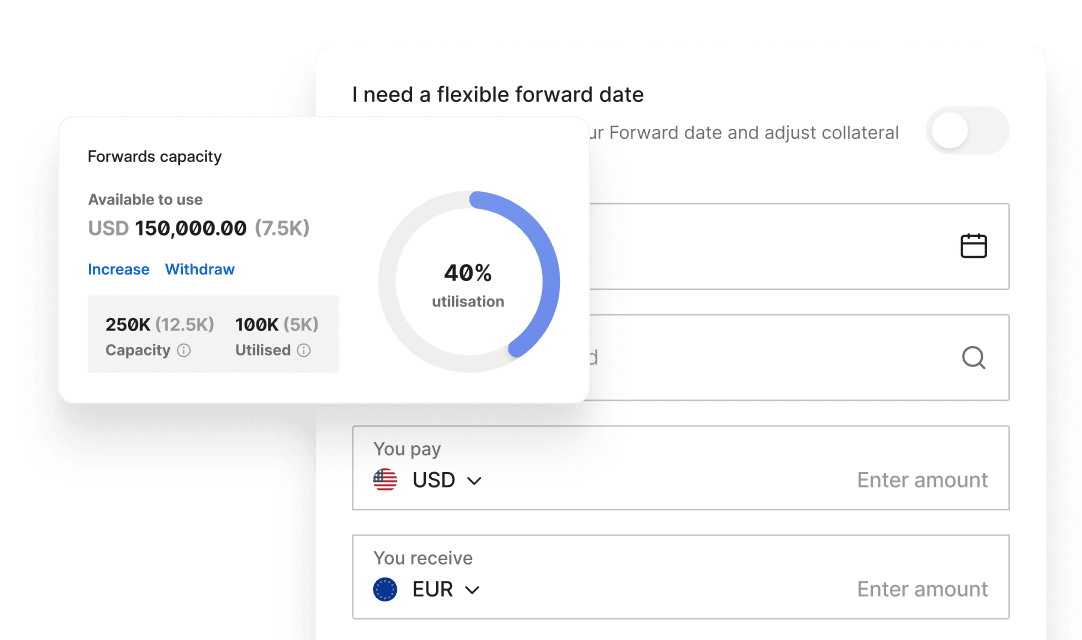
Protect your margins from rate movements. See how OFX Forward Contracts work.
Three hedging tools that can give finance teams more control.
A layered hedging strategy typically draws on a combination of three tools. Understanding what each does, and when to use it, is the foundation of a structured approach.
- Forward Contracts*
A Forward Contract lets you lock in an exchange rate today for a payment up to 12 months in the future. You know exactly what you’ll pay, regardless of where the market moves. This is the anchor of most layered hedging frameworks: covering a known, committed exposure with certainty.
Most teams are careful not to over-hedge. For example, locking in 100% of forecast exposure removes all upside if the rate moves to your benefit. Many frameworks cover a rolling proportion, enough to protect the business, not so much that it eliminates flexibility.
For example: In the lead up to the 2020 US presidential election, EUR/USD appreciated by around 13% between May and December. A machinery broker sourcing glass equipment from Italy — negotiating in USD with buyers, paying suppliers in EUR — used Forward Contracts on each invoice, covering approximately €2 million in total. By locking in the pre-election exchange rate across its invoices, the business protected its margin through a period of significant EUR/USD movement, saving the equivalent of five figures on the year’s transactions. - Limit Orders^
A Limit Order lets you set a target rate and act when the market reaches it. Rather than watching screens and trying to time the market manually, you define the rate that works for your business and let FX specialists do the work for you.
Limit Orders are particularly effective as a complementary layer to Forward Contracts — covering the portion of your exposure where you’re willing to wait for a better rate, without committing to act at spot. - Spot Transfers
Spot transfers remain part of the picture, particularly for payments that arise unexpectedly or where the rate is already to your benefit. A layered framework doesn’t eliminate spot transfers. It places them in context, so they’re a considered part of the strategy rather than the default.
Forward contracts gave us the ability to plan and know exactly what our costs would be. It’s not just about the rate, it’s about having a strategy.”
Steven Moffat, VP Finance, North American Produce Buyers
Building a rolling hedging framework.
The practical question for most finance teams isn’t whether to hedge. It’s how to build a process that runs consistently without requiring constant manual intervention.
A rolling framework typically works in three steps.
Step 1: Map your exposure
Start with what you actually know. Which payments are committed and in which currencies? What’s the timing? Which are firm obligations versus forecasts? The goal is a clear picture of near-term, medium-term, and long-term exposure across each currency corridor you operate in.
Step 2: Define your coverage ratio
Decide what proportion of each exposure window you want to cover with certainty, and what proportion you’re comfortable leaving open to the market. There’s no universal answer — it depends on your margin sensitivity, your forecast confidence, and your appetite for rate movement. A starting point for many businesses is covering 60–80% of near-term committed exposure with Forward Contracts, and using Limit Orders for a further proportion of medium-term exposure.
Step 3: Build the review cadence
A rolling framework requires regular review. Not daily, but at a defined frequency that matches your payment cycle. Monthly is common for businesses with consistent cross-border payment volumes. The review updates the exposure picture, assesses current coverage, and makes the next round of hedging decisions.
The discipline is in the consistency, not the complexity. When you’re ready to go deeper, explore more types of hedging strategies.
Stop reacting. Start planning.
Currency exposure doesn’t wait for a convenient moment. It builds across every committed payment, every new supplier corridor, and every invoice raised in a foreign currency. By the time it shows up in the numbers, the opportunity to manage it well has already passed.
That structure looks different for every business. The instruments are the same. Forward Contracts to lock in committed exposure, Limit Orders to capture upside without watching screens, Multi-currency Accounts to hold currency where it’s needed. The framework around them needs to reflect how your business actually moves money.
That’s where OFX Specialists come in. They can help you understand the tools available to manage currency risk, explain how different strategies work, and help you get the most out of our platform as your business operates internationally.
Volatility is the environment now, not the exception. The businesses that hold their margins through it aren’t the ones who called the market right. They’re the ones who stopped needing to.
*If you book a Forward Contract, it may mean losing out if the market rate improves because you’re contracted to settle at the agreed rate. Read more.
Forward Contracts are not available for clients in Singapore.
NZForex issues derivatives to wholesale clients only. Retail clients are not permitted or eligible to enter into any forward contract.
^If you book a Limit Order, it may mean losing out if the Market Rate continues to move above your Target Rate. There is no guarantee that your desired rate will be reached. Once the order is triggered, the transfer is binding and cannot be voided.
Stop watching rates.
Start locking them in.
Sources