Foreign exchange markets move constantly. For businesses operating internationally, these movements can directly impact costs, revenue, and profitability.
Exchange rate volatility and FX risk are not just financial concepts, they are operational realities that affect pricing decisions, cash flow forecasting, and long term growth.
In this guide, we explain what causes exchange rate volatility, how FX risk affects businesses, and how OFX helps companies manage currency risk through flexible FX solutions and global payment tools.
What is exchange rate volatility?
Exchange rate volatility refers to the degree and speed at which one currency’s value changes against another. These fluctuations are a natural feature of the global FX market and can occur daily or even within minutes.
Currency volatility matters because even small movements in exchange rates can significantly affect the cost of international payments, overseas payroll, supplier invoices, and foreign revenue.
Key causes of exchange rate volatility
- Economic indicators: Inflation data, employment figures, GDP growth, and consumer confidence influence how markets value a currency.
- Interest rates and central bank policy: When central banks raise or lower interest rates, currencies often react quickly as investors rebalance capital flows.
- Monetary and fiscal policy decisions: Stimulus programs, quantitative easing, and government spending plans can increase or reduce currency demand.
- Market sentiment and risk appetite: During periods of uncertainty, investors often move capital into perceived safe haven currencies, increasing volatility elsewhere.
- Geopolitical events: Elections, trade negotiations, geopolitical conflict, and regulatory changes can all trigger sharp currency movements.
- Trade balances and capital flows: Countries with strong exports or high foreign investment demand may see their currencies strengthen relative to others.
Understanding these drivers helps businesses anticipate periods of higher FX volatility and plan accordingly.
Get started today. The saving lasts forever.
You have nothing to lose, and so much time and money to save. Your all-in-one control platform is ready.
What is FX risk? Why it matters for businesses.
FX risk, also known as foreign exchange risk or currency risk, occurs when changes in exchange rates affect the value of international transactions.
Any business that pays or receives money in a foreign currency is exposed to FX risk. This exposure exists between the time a contract is agreed on and when a payment is settled.
Common types of FX risk
- Transaction risk: Occurs when exchange rates change between the invoice date and the payment date.
- Translation risk: Affects businesses that consolidate foreign subsidiaries into their reporting currency.
- Economic risk: Long term exposure that impacts competitiveness, pricing, and market positioning.
Without a clear FX risk management strategy, currency volatility can reduce margins, distort forecasts, and create cash flow uncertainty.
Managing currency risk without adding complexity.
For many finance leaders, managing currency risk feels like a balancing act. There is pressure to reduce exposure and avoid surprises, but also a need to keep processes lean and practical. The goal is not to manage FX perfectly. It is to manage it deliberately.
Managing currency risk starts with visibility and intent, not advanced market forecasting. It means understanding where exposure exists, how it changes over time, and which risks are material enough to warrant action.
In practice, this often involves a shift from reactive decision-making to planned execution. Instead of converting currency only when a payment is due, finance teams consider timing, aggregation, and predictability. They look at upcoming obligations, recurring payments, and cash flow needs together, rather than in isolation.
Just as importantly, effective currency risk management knows that not all exposure needs the same treatment. Some payments may tolerate short-term volatility. Others may justify locking in certainty. The value comes from having a framework that supports those decisions consistently, without relying on manual workarounds or last-minute judgement calls.
Managing currency risk does not require new layers of process or specialist teams. It requires clarity, alignment, and tools that support the way finance teams already operate. With that foundation in place, an FX strategy becomes a natural next step rather than a disruptive change.
How to manage FX risk with OFX.
FX volatility cannot be eliminated, but it can be managed. OFX gives businesses tools, insights, and specialist support to help reduce uncertainty and gain greater control over international payments.
Step 1: Review Your FX Exposure
The first step is understanding where and how your business is exposed to foreign exchange risk. This may include supplier payments, customer receipts, intercompany transfers, overseas payroll, or regular international expenses.
OFX specialists work with businesses to review currency exposure across operations and identify where exchange rate movements may impact cash flow, margins, or financial forecasts.
Step 2: Set Clear FX Goals
Once exposure is understood, the next step is defining what success looks like for your business. FX goals may include protecting profit margins, improving budget certainty, smoothing cash flow, or reducing the impact of short-term market volatility.
Setting clear objectives helps determine which FX tools and strategies are most appropriate for your business needs.
Step 3: Develop an FX Strategy
With exposure and goals defined, businesses can develop a tailored FX strategy using OFX solutions.
- Lock in exchange rates with Forward Contracts*
Forward Contracts* allow businesses to lock in an exchange rate today for a future payment. This can be particularly valuable for budgeting and protecting margins when future costs are known.
With OFX Forward Contracts* businesses can secure rates for up to 12 months ahead, helping reduce uncertainty caused by currency fluctuations.
- Take advantage of market opportunities with Limit Orders**
Limit Orders** allow businesses to target a specific exchange rate. When the market reaches that level, the transaction can be executed or flagged for action.
This approach helps businesses take advantage of favorable movements without having to monitor the FX market constantly.
- Make fast and secure Spot Transfers.
For immediate currency needs, Spot Transfers enable businesses to exchange currency at the current market rate with fast settlement and competitive pricing.
OFX Spot Transfers are ideal for one-off payments, urgent supplier invoices, or short term FX requirements.
Step 4: Execute and Review Regularly
Once a strategy is in place, businesses can execute FX transactions with confidence using OFX’s secure global payment platform. Many businesses choose to review their FX strategy regularly and layer hedging over time, such as on a monthly basis, to adapt to changing cash flow needs and market conditions.
OFX specialists continue to support businesses with market insights, tools, and guidance to help refine strategies as conditions evolve.
Access to 30+ currencies directly linked to your business account, reducing unnecessary exchange conversions when you spend in those currencies.
Integrate FX management into your business workflow.
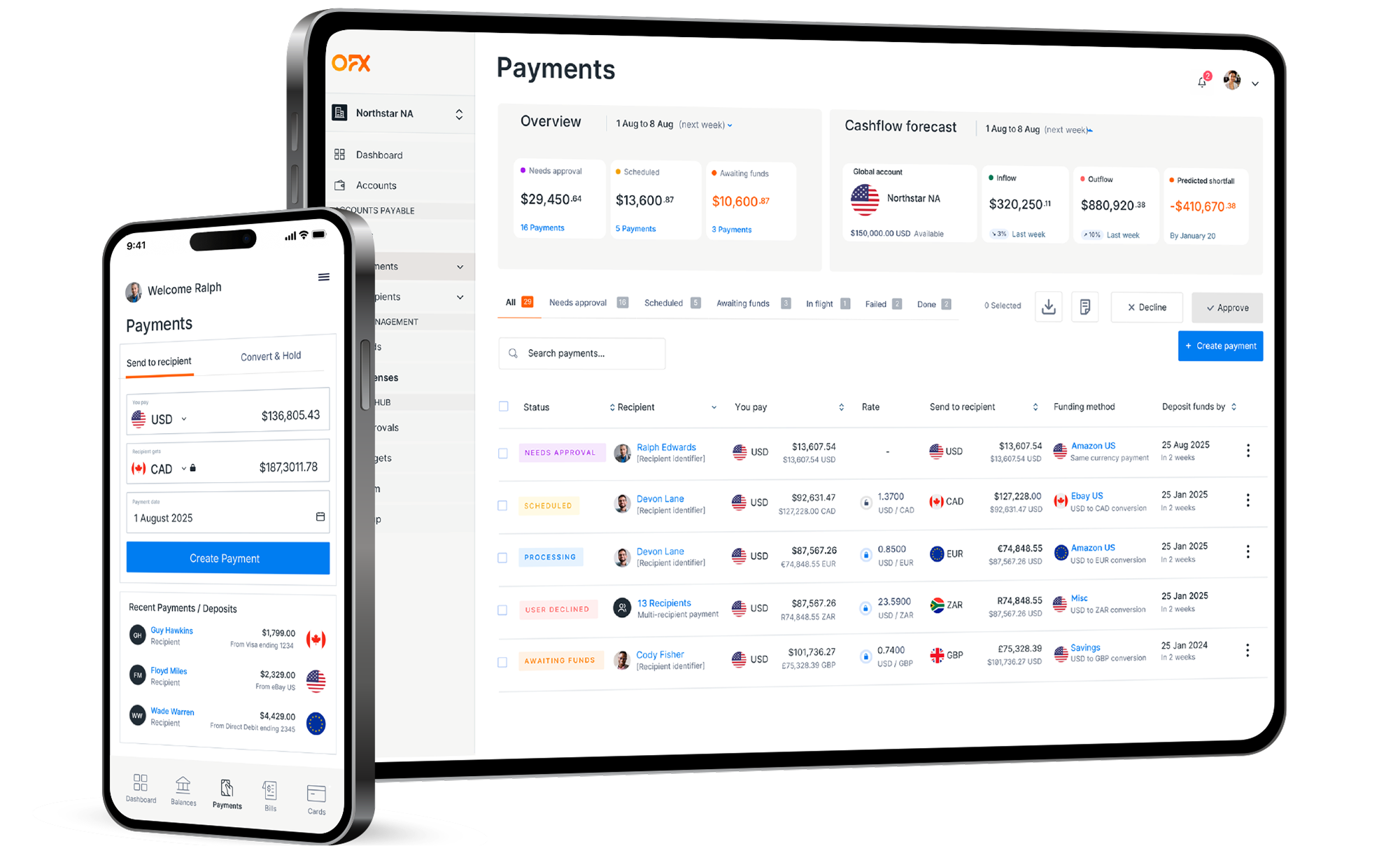
OFX integrates with leading accounting platforms such as Xero and QuickBooks, helping businesses streamline reconciliation, improve reporting accuracy, and maintain visibility over FX costs.
This integration allows finance teams to manage international payments and FX exposure within existing workflows.
OFX provides additional tools to help businesses monitor and respond to FX market movements:
- Real time exchange rate tracking.
- Rate alerts to notify you when target levels are reached.
- Market insights and currency commentary.
- Historical exchange rate data.
Why businesses choose OFX for FX risk management.
A practical FX risk management example
For a business making regular overseas supplier payments:
- Forecast upcoming foreign currency payments.
- Identify the time gap between agreement and settlement.
- Choose the right FX tool
- Use Forward Contracts* for known future payments.
- Use Limit Orders** to target favorable exchange rates.
- Use Spot Transfers for immediate needs.
- Monitor the FX market with rate alerts and insights.
- Reconcile payments using integrated accounting software
This approach helps reduce surprises and supports more stable financial planning while streamlining domestic and global payments, all in one place.
Businesses across industries use OFX to manage foreign exchange exposure with confidence. Key benefits include:
- Competitive exchange rates.
- Flexible FX solutions tailored to business needs.
- Expert support from FX specialists in country.
- Secure and reliable global payment infrastructure.
OFX helps businesses turn FX volatility into a manageable part of international growth.
Take control of FX volatility with OFX.
Exchange rate volatility and FX risk are unavoidable in global business. However, they do not have to undermine profitability or growth. With the right strategy and the right partner, businesses can manage currency exposure more effectively.
OFX offers a complete suite of FX solutions, global payments, and expert guidance to help businesses navigate currency markets with confidence.
Explore OFX FX solutions today and speak with an OFX specialist to build a smarter FX strategy.
*If you book a Forward Contract, it may mean losing out if the market rate improves because you’re contracted to settle at the agreed rate. Read more.
**If you book a Limit Order, it may mean losing out if the Market Rate continues to move above your Target Rate. There is no guarantee that your desired rate will be reached. Once the order is triggered, the transfer is binding and cannot be voided.