
Savvy finance leaders are protecting their margins by delaying international supplier payments for the right moment.
Picture this: your business is buying goods from China. Production and shipping may take six months. While your supplier invoice is locked in, your FX rate is not. By the time goods arrive and payment is due, currency movements could increase costs well beyond what you approved at the time of purchase. What now?
Ordering goods from overseas often comes with a built in time gap. You agree on a price today, but payment happens weeks or even months later. In that time, foreign exchange rates can move significantly. For finance leaders, this is not a small technical detail. It is a material risk that can disrupt budgets, margins, and cash flow forecasts.
Explore how embedding FX into the procure to pay process helps your finance team gain visibility and control over currency exposure, from purchase approval to payment.
The FX risk behind ordering today, paying tomorrow.
For finance leaders, few things are more frustrating than signing off on a budget that later proves inaccurate through no fault of the business. When international purchases are approved months before payment is due, FX risk quietly enters the equation.
Ordering goods from overseas often involves long lead times. Businesses may agree on pricing today, but settlement can occur months later. During that gap, foreign exchange rates can move significantly.
For finance teams, this creates real pressure. A purchase approved at one exchange rate can end up costing far more by the time payment is due. For example, a business buying goods from China may face a six month production and shipping timeline. While the supplier invoice is fixed, the FX rate is not. Even a small currency movement can have a material impact on margins.
What matters most is identifying this risk early, before it shows up as a budget variance that is difficult to explain or recover.
Get started today. The saving lasts forever.
You have nothing to lose, and so much time and money to save. Your all-in-one platform for global and domestic payments is ready.
Where FX exposure begins in procure to pay.
FX risk rarely appears overnight. It builds gradually, often starting well before finance teams are actively involved in making a payment.
FX exposure often begins at purchase approval, when budgets are set using an indicative exchange rate that may not apply at settlement. As weeks or months pass, that initial assumption becomes less reliable.
Limited visibility of future foreign currency payables, long settlement delays, and manual processes all increase the likelihood of cost surprises when invoices fall due. By the time payment is actioned, finance teams may be left managing the consequences rather than the risk itself.
Understanding where FX exposure originates is a critical first step toward regaining control.
How finance leaders manage FX risk earlier.
Currency markets are unpredictable, especially over longer timeframes. For finance leaders, managing the impact of that uncertainty is often more important than trying to forecast every movement.
Savvy teams bring FX decisions forward in the procure to pay process. Instead of waiting until payment day, they focus on early visibility and proactive management.
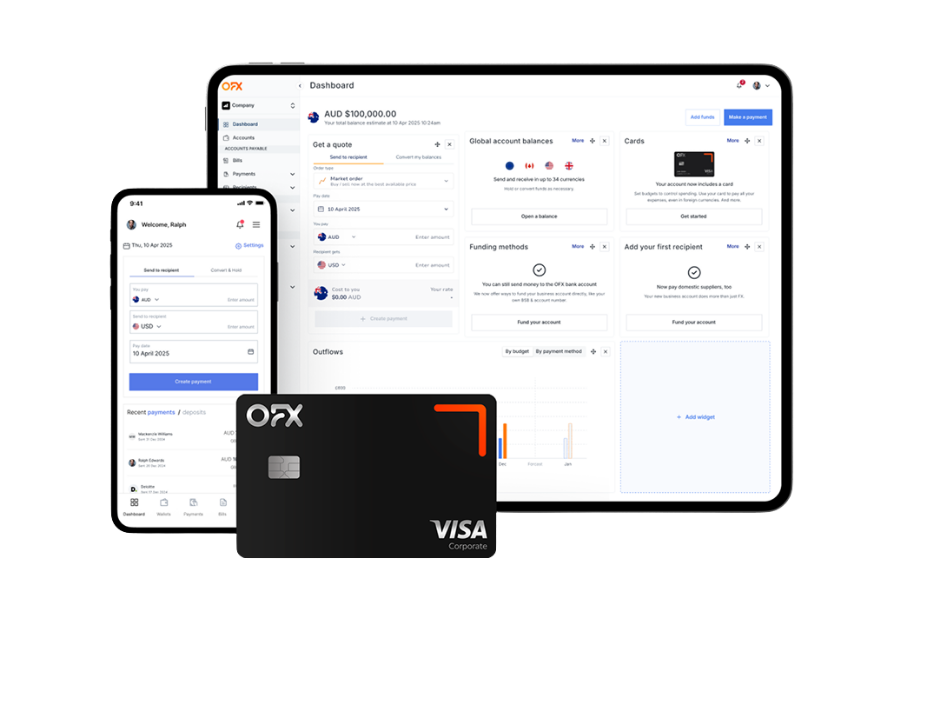
This means understanding upcoming foreign currency obligations, aligning FX decisions with purchase approvals, and creating shared visibility between finance and procurement. Consolidating international payments through tools like the OFX Global Business Account helps teams see and manage multi currency exposure in one place.
A real-world example: North American Machinery Broker uses Forward Contracts* to manage risk.
- Order placed: The client places an order for EUR 2,000,000 using the current FX rate of 1.03738 EUR/USD, meaning their payment will be US$2,074,760.^
- Payment due in 11 months: The FX rate has changed drastically since the order was placed. At time of payment the rate is EUR/USD 1.20391, meaning that the business would have paid US$2,478,200.
- Impact without FX management: The cost of the order rises over US$400,000 due to the changing rates.
- Solution with FX management: The 1.03738 EUR/USD rate was locked in at the time the order was placed using a Forward Contract and the client was able to pay exactly as they had forecasted, saving the client over US$403,000.
- Key takeaway: Protecting FX rates ensures cost certainty, reduces reconciliation work, and avoids hidden budget overruns.
When FX is treated as part of everyday financial planning, it becomes easier to support the business without slowing it down.
Procure to pay (P2P) is the integrated, end-to-end business process of requesting, purchasing, receiving, and paying for goods and services.
Tools that protect margins and cash flow.
Once FX exposure is visible, finance teams can choose tools that match the level of risk and certainty they need.
Forward Contracts* are one of the most effective tools for managing FX exposure. Order today, pay tomorrow risk. They allow businesses to lock in an exchange rate today for settlement at a future date, helping ensure final costs align with approved budgets.
Holding and paying in foreign currencies where possible can also reduce unnecessary conversions. Paying suppliers in their local currency often lowers costs and strengthens relationships. Solutions like OFX Corporate Cards support spending in multiple currencies without adding operational complexity.
The right tools give finance leaders confidence that margins and cash flow are protected, even when timelines stretch out.
From FX uncertainty to confident global payments.
Working with international suppliers inevitably involves delayed payments. For finance leaders, that reality brings pressure to balance growth, cost control, and predictability.
Order today, pay tomorrow arrangements do not have to mean accepting FX uncertainty. By embedding FX into the procure to pay process, finance teams gain greater visibility, stronger control, and more confidence in their numbers.
Early awareness, locked in rates, and thoughtful currency management allow finance leaders to protect margins while supporting the business as it scales globally.
*If you book a Forward Contract, it may mean losing out if the market rate improves because you’re contracted to settle at the agreed rate. Read more.
^ This example has been calculated on market rate at time of writing. Log into your account at ofx.com to determine your own rate.
