
When businesses think about the cost of international payments, most focus on the obvious: the exchange rate or the transaction fee. But the reality is more complex — and far more expensive.
International payments can feel like a routine part of operations. It could be a line item in the monthly ledger, a task that finance quietly handles, or a cost that’s accepted as part of doing business. Most businesses only focus on the obvious: the exchange rate or the transaction fee. But the truth could be costing you more than you realise.
FX (foreign exchange) doesn’t just cost money at the point of transfer. It can quietly consume hours of effort, create operational bottlenecks, and even introduce risk to strategic planning.
In other words, normal FX processes are expensive, not because of the fees themselves, but because of the work and inefficiencies they generate.
What is FX friction and how does it happen?
At its most basic level, FX friction is the extra work required to manage FX when making international payments.
The extra work comes from teams doing their best to mitigate uncertainty around rates, fees, and visibility.
The added layer of complexity is largely driven by the nature of cross-border payments moving through fragmented banking systems. If a team has to manage multiple bank accounts and currencies, they might rely on manual checks, reconciliations, tracking, and follow-ups to ensure payments are accurate and accountable.
Over time, it can create ongoing effort, delays, and risk that quietly consumes time, money, and attention – often without ever appearing as a formal cost.
The invisible costs of “routine” FX.
When we talk about the “cost” of FX, it’s easy to fixate on visible fees, such as a markup on a transfer or the occasional unfavorable spot rate. But these visible costs are often just the tip of the iceberg. The invisible costs can be far larger and far more damaging, yet they are rarely tracked.
Invisible costs can be financial or non-financial, and can quietly undermine business performance, team efficiency, and employee morale.
This can look like:
- Losing profit through unnoticed rate swings and markups.
- Spending extra hours on manual rate checks, reconciliations, and follow-ups.
- Holding idle cash to cover unpredictable FX costs.
- Additional steps in approvals.
- Constantly checking and comparing rates across providers.
- Reconciling discrepancies between expected and actual amounts received.
- Chasing visibility across departments to confirm payment status.
- Adding extra “just-in-case” steps to protect against errors. Occasionally correcting mistakes from errors or penalties in payments.
- Maintaining manual tracking workarounds to compensate for gaps in visibility if platforms don’t integrate across domestic and international payments.
While each can seem small on its own, collectively they can form a heavy operational burden. These tasks don’t appear on the budget, don’t show up in reports, and are rarely discussed — yet they consume significant time, attention, and energy.
There are 5 main areas of invisible costs. If any of the below apply to your business, it could be time to reassess.
1. Profit erosion from volatility and markups.
Exchange rates fluctuate constantly. A payment made today could be worth less tomorrow due to market volatility, or banks may add additional costs in its FX rate. For a business making regular international payments, these small differences can silently erode profits.
Most finance teams accept this as “the cost of doing business,” rarely questioning whether there are better ways to protect revenue. But in reality, these small losses accumulate over time, increasing costs and in turn, reducing funds available for the business.
“We saved between $20,000 and $30,000 just by going with OFX…”
Protect your bottom line and hard earned profits with our competitive rates. OFX has been supporting clients with FX for over 25 years. See how we help Apt Wealth Partners with their international payments.
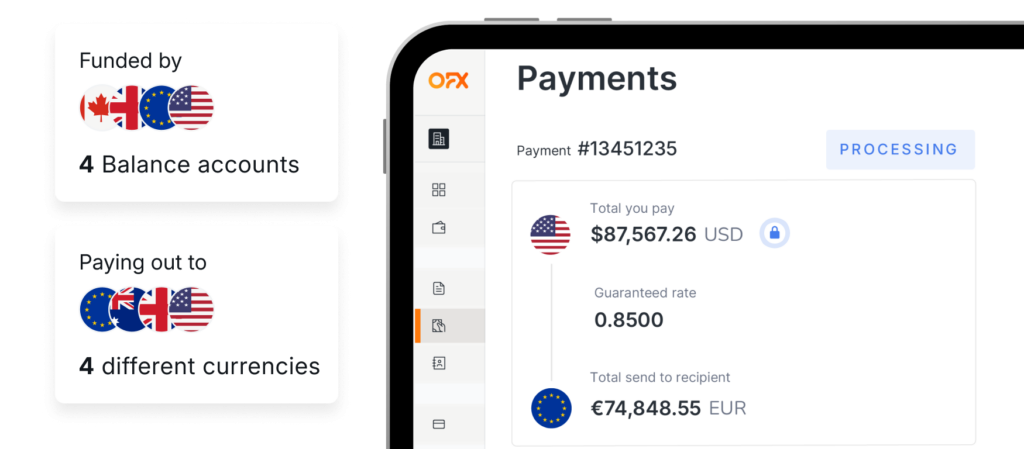
2. Effort costs and operational burden exceed visible fees.
Manual FX processes like checking rates, reconciling discrepancies, and chasing confirmations across departments can consume hours of highly skilled work — and are a recurring operational burden.
Even if each payment incurs only $50 in visible fees, the hands-on work to manage it may end up costing far more. For businesses processing dozens or hundreds of payments monthly, the cost quickly outpaces transaction fees.
Now, imagine you have a finance team of five, handling 50 international payments per month. If each payment takes an extra 30–40 minutes of manual effort due to FX inefficiencies, that’s roughly 25–33 hours per month of work lost to repetitive administrative tasks.
It doesn’t just impact time; it impacts focus. Teams constantly shift between transactional tasks and strategic priorities, which can lead to mistakes, fatigue, and slower decision-making across an already stretched finance function.
Your team’s focus could be spent on higher-value activities.
3. Strategic blind spots.
FX friction doesn’t just hit the immediate budget; it can impact financial visibility. When costs are unpredictable, forecasting becomes unreliable. Finance teams may have to hold extra cash reserves “just in case,” tying up capital that could be used elsewhere.
This unpredictability also makes strategic decisions harder. Expansion into new markets, pricing decisions, or negotiating supplier contracts all rely on accurate financial projections. Invisible FX costs can introduce uncertainty, increasing risk and reducing confidence in decision-making.
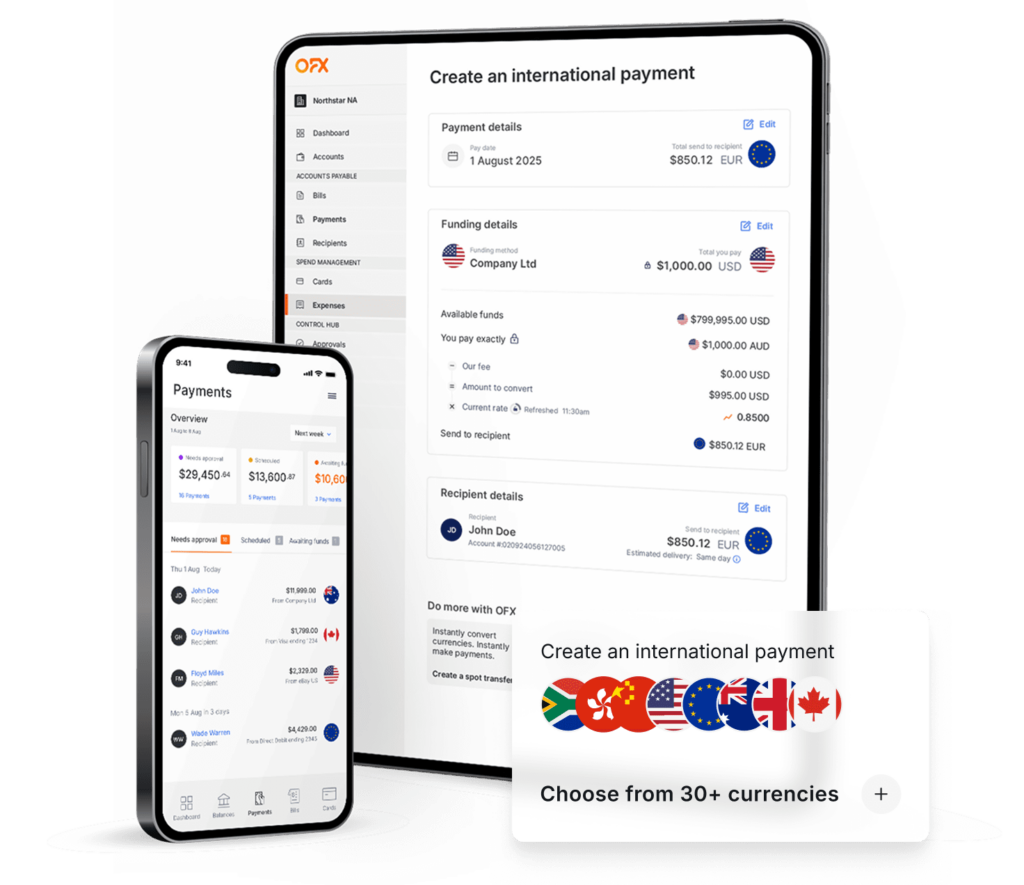
Take the friction out of FX with OFX.
FX can be simple when you integrate international payments with finance workflow. Automation, approval workflows and competitive rates. All in one place.
4. Delayed decision-making.
FX friction slows more than payment processing — it slows decisions across the business.
When departments can’t see payment statuses in real time, they delay operational or procurement decisions. Purchasing managers may hold off on critical vendor orders, sales teams may hesitate to finalize deals dependent on cross-border transactions, and finance may postpone investments until cash flow is fully reconciled.
Every delay has a cost, from missed revenue opportunities to weaker supplier relationships. Over time, these small delays can compound into significant business disadvantages.
5. Increased risk and “just-in-case” work.
Because visibility and control are limited, teams often take extra precautions. It could be manual tracking, double-checking payments, or adding buffer steps to protect against mistakes. Unfortunately, this can become standard practice. While these measures may prevent errors, they add complexity and slow operations.
Without automated oversight, a business can become more exposed to errors, fraud, or compliance issues. One overlooked discrepancy can cascade, triggering operational headaches or regulatory scrutiny.
The impact of “normal.”
In today’s global economy, speed and flexibility are competitive advantages. Businesses that can make cross-border payments quickly and confidently can respond to market changes, secure better supplier terms, and expand into new regions faster.
Essentially, if a business is experiencing FX friction, they can be slower to act. Unnecessary operational drag, strategic blind spots, and inefficient capital deployment can all reduce competitiveness on a global scale.
“The bulk of the work of manually entering information is gone…”
“OFX isn’t just about FX. [They] consolidated everything, made payments and approvals intuitive, and gave us real-time visibility and control.” See how Arms of Eve now benefits from an all-in-one financial software solution that truly works.

FX friction doesn’t have to be inevitable.
FX friction exists because cross-border payments are complex. You’re juggling multiple currencies, fluctuating rates, fragmented systems, manual reconciliation, and limited visibility. It all combines to create hidden costs.
One method to reduce FX friction is to streamline the way payments move through your systems.
Smart technology like a single financial operations platform across both international and domestic payment workflows can help to tame the complexity and remove inefficiencies. By combining automation, visibility, and integration, technology transforms international payments from a source of friction into a more predictable, efficient, and manageable process. Using technology to mitigate FX friction can reduce operational drag, lower hidden costs, and greater confidence in financial decisions.
Key ways technology solves FX friction:
- Automated rate monitoring and execution – Platforms can alert finance teams to optimal exchange rates and execute payments automatically, reducing hours of manual rate-checking.
- Unified visibility – By consolidating payment tracking, reporting, and multi-currency accounts in one dashboard, teams can see the status of all payments in real time, reducing follow-ups and internal friction.
- Integrated reconciliation – Financial platforms connect payments with accounting and ERP systems, streamlining reconciliation, reducing errors, and making forecasting more reliable.
- Consistent, automated processes – Repetitive or recurring payments can be automated, cutting down on manual workflows and freeing teams to focus on strategic tasks.
- Proactive risk management – Platforms can flag delays, discrepancies, or currency volatility, enabling finance teams to act before problems escalate.
The bottom line.
FX costs frequently extend beyond fees – the real expense often lies in the manual work it creates.
Manual rate checking, chasing payment visibility, reconciling discrepancies, and managing “just-in-case” processes quietly sap time, attention, and resources.
Financially, this friction can erode profit margins, increase work costs, and introduce unpredictability into forecasts. Operationally, it can also slow decision-making, add risk, and reduce agility. Strategically, it limits a business’s ability to grow confidently and compete globally.
“Normal” FX is often expensive, but it doesn’t have to be.
By identifying and addressing small inefficiencies in FX processes, businesses can reclaim time, reduce costs, and make international payments seamless. FX friction is optional when you use a smarter FX strategy.
Get the visibility and efficiency your FX payments need with OFX.
