
For many businesses, global growth arrives quietly. A new overseas supplier. A customer paying in another currency. A team expanding into a new market. Suddenly, money is crossing borders and the way you manage it starts to matter.
Because the account you choose for international payments doesn’t just move money. It shapes your costs. Your control. Your confidence.
Let’s break it down. Clearly and simply.
Why account choice matters for international payments.
International payments aren’t just a transaction. They’re a workflow.
They touch finance, operations, forecasting, approvals, reconciliation, and reporting. When the setup isn’t right, the friction shows up everywhere; in lost time, creeping costs and limited visibility.
Many businesses default to traditional bank accounts because that’s what they know. Others turn to multi-currency accounts as their international footprint grows.
Both have their pros and cons, but they work very differently. Understanding the difference puts you back in control.
Understanding traditional bank accounts.
A traditional bank account is usually built for domestic banking first, international payments second.
Banks enable cross-border payments by converting currencies at the point of transfer, often routing funds through intermediary banks along the way. It works, but it can be slow, opaque, and harder to manage at scale.
This is from things like most banks requiring an in-person visit to open an international business account, and some banks may require multiple accounts for managing multiple currencies. Not easy to to do all of that within bank business hours, and the cost of managing all these accounts, and exchanging funds between them, can really creep up.
Traditional bank accounts are typically used for:
- Domestic payments and collections.
- Occasional international transfers.
- Holding funds in a single base currency.
For simple needs, this may be enough. But once international payments become frequent, complexity starts to build.
How multi-currency accounts work and what they offer.
A multi-currency account is designed for global money movement from the ground up.
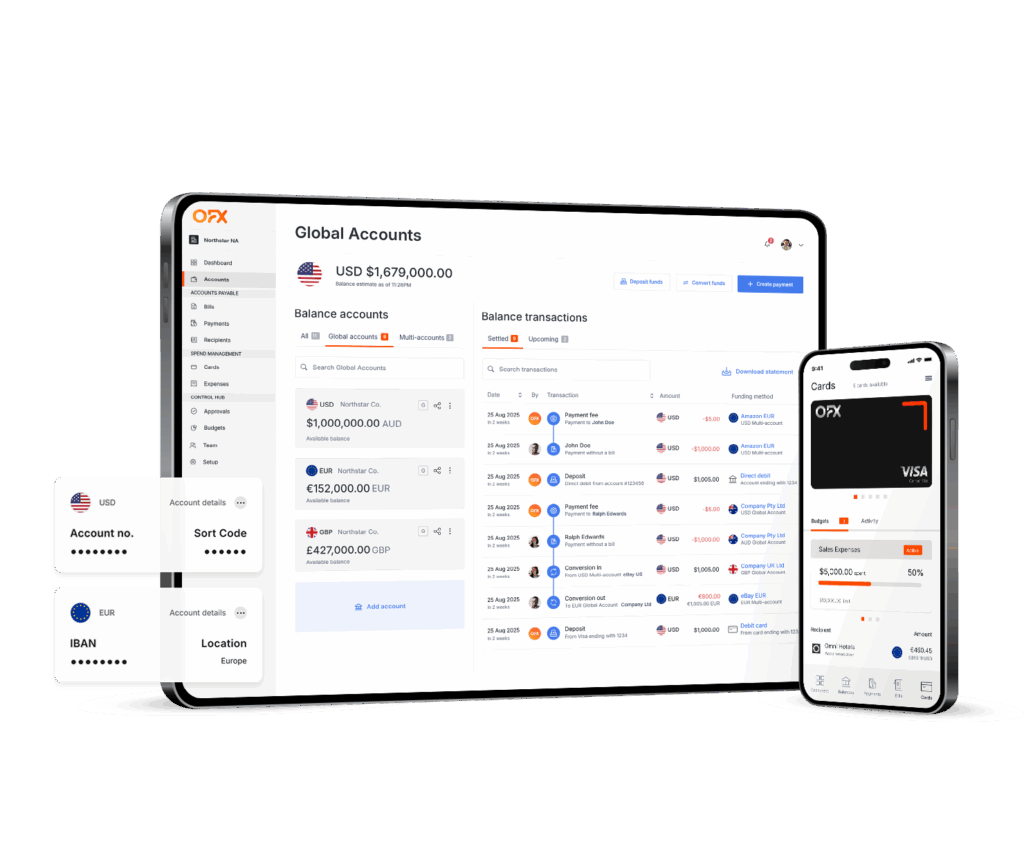
Instead of converting funds every time you pay or get paid, you can hold, receive, and send multiple currencies from one central account. Often with local account details in different regions.
This means you could hold off on converting a lump sum until the exchange rate benefits you, rather than having to convert every single time, regardless if that rate benefits you or not. Or, you could skip conversion costs completely by receiving and paying directly from your currency account. If you get paid in USD and pay a supplier in USD, there’s no need to convert at all.
Having more choice and control over how and when you convert, lets you manage FX related costs, and helps to protect your bottom line.
Beyond choice and control, a multicurrency account can be set up in minutes. No need for an in-person visit. And, quality providers will ask for business documentation as part of your setup; to ensure all compliance, security and fraud prevention standards are followed. It’s a simple and secure way to make international business, easier.
Multi-currency accounts are commonly used by businesses that:
- Pay domestic and international suppliers regularly.
- Collect revenue in their home currency and foreign currencies.
- Want visibility across global balances.
- Need flexibility as they scale internationally.
Open a multi-currency account with OFX, today.
Start managing your global cash flow with an OFX Global Business Account and see how easy international payments can be.
Compare between bank accounts and multi-currency accounts.
Choosing between a traditional bank account and a multi-currency account depends on how your business operates today and where it is headed.
If international payments are occasional and FX exposure is minimal, a traditional bank account may suffice. However, a multi-currency account might be a better fit for businesses with regular cross-border transactions being received and paid in multiple currency payments, and ambitions for international growth. This is because a multi-currency account provides more control, visibility, operational efficiency – often with higher cost savings.
Outlined below is our comparison of bank accounts vs. multi-currency accounts.
Costs and fees: how they really differ.
International payment costs aren’t always obvious. And that’s part of the problem. One of the biggest differences between traditional bank accounts and multi-currency accounts is how costs are structured and how FX risk is managed.
Traditional bank accounts often bundle FX margins into exchange rates and may charge international transfer fees and intermediary bank fees. These costs can be hard to track and can accumulate quietly over time.
In contrast, multi-currency accounts offer transparency. FX rates are often shown upfront, with fewer hidden charges, and conversions can be timed to take advantage of favorable rates.
These differences can add up, especially when transaction volumes grow.
Compare costs and fees
Traditional bank accounts often include:
- FX margins built into exchange rates
- International transfer fees
- Intermediary bank charges
- Additional costs for holding or opening foreign accounts
Multi-currency accounts tend to offer:
- Clear FX rates
- Fewer intermediary fees
- Reduced need for repeated conversions
- Centralized fee visibility across currencies
FX risk and currency management.
Currency markets move constantly. Even small shifts can impact profitability. While the impact may seem small, it can really add up.
With traditional bank accounts, conversions usually happen at the time of payment. That leaves you vulnerable to rate movements you didn’t plan for and makes forecasting harder — especially for businesses with tight margins or long payment cycles.
Add to that, banks will often bundle their higher FX margins into exchange rates and may charge international transfer fees and intermediary bank fees. These costs can be hard to track and can accumulate silently over time.
Multi-currency accounts allow businesses to hold foreign currency, reducing exposure to market volatility and eliminating unnecessary conversion fees. This not only lowers costs but also helps finance teams forecast more accurately and plan with confidence.
By converting once and holding funds in the required currency, businesses can use them whenever needed. Payments become faster to execute, and repeated FX conversions — and the costs that come with them — are avoided because funds are already available in the account.
Currency fluctuations are no longer an unpredictable risk; they become a factor that can be managed strategically. More control. Less surprise.
Compare FX and currency management
With traditional bank accounts, FX exposure is usually:
- Unavoidable at the point of payment
- Locked in at the bank’s available rate
Multi-currency accounts give you more choice:
- Hold foreign currency balances
- Convert when rates are favorable
- Align FX decisions with cashflow needs
- More efficiency and control of domestic and international payments
Operational efficiency and workflows.
International payments create work behind the scenes and involve more than simply moving money. They require approvals, tracking, reconciliation, and reporting.
With traditional bank accounts, managing multiple currencies often means managing multiple accounts, each with separate logins, statements, and reconciliation processes. This increases manual work and introduces opportunities for error or delay. This is where complexity quietly drains time.Multi-currency accounts centralize global financial operations. With all domestic and international payments integrated into one platform, approvals can be controlled in a structured workflow, and reconciliation becomes smoother. Transactions are grouped logically rather than spread across multiple accounts.
Compare operational efficiency and workflows
Traditional bank accounts can create extra work:
- Separate accounts for each currency
- Multiple logins and statements to manage
- Reconciliation happens manually, account by account
- More approvals and hand-offs across systems
Multi-currency accounts give you more choice:
- One platform for multiple currencies
- Centralized approvals and permissions
- Fewer manual hand-offs
- Easier reconciliation across regions
- Streamlined visibility and approval processes.
Visibility, control, and reporting.
When spend moves globally, visibility matters.
Traditional bank setups often fragment financial data across accounts, currencies, and systems.
That makes it harder to answer simple questions quickly:
- Where is our cash right now?
- What’s been paid? What’s pending?
- How exposed are we to FX movements today?
Visibility isn’t a luxury for finance teams. It’s essential. This makes it harder to answer simple questions quickly — especially under pressure.
Compare visibility, control and reporting
Traditional bank setups often delay insight:
- Balances sit in different accounts
- FX impacts are only visible after settlement
- Payment statuses aren’t always real-time
Multi-currency accounts bring everything into view:
- Real-time balances across currencies
- Clear payment statuses
- Centralized reporting
- Better audit readiness
Security and compliance.
Security and compliance are crucial for any business handling international payments. Neither should ever be a trade-off.
Both traditional banks and multi-currency providers operate within strict regulatory frameworks. The difference is how controls are applied, day to day.
Traditional banks provide:
- Payment authorizsation controls such as dual approvals or authentication checks, before being processed.
- Fraud and security monitoring and safeguards to detect unusual activity, payment destinations, or transaction patterns that could indicate fraud.
- Regulatory controls, anti-money laundering and reporting obligations are applied automatically to cross-border payments.
Multi-currency accounts have these as well, but often provide additional operational controls.
- Role-based user permissions let you set precise user permissions for balances, payments, approvals, and FX.
- Structured approval workflows allow for multi-step approvals that can be automated for speed, and eliminate manual work.
- Audit trails and activity logs that can track actions in searchable logs.
- Compliance and policy enforcement that can include thresholds, templates, beneficiary checks, and segregation of duties.
This makes governance easier and reduces the risk of mistakes or unauthorized transfers, giving teams peace of mind while maintaining flexibility.
Compare security and compliance
Traditional banks may have more limited day-to-day control:
- Standard user permissions, often limited flexibility
- Fewer structured approval workflows
- Limited transaction-level visibility
- Compliance controls managed mostly by the bank, not the business
Multi-currency platforms often include:
- Granular user permissions
- Approval workflows
- Transaction-level visibility
- Built-in compliance controls
Scalability as your business grows.
Growth changes everything. What works for a handful of international payments can quickly break under volume, new markets, or added complexity.
Opening traditional bank accounts in different regions can take time and add unnecessary complexity. Scalability is where multi-currency accounts really shine — they’re designed for global use.
With a multi-currency account, new currencies can be added without opening separate accounts. They can be added with just a few clicks, into the same platform for visibility and easy management. And increasing transaction volumes do not necessarily increase administrative workload. The account evolves with the business, supporting international expansion without compromising control or visibility.
Compare scalability
Traditional banks can introduce delays:
- Time-consuming account setup
- Increased administrative overhead
- More fragmented visibility
Multi-currency accounts are built to scale:
- Add currencies without opening new accounts
- Support expansion into new markets faster
- Handle growing transaction volumes without growing admin
The key differences, at a glance.
| Bank accounts | Multi-currency accounts | |
|---|---|---|
| Purpose | Primarily domestic banking with occasional international payments | Built for cross-border business and multiple currencies |
| Ideal use case | Businesses with occasional international payments; simplicity prioritized | Businesses with regular cross-border transactions; FX cost, control, and visibility are critical |
| Currencies | Usually one base currency; separate accounts required for others | Hold multiple currencies in one account; local payments supported |
| FX conversion | Conversion happens automatically at payment; rates include hidden margins | Control when and how conversions occur; can convert favorable rates and hold funds in account |
| Fees & costs | FX margins, transfer fees, intermediary fees, additional foreign currency account charges; often opaque | Transparent FX pricing, fewer intermediaries, predictable costs, centralized reporting |
| Operational efficiency | Multiple logins, statements, and reconciliations; manual workflows | One platform, centralized approvals, automated tracking, easier reconciliation |
| Visibility & reporting | Balances across multiple accounts; FX impacts only visible after settlement; delayed payment statuses | Real-time balances, clear payment statuses, centralised reporting, strong audit trails |
| Security & compliance | Standard user permissions; compliance managed mainly by bank; less day-to-day operational control | Granular user permissions, approval workflows, transaction-level visibility, built-in compliance controls |
| Scalability | Adding currencies or accounts adds complexity; more administrative overhead | Easily add currencies, support new markets, handle growing volumes without increasing workload |
Final thoughts: staying in control of international payments.
International payments don’t need to feel complex, fragmented, or hard to control.
The account structure you choose sets the stage for how efficiently and confidently your business can operate across borders. Multi-currency accounts bring clarity where there was guesswork, control where there was friction, and visibility where there was fragmentation.
With the right setup, integrated domestic and global payments become simpler, predictable, and strategically manageable. Your business can move money with confidence, focus on growth, and stay ready for whatever comes next.
Simplify international payments with OFX today