For any business moving money across borders, foreign exchange (FX) isn’t just a back-office necessity. It’s a strategic lever that can impact profit margins, supplier relationships, and even competitiveness in global markets.
That’s where having the right FX tools in your back pocket makes all the difference.
We’ll give you clear definitions, real-world scenarios, risk management considerations, and a handy comparison table.
By the end, you’ll know how to choose the right currency tool for the job, and how OFX helps integrate FX strategy directly into your Accounts Payable (AP) and treasury workflows.
Spot transfers: fast and straightforward.
When speed matters most, spot transfers are the go-to FX tool. They let you lock in today’s exchange rate and settle quickly.
This makes spot transfers ideal for urgent supplier invoices, one-off overseas expenses, or last-minute obligations.
The trade-off?
While you get immediacy and flexibility, you also take on high exposure to currency swings.
For businesses that rely heavily on predictability, this exposure to volatility can be risky.
What is a spot transfer?
A Spot Transfer is the simplest FX transaction. We guarantee our spot rates for 48 hours. Lock it in now and carry on.
Think of it as paying the “today price” for your foreign currency.
When to use it:
- Time-sensitive payments: An overseas supplier needs to be paid immediately.
- Unexpected expenses: You suddenly need to cover shipping, taxes, or an urgent invoice in another currency.
- Short-term obligations: You’re not looking to hedge or speculate — you just need the funds moved quickly.
Risk management considerations:
- Pros: Instant, transparent, and flexible.
- Cons: You’re fully exposed to market volatility. If the rate moves against you tomorrow, there’s no protection.
Forward contracts: Lock in price certainty.
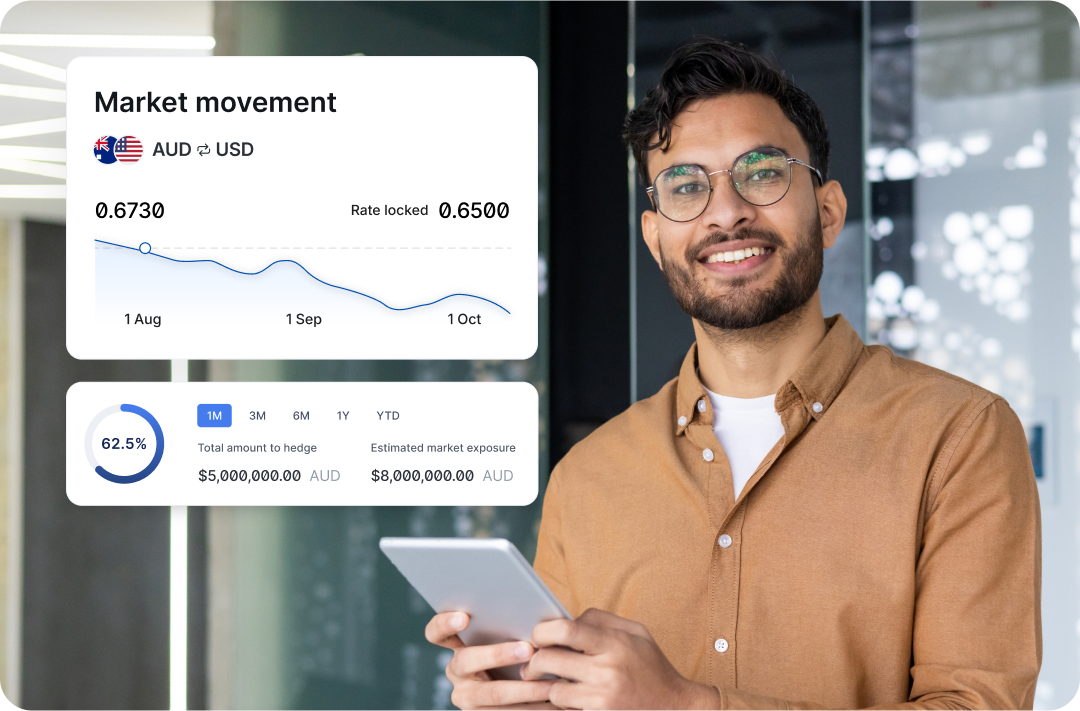
When predictability is the priority, Forward Contracts* gives you price and budget certainty by locking in today’s exchange rate for a future payment — anywhere up to 12 months ahead.
They’re especially valuable for businesses with recurring or forecast obligations, like supplier contracts or overseas payroll. By removing the uncertainty of market swings, you know exactly how much your future payment or receivable will cost in your home currency, helping you protect your margins and supporting accurate financial planning.
For example, a UK-based eCommerce retailer agrees to pay a Chinese supplier US$250,000 in six months. Instead of gambling on what the GBP USD rate will be in six months, they lock in today’s rate with a Forward Contract.
The trade-off?
Although Forwards protect margins and make budgeting easier, they do mean sacrificing flexibility if rates move in your favour, after your Forward is locked in.
*Forward Contracts are subject to advanced payments during the duration of your contract. For full details on advanced payments and deposit calls, please reference our Terms and Conditions. If you book a Forward Contract, it may mean losing out if the market rate improves, because you’re contracted to settle at the agreed rate.
What is a forward contract?
A Forward Contract lets you lock in today’s exchange rate for a future date (up to 12 months ahead), with the flexibility to settle the contract online through our platform. This gives you certainty over your future currency costs, no matter where the market moves.
When to use it:
- FX Forecasting: You know you’ll need to pay an overseas supplier €500,000 in three months.
- Budgeting global expenses with confidence: You want to guarantee your cost base for the quarter or year ahead.
- Margin protection: You operate on tight margins and can’t afford exchange rate swings eating into profit.
Risk management considerations:
- Pros: Locks in exchange rates, enables accurate forecasting, reduces uncertainty.
- Cons: Less flexibility if the market moves in your favour, you won’t benefit.
Hedge smarter with OFX Forward Contracts.
Competitive rates are just the beginning. OFX Forward Contracts allow for part payments and mixed FX transfer types.
If you have a US$100,000 invoice to pay, you can hedge US$60,000 with a forward contract, and use a spot transfer to ‘top up’ or layer the last US$40,000.
Take control with our self-serve, online platform and reduce your FX exposure.

Limit orders: Set your target rate.
If timing is on your side, limit orders let you set a target exchange rate and automatically trigger your transfer once the market reaches it.
They’re well-suited for larger or non-urgent transactions, where capturing even a small rate improvement can deliver meaningful savings.
Because you are selecting an “ideal” exchange rate in the hopes that it will be reached – rather than making a decision based on a current rate – it requires your provider to monitor rates, notify you and process the transaction on your behalf. A quality provider will have this automated, so you will automatically be notified at every step of the way.
When you’re away or other projects are on the go, the benefit of using limit orders is that you can rest easy, knowing your provider is looking after your FX.
The trade off?
It can mean that your chosen rate may never be hit, making your payments uncertain.
What is a Limit Order?
A Limit Order lets you set your target exchange rate. When the market reaches your chosen rate, OFX automatically executes your transfer. It’s about patience and precision — letting technology watch the market for you.
When to use it:
- Strategic planning: You’re not in a rush to make a payment but want to take advantage when the rates are in your favor.
- Large transactions: Small shifts in exchange rates can make a big difference on high-value transfers.
- Busy teams: You don’t want to spend time monitoring the market every day.
Risk management considerations:
- Pros: Allows you to capture better-than-market rates without constant monitoring.
- Cons: No guarantee the market will reach your target, so timing of payments may be uncertain.
OFX Limit Orders: Smart FX for your business.
If you don’t need to exchange currency immediately, OFX Limit Orders are a “set it and forget it” solution that helps you take advantage of market opportunities.
Simply set your ideal exchange rate, and if your target rate is reached, we purchase the currency for you. It’s all done for you, from onitoring, to notification and transfer.

| Tool | Best for.. | Flexibility | Example scenario |
| Spot Transfer | Immediate, urgent payments | High | Paying a supplier invoice today |
| Forward Contract | Predictable, future obligations | Moderate | Locking in €500,000 payment for 3 months ahead |
| Limit Order | Opportunistic strategy | Variable (depends on the market) | Targeting a better rate for a large, non-urgent transfer |
The OFX difference: Integrating FX into your finance workflow.
An FX strategy isn’t just a finance tool — it’s a workflow enabler.
With OFX, foreign exchange doesn’t exist in isolation; it integrates seamlessly into your Accounts Payable (AP) and treasury operations, helping you control costs, reduce risk, and maintain operational efficiency.
- Accounts Payable (AP): With OFX, you can structure FX decisions around supplier invoices. Use Spot Transfers for urgent payments, Forwards to lock in costs for global recurring purchases, and Limit Orders when you want to secure the best possible rate for larger, non-urgent obligations.
- Treasury management: Forwards are powerful tools for managing exposure across a portfolio of contracts or international receivables. Limit Orders can be used to streamline the timing of currency conversions, especially in volatile markets.
- Automation & controls: OFX’s digital platform integrates with your workflow by providing approval chains, reporting dashboards, and real-time visibility. That means FX strategy isn’t just a back-office afterthought — it’s part of your financial control centre.
Bringing it all together
Mastering FX isn’t about picking one tool and sticking with it — it’s about matching the right tool to the right business need. Each tool serves a distinct purpose:
- Need speed? Use a Spot Transfer.
- Need certainty? Choose a Forward Contract.
- Need opportunity? Set a Limit Order.
By combining these tools, businesses create a balanced FX strategy that supports growth while managing risk.
For example, you may choose not to hedge 100% of your exposure, rather, you hedge 50% with a Forward Contract and then use Spot Transfers as a method to top up or layer with your Forward Contracts.
With OFX, you get more than just execution, you get expert FX insights, integrated workflows, and 24/7 global support.
Ready to master FX with OFX?
Transform your FX, no matter your goals, our tools and expertise help you make smarter global payments — every time.