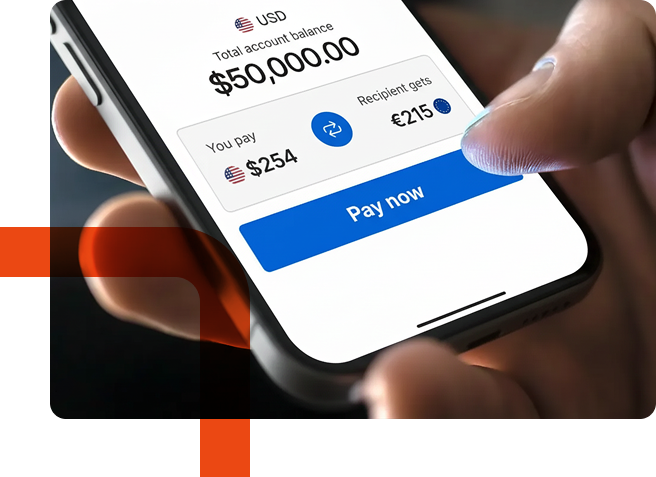
Last month, your overseas supplier invoice cost exactly what you budgeted for. Your margins were intact, your cash flow forecast held steady, and there were no last minute surprises at month-end.
This month, your order remains the same except for one thing. The exchange rate. Suddenly your costs are higher than planned, eating into your profits and going over budget.
For businesses dealing in cross-border payments, this kind of unpredictability can be stressful, making it hard to control budgets. That’s where Forward Contracts can help.
What is a Forward Contract?
Think of it like locking in today’s fuel price for a future road trip. You don’t pay upfront, but you commit to buying the fuel later at that fixed price.
Similarly, a Forward Contract* allows you to lock in an exchange rate today for a future foreign currency (FX) payment. It’s a buy now, pay later option for individuals or businesses looking to take advantage of a beneficial rate today. However, it’s also worth noting that locking in an exchange rate now for a future payment could mean losing out if the market rate improves.
By locking in an exchange rate ahead of time, you remove one big unknown from your financial planning. This approach, also known as “hedging” is a way to help protect your business from disadvantageous currency swings.
*If you book a Forward Contract, it may mean losing out if the market rate improves because you’re contracted to settle at the agreed rate. This means you benefit if the market rate worsens, but you lose out if the market rate improves.
When are Forward Contracts useful?
They are especially useful when you know an international payment is coming, but not certain what the exchange rate will be when the payment is due. It can be useful if your business needs to:
- Manage regular overseas supplier payments without worrying about exchange rate swings.
- Lock in costs ahead of peak or seasonal purchasing periods to avoid unexpected price increases.
- Protect fixed revenue when selling to overseas customers on fixed-price contracts.
- Keep overseas contractor or service payments consistent and predictable each month.
- Reduce currency risk when covering setup and operating costs in a new overseas market.
For finance teams, they can use Forward Contracts to:
- Fix exchange rates for known future expenses, keeping FX budgets fixed and plan ahead with confidence.
- Set a budget rate that allows more control over forecasting and future cashflow.
Different ways you can use Forwards.
A Forward Contract can be an effective way to keep your business costs under control and avoid the risks associated with adverse exchange rate movements.
Depending on your business needs, you can lock in exchange rates for all your planned FX payments for the year ahead, or just a portion of them.
For example, some businesses choose to fix the exchange rate on part of a payment (such as 50%), allowing them to manage risk while still keeping some flexibility if rates improve.
Whether you choose to lock in the full amount, or make a partial hedge, it could help protect your margins and prevent unexpected currency changes from impacting your bottom line.
Manage your margins and cash flow with confidence.
Imagine you have a fixed monthly invoice of US$50,000 to pay from your local currency. This exposes your business to FX risk.
If you pay the invoice in US dollars when the USD is strong, that US$50,000 invoice could cost you more than paying it at a time when the US dollar is weak. This cost could affect your profit margins and cash flow.
For BikesOnline, a global ecommerce company, managing currency risk became critical to protecting margins as their business grew. By using OFX Forward Contracts, they were able to lock in exchange rates for future shipments, giving them clear visibility over costs, greater control over cash flow, and confidence to scale internationally.

Jonathon Allara, Co-founder at BikesOnline
“We regularly book in Forward Contracts so we can understand what we have to pay and what exchange rate we apply to that shipment. It means we can better manage our margins and future cash flow.”
Are Forward Contracts right for my business?
Like any financial tool, Forward Contracts aren’t about predicting the market, they’re about reducing uncertainty and planning ahead with confidence. Here are some pros and cons when evaluating a Forward Contract for your business:
| Pros | Cons |
| Lock in a beneficial exchange rate for a future date | Forward Contracts are binding and cannot be terminated |
| Protection from adverse exchange rates | Could miss out on advantageous exchange rates |
| Achieve greater certainty over your cash flow and budget for up to 12 months | Locking in an exchange rate now could also mean losing out if the market rate improves. |
Initial deposits in a Forward Contract.
When you book a Forward Contract, an initial deposit (also called collateral, margin or an advance payment) may be required. This amount is typically calculated as a percentage of your total Forward Contract value, often around 5%. However, this may vary based on your credit limit and risk profile.
It’s important to pay the deposit quickly, usually within three business days of booking to avoid the contract being in breach. You’d also need to settle your Forwards before the “Forward date” (or maturity date). This is the date your Forward Contract expires.
Keep costs steady, even as exchange rates fluctuate.
By understanding how Forward Contracts work and what the advantages and disadvantages are, you can make informed decisions to better manage your cash flow.
Teaming up with a trusted online business platform like OFX gives you extra peace of mind. On top of competitive exchange rates and effective risk management tools, our specialists are here to support.
© 2026 CanadianForex Limited trading as OFX.
OFX is registered with the Financial Transactions and Reports Analysis Centre FINTRAC under registration number M08560392. OFX is a registered as a money services business with Revenu Québec under registration number 10713.
Visa is a trademark owned by Visa International Service Association and used under license.
Apple Pay is a service provided by certain Apple affiliates, as designated by the Apple Pay privacy notice. Neither Apple Inc. nor its affiliates are a bank. Any card used in Apple Pay is offered by the card issuer.
Google Play and Google Pay are trademarks of Google LLC.
Cashback Terms: All transactions linked to the OFX Card are subject to the cashback reward program terms and conditions. To learn more, see the Terms.